le sputnik in Tokyo, a Michelin-Starred Table Between France and Japan


In Tokyo, some addresses reveal themselves with the discretion of a closely guarded secret, far removed from spectacular façades and expected panoramic views. On a quiet street in Roppongi, le sputnik embodies the understated elegance sought by discerning gourmet travelers: a Michelin-starred table where French cuisine meets Japanese sensibility in a precise, poetic, and intensely seasonal dialogue. Led by chef Yujiro Takahashi, who trained in both Tokyo and Paris, this intimate restaurant invites guests on a nuanced culinary journey, blending classical techniques, contemporary inspiration, and compositions of rare beauty.
In the Elegant Seclusion of Roppongi
In the heart of Tokyo, le sputnik occupies a discreet address on the quieter, more elegant side of Roppongi, between Tokyo Midtown and Nogizaka. Set on the ground floor of a small building along an unassuming side street, the restaurant does not seek the dramatic impact of a soaring tower or panoramic view. Instead, it embraces the rarer allure of an intimate, almost secret address, discovered just a few steps from the energy of the city. This discretion echoes its name: “Sputnik,” a reference to the first artificial satellite launched by the former Soviet Union, also means “companion” or “traveling companion” in Russian. By pairing it with the French article “le,” the restaurant subtly conveys its respect for French culinary tradition while expressing a spirit of exploration and innovation. Its location perfectly encapsulates this philosophy: central, prestigious, and easily accessible from Roppongi, Akasaka, and Azabu’s leading hotels, yet entirely unostentatious—an elegant gastronomic stop for curious travelers.


Since 2016, a Michelin Star That Has Never Faded
At le sputnik, the cuisine unfolds as a sensory journey, guided by unfettered creativity and a profound respect for the seasons. Crafted from impeccably fresh ingredients, the menus bring classical French techniques into dialogue with the delicacy of Japanese produce. Each beautifully presented plate feels like a work in motion: a succession of moments, textures, and flavors celebrating the current season with elegance and sincerity.
Chef Yujiro Takahashi’s vision, enriched by his years in Paris, is expressed through a bold exploration of maturation, fermentation, and flavor extraction. His background in pastry emerges in three-dimensional compositions where delicate tuiles, crisp textures, and intricate constructions add depth and surprise. Within a calm, intimate atmosphere, this aesthetic precision and mastery of unexpected pairings explain the restaurant’s distinctive aura. Opened in July 2015, le sputnik earned its first star in the Michelin Guide Tokyo 2016, unveiled in December 2015—just over four months after opening. It has retained the distinction without interruption through the Michelin Guide Tokyo 2026, eleven consecutive editions confirming the enduring consistency of its culinary vision.


Yujiro Takahashi, a Culinary Journey Between Tokyo and Paris
At its helm, chef-owner Yujiro Takahashi creates cuisine of remarkable finesse, shaped by a career spanning Tokyo and Paris. After beginning his career in 2001 at a French restaurant in the Japanese capital, he refined his craft at several iconic Parisian establishments, from three-Michelin-starred Ledoyen to the convivial Chez L’Ami Jean, as well as Maison Kayser and Pain de Sucre, where he deepened his knowledge of breadmaking and pastry. Upon returning to Tokyo, he became sous-chef and later head chef at Michelin-starred restaurants before founding le sputnik in 2015, a personal showcase for his culinary elegance, combining French precision, Japanese sensibility, and contemporary imagination.

A Subtle Franco-Japanese Dialogue
On the plate, the evening experience unfolds through a multi-course tasting menu conceived as a genuine sensory progression. From the very first bites, each dish reveals meticulous attention to texture, balance, and seasonality, inviting guests to savor an exquisitely nuanced dinner defined by elegance, surprise, and culinary mastery.
The Finger Food opens the meal as an elegant, multi-textured prelude, at once vegetal, oceanic, and indulgent. It begins with seaweed crisps topped with aubergine and sea urchin mousse, alongside churros served with green soybean purée, green soybean powder, and a touch of sugar—a refined introduction in which crispness, creaminess, briny flavors, and sweetness respond to one another with precision. Then, inside a small cylindrical case, two golden croquettes rest on a bed of aromatic greenery, suggesting a crisp mouthful of pork, shrimp, and artichoke. Beside them, delicate portions of quiche are crowned with onion purée and a cloud of freshly grated pecorino.


Continuing in this delicate vein, the next dish arrives as a luminous, jewel-like composition, centered on a large white plate. A slender ring of carrot encircles a pearlescent shellfish tartare, delicately crowned with caviar and tiny white flowers. The velvety sweetness of the carrot purée meets the briny freshness of the shellfish and the gentle richness of the scallop, while a vivid saffron buttermilk sauce, flecked with green oil, lends silky acidity and an almost sunlit aromatic depth. The result evokes a fine-dining starter that is both marine and vegetal, refined in texture, precise in its contrasts, and as visually elegant as a jewel placed at the center of the plate.
The journey continues with a reinterpretation of oyaki, a Japanese specialty from Nagano: a small rustic dumpling traditionally filled with vegetables or miso, here reimagined through a French lens. Its golden, crisp exterior, fried in sesame oil, reveals a generous and intensely aromatic center when cut open. Made with potato and buckwheat, the dough offers a texture that is both rustic and delicate, while the pink, succulent venison brings an elegantly gamey depth. Around the meat, nozawana appears as a glossy, flavorful green filling, enhanced by the rounded umami of miso. This small, warm dumpling evokes both the Japanese mountains and the precision of a contemporary restaurant, balancing comfort, character, and refinement.


After this evocation of the mountains, the next creation introduces a brighter, more vegetal energy in the form of a miniature gourmet taco. Crisp, silvery sweetfish from Shiga Prefecture rests inside a delicate taco-style tortilla, crowned with a vibrant bouquet of watercress and fresh herbs. Small green accents of melon, cucumber, and green tomato add a luminous, refreshing succulence, while salsa verde brings everything together with elegant vegetal acidity. Sansho pepper, with its citrus fragrance and gently numbing quality, lends the dish a subtle Japanese vibration, transforming this bite into a sophisticated encounter between the delicate freshwater flavors of Shiga and the lively spirit of a contemporary taco.

In an even more pared-back style, the eel is presented as a distinctly contemporary, almost minimalist composition. A few delicately seared pieces of eel meet a precisely placed spear of sautéed white asparagus, golden and glossy. An airy asparagus mousse envelops the dish in silky vegetal sweetness, while paprika sauce adds a subtly smoky, spiced depth that highlights the eel’s richness without weighing it down. Tiny purple flowers provide a precious floral accent, transforming this bite into a fine-dining moment that is at once earthy, marine, and refined.


At this point in the meal, my husband and I chose to try two different dishes, allowing us to extend the experience from complementary perspectives. He opted for the pâté en croûte, a plate rustic in spirit yet highly refined in its execution. Served as a generous slice within a golden pastry crust, the terrine revealed a rich center of duck and foie gras, lifted by the crunch of pistachios and the fruity sweetness of dried apricots. Around it, condiments of grated carrot, purple carrots, pickles, green beans, and celeriac purée brought freshness, acidity, and lightness, elegantly balancing the intensity of the foie gras. It was the kind of plate one lingers over before tasting, its composition resembling a small, exquisitely detailed edible garden.


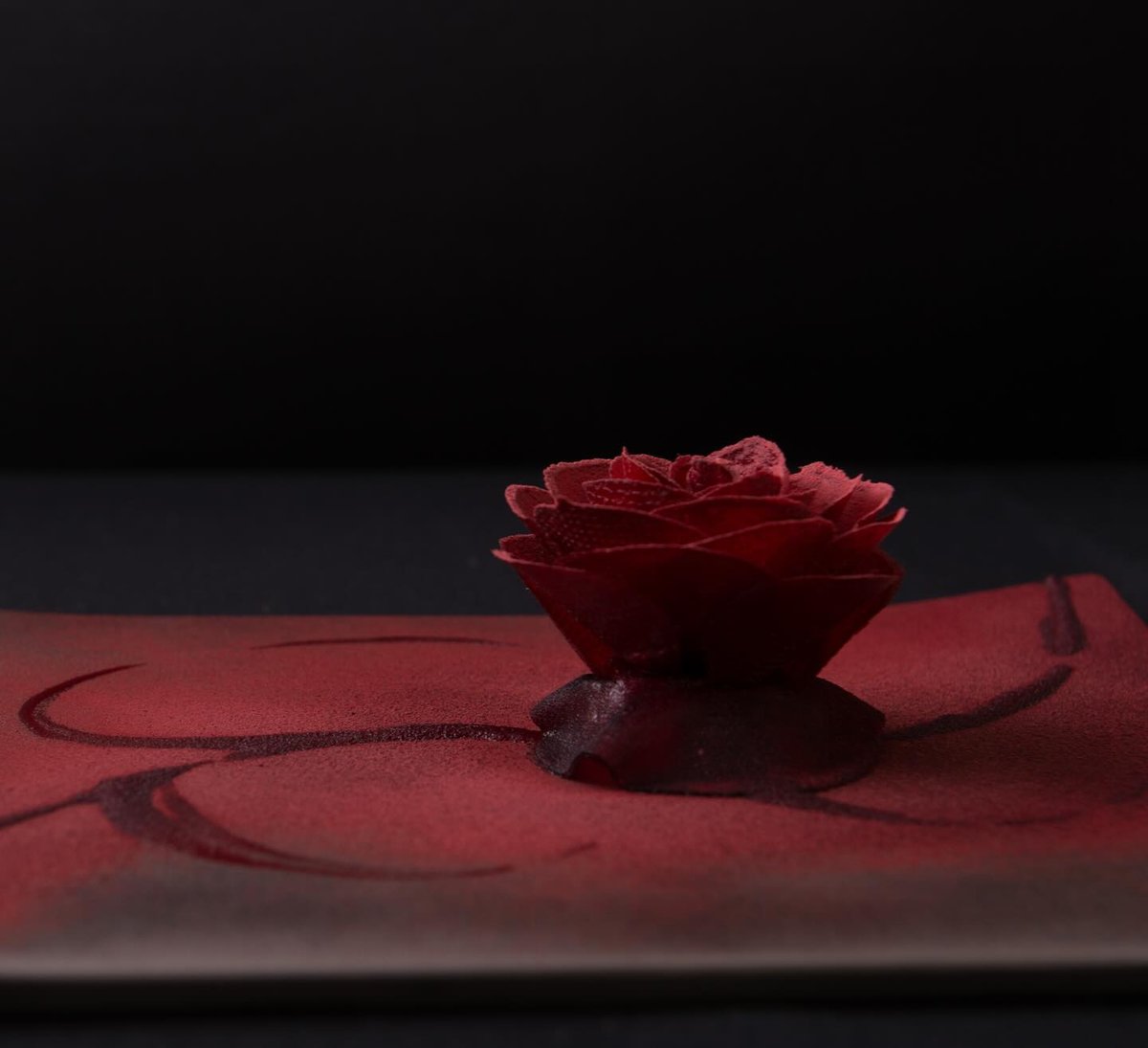
I chose the Beetroot and Foie Gras Rose, the restaurant’s signature dish, instantly recognizable by its immaculate presentation: a sculpted crimson rose of mesmerizing precision, each petal formed from a paper-thin, almost translucent slice of beetroot. At its base, the foie gras is concealed beneath a veil of beetroot gel, creating a superb contrast between the beetroot’s earthy, gently sweet character and the silky richness of the foie gras. This spectacular composition transforms the plate into a genuine work of art, as striking in its floral construction as it is indulgent in the balance of its flavors.

After this foie gras interlude, the menu returns to the delicacy of the sea. A piece of pearlescent kinmedai, crowned with its lightly glazed orange skin, is topped with a fresh garnish of Japanese onions, shallots, and finely chopped green herbs. Alongside it, soy sauce enriched with fermented mushrooms brings depth, umami, and salinity, while fermented yuzu pepper awakens the dish with a bright, citrusy, subtly piquant note. The plate plays on the contrast between the fish’s almost silky tenderness, the vegetal crunch of the onions, and the fermented complexity of the sauce, all expressed in a precise and elegant contemporary Japanese style.

The pace then intensifies with a dish named "Wagyu Grapes," a dark and theatrical plate on which grilled wagyu, served pink and glistening, reveals its exceptional tenderness. Around the meat, shiitake mushrooms add earthy, woodland depth, while semi-dried grapes offer a concentrated, almost candied sweetness that complements the richness of the beef. Glossy strokes of black garlic sauce and red wine umeboshi create a graphic composition across the plate, balancing acidity, umami, and fermented notes, while black powder evokes glowing embers. It is an intense and sophisticated dish, both earthy and fruity, with each bite playing on the contrast between luxurious marbling, smokiness, sweetness, and vibrant acidity.

The sweet courses begin with a dessert of remarkable precision, served in a rustic bowl that accentuates the delicacy of its colors: finely grated cocoa shavings, white shards of yogurt, juicy cherries, fresh mint leaves, and touches of purple and yellow flowers. Beneath this almost botanical composition lies a creamy, comforting crème brûlée-style pudding, enlivened by okisarisu and an aromatic, fresh, gently herbaceous bay leaf ice cream. The cocoa brings elegant bitterness and the cherries a burst of juicy acidity, while the mint and yogurt lighten the whole with a vivid, milky freshness.

In a more ethereal spirit, the coconut, pineapple, and chamomile "Meteorite" appears as a small lunar sculpture at the center of a textured white plate that heightens its frosted radiance. A block of whipped and frozen coconut milk rises like a fragment fallen from the sky above a creamy base where the exotic sweetness of coconut meets the juicy acidity of pineapple. Chamomile ice cream brings a soothing floral freshness. Touches of lychee and tiny delicate flowers complete the composition, creating a dessert of striking visual purity that is at once tropical, weightless, and exquisitely refined.

Finally, the mignardises bring the meal to an elegant close, served with a cup of tea that prolongs the sweetness of the moment. The duo plays on contrasts: on one side, an orange and chocolate choux with a deeply caramelized surface promises a rounded, intense, gently bitter mouthful; on the other, a delicate tartlet filled with fresh cheese brings together rhubarb, strawberry, and rose jelly in a composition that is fresh, floral, and vibrant.

My Review
le sputnik leaves the rare impression of a restaurant where every detail is guided by precision, poetry, and a passion for travel. At this intimate Roppongi address, Yujiro Takahashi creates an experience of remarkable coherence, shaped by French mastery, Japanese sensibility, and creativity that is never pursued for its own sake. From the first amuse-bouche to the final mignardises, dinner unfolds with grace, alternating boldness, delicacy, and aromatic depth while preserving the elegant restraint that defines Tokyo’s finest establishments. For travelers seeking an intimate, refined, and truly memorable evening in Tokyo, le sputnik is an exceptional gastronomic destination—one to reserve with care and savor slowly.