Pedro Subijana's three-Michelin-star temple to new Basque cuisine now anchors a striking modernist hotel on Monte Igueldo, where 22 minimalist rooms—starting at fifty square metres—frame the Cantabrian coastline through floor-to-ceiling glass, many with deep soaking tubs positioned before the view. The stone-clad spa channels Alpine bathhouse serenity, while suites add private plunge pools. Adults-only atmosphere; no guests under fourteen.
Where to Stay
This Belle Époque landmark commands the banks of the Urumea, its marble columns and ornate chandeliers preserved through meticulous restoration. The 136 rooms pair period elegance with modern comforts—marble bathrooms, private terraces, views stretching to the Cantabrian Sea. Cyclists can borrow bikes to explore the pintxos bars; four-legged companions are welcome throughout. A grand hotel in the truest sense.
Chef Nobu Matsuhisa's boutique property occupies a prime beachfront position on Paseo Mirakontxa, its 20 rooms dressed in modern Japanese minimalism with many opening onto private terraces above the bay. Guests dine on the chef's signature dishes while watching waves roll toward golden sand, then retreat to the seasonal outdoor pool or arrange spa treatments on request. The pet-friendly policy suits travelers who refuse to leave companions behind.
The sole surviving 19th-century villa on La Concha's beachfront promenade now operates as a 25-room adults-only retreat. Sea-facing accommodations feature full-length windows and private terraces overlooking the bay, their interiors dressed in Atlantic blues against restrained neutrals. Paulo Airaudo's two-Michelin-starred Amelia anchors the culinary program, bringing Argentine-Italian influences to every meal, breakfast included.
A century-old façade masks this 58-room boutique hotel's sleek contemporary interior, where blues and grays create a minimalist calm. Sea View rooms frame the fishing port's daily theatre, while the rooftop terrace delivers a full 360-degree sweep from harbour to hills. The on-site restaurant channels Basque traditions, and the adults-only policy ensures quietude. An old-town address puts pintxo bars within easy walking distance.
A 19th-century merchant family's residence turned intimate 25-room retreat, Hotel Villa Soro preserves its aristocratic bones—sweeping oak staircase, marble floors, rich wood panelling—while offering a choice between traditionally appointed chambers in the main house or contemporary quarters in the converted stables. Gardens laid out by a Royal Palace gardener provide a leafy buffer from the city, minutes from the Old Town and La Concha beach.
A seventeenth-century convent reimagined with unexpected flair: leather headboards, tartan throws, and gem-toned accents channel British country-house warmth within the stone walls. Junior suites open onto private terraces facing the Cantabrian Sea. The spa complex—pool, solarium, sauna—offers respite after exploring the city center, while the restaurant delivers Basque cooking with inventive, contemporary technique.
A listed 19th-century mansion on a quiet residential street, Hotel Villa Soro pairs period grandeur with a French landscape garden and English-style brick carriage house. The 25 rooms showcase contemporary artworks by local artists against white marble bathrooms and generous natural light. Five minutes from Zurriola beach, the hotel deliberately forgoes a restaurant—its concierges instead navigate guests toward the city's seven Michelin-starred tables.
A seventeenth-century palace turned boutique retreat, Iriarte Jauregia sits amid the rolling farmland of Gipuzkoa, twenty-five minutes from San Sebastián's pintxo bars and Michelin-starred tables. Original stonework and rough-hewn timber beams give the nineteen rooms a vaulted, almost ecclesiastical character, while windows frame views of gardens and forested hills. Chef Enrique Fleischmann's restaurant Bailara anchors the culinary offering with refined Basque-inflected cuisine.
Eight rooms occupy this refined marina-side retreat in Hondarribia, a quiet Basque port town between San Sebastián and Biarritz where fishing boats still line the harbor. The historic house has been reworked with a focused contemporary palette—walk-in showers, Marshall speakers at the bedside—while a compact spa with sauna and the all-day Mahasti Gastronomic Wine Bar add layers of comfort to an intimate, unhurried stay.
Where to Eat
Perched on Mt Igueldo with sweeping views of the Bay of Biscay, this three-Michelin-star restaurant belongs to Pedro Subijana, a founding father of New Basque Cuisine who recently marked fifty years at the stoves. His menus oscillate between contemporary invention and reinvented signature dishes, each plate reflecting decades of technique refined without abandoning regional roots. A pilgrimage for serious gastronomes.
Spain's first three-Michelin-starred restaurant remains a pilgrimage site for serious gastronomes. Juan Mari Arzak and daughter Elena—among the rare women commanding a triple-starred kitchen—orchestrate avant-garde Basque cuisine from their laboratory stocked with over a thousand ingredients. Signatures like sole roasted inside sugar cane and oysters with fermented garlic reveal a kitchen still pushing boundaries after five decades at the summit.
Three Michelin stars crown this elegant countryside retreat where Martín Berasategui channels decades of Basque culinary mastery into dishes of startling originality. The signature caramelised millefeuille layers smoked eel with foie gras and green apple, while charcoal-grilled Burela hake arrives with seaweed jam and plankton. Service, orchestrated by son-in-law José Manuel Borrella, matches the kitchen's precision. A pilgrimage for serious gastronomes.
Argentine chef Paulo Airaudo holds two Michelin stars at this intimate La Concha address, where Basque seafood traditions intersect with Spanish, Italian, and Asian inflections. Before each course, the kitchen presents its premium ingredients tableside—a ritual that precedes dishes like the signature whole-lobster preparation. Guests seated at the bar watch the brigade cook and plate, then receive dishes directly from the chefs themselves.
Andoni Luis Aduriz's two-Michelin-starred laboratory in the hills above San Sebastián treats dining as provocation. A single tasting menu arrives without conventional sequence—dishes eaten by hand, conceptual creations like cider gelatine pressed onto diners' faces. The glossary provided at each table hints at the intellectual framework beneath the playfulness. For gastronomes seeking confrontation rather than comfort, an essential pilgrimage.
The Txapartegi brothers honor their grandmother Julia's maxim—"the shorter the distance between the soil and the stove, the better"—at this one-Michelin-starred table in nearby Hondarribia. Their "Bidasoa cooking" channels the terroir of the Bidasoa-Txingudi borderlands through a contemporary Basque lens, with the marinated and smoked Bonito del Norte proving an exemplary signature. Two tasting menus, Hondarribia and Gartzinea, chart the region's seasonal riches.
Named after the prized barbels of hake and cod central to Basque gastronomy, Kokotxa holds one Michelin star under chef Daniel López. The kitchen draws from local market traditions while threading in Japanese, Indian, and Turkish accents—subtle enough to intrigue without overwhelming. Two tasting menus, De Mercado and Degustación, are served communally; the Bresse chicken with pak choi, hazelnuts, and PX sherry remains a standout.
Chef Paulo Airaudo has revitalized this central San Sebastián address with his personal interpretation of Basque tradition. The intimate basement dining room seats just six tables, each equipped with its own cupboard, while upstairs a casual bar serves freshly prepared tapas. Market-driven tasting menus showcase spectacular grilled Carabinero prawns and the signature five hake cheek kokotxas—battered, grilled, and confit—demonstrating mastery of time-honoured technique.
Descend the stairs of Gatxupa and a speakeasy-style basement reveals chef Bruno Oteiza's singular vision: Basque-Mexican fusion built on premium local ingredients. The open kitchen anchors the contemporary space, where an Amakase menu—a playful portmanteau evoking both Japanese omakase and maternal comfort—extends the tasting experience. For adventurous palates seeking cross-cultural dialogue through the lens of Basque terroir.
Chefs Gorka and Javier practice a philosophy of radical locality at this Michelin-starred table in Tolosa, where weekly menus pivot entirely on what the surrounding Basque countryside yields. Their approach strips traditional home cooking to its essence—minimal ingredients, maximum clarity. During game season, Sagardoz venison appears; year-round, an exquisite cheesecake demands attention. The Green Star signals their commitment: what is local protects us.
What to Do
Perched on Mount Igeldo above the Cantabrian Sea, this 800-square-meter wellness sanctuary guides visitors through a contemplative circuit: heated pool, Turkish steam bath, sauna, and treatment rooms where Valmont and Sisley products merge with Dead Sea salt and local ocean stones. The adults-only policy (18+) preserves an atmosphere of absolute stillness, culminating in Zen-inspired lounges with unobstructed Atlantic panoramas.
Frequently Asked Questions
What are the main neighborhoods to stay in San Sebastián?
+
The Centro offers Belle Époque grandeur and proximity to La Concha beach. The Parte Vieja places you within steps of the city's densest concentration of pintxos bars. Gros attracts a younger crowd with its surf culture and contemporary dining scene along Zurriola beach. Each neighborhood has a distinct character, and all are walkable from one another.
When is the best time to visit San Sebastián?
+
September brings the film festival, warm swimming weather, and the tail end of summer energy without August's peak crowds. May and June offer mild temperatures and longer evenings ideal for the txikiteo — the Basque tradition of bar-hopping. Winter appeals to food-focused visitors, when top restaurants are easier to book and the city's sidrerías open for cider season.
How does the pintxos culture work in San Sebastián?
+
Pintxos are eaten standing at the bar, typically with a small glass of txakoli or wine. The tradition involves moving between several establishments in one evening, eating one or two bites at each. In the Parte Vieja, bars display their offerings on the counter; in more modern establishments, you order from a menu. Locals eat late — pintxos around 8pm, dinner rarely before 9:30pm.
Nearby Destinations
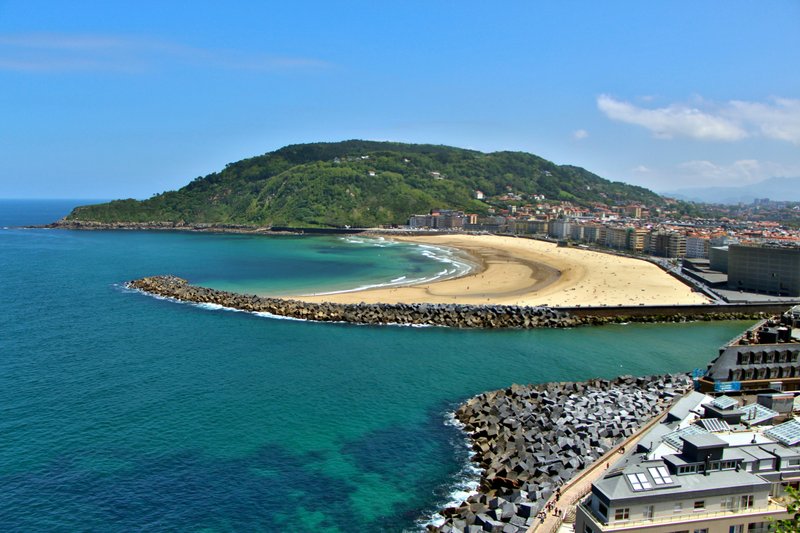
Explore SpainSan Sebastián curves around La Concha bay with the confidence of a city that has always known its worth. The Parte Vieja, the old quarter wedged between Monte Urgull and the Urumea river, pulses with pintxos bars and narrow streets where Basque is spoken as readily as Spanish. Across the river, Gros draws surfers and younger crowds to Zurriola beach, its grid of early twentieth-century buildings now home to natural wine bars and contemporary Basque cooking. The Centro, with its orderly Belle Époque grid, hosts the grand hotels that have welcomed European aristocracy since the 1880s.
The dining scene here operates at a different altitude. Three restaurants hold three Michelin stars; dozens more push the boundaries of Basque cuisine with an intensity matched nowhere else in Spain. Morning rituals matter: coffee at a marble-topped bar, a txakoli poured from height at midday, an evening spent moving from bar to bar assembling dinner one pintxo at a time. The city empties onto its beaches in summer and retreats to cider houses in the hills come autumn. Everything here — the food, the architecture, the social rhythms — reflects a Basque culture that remains fiercely distinct.