A beaux-arts grande dame from the late 19th century, this 156-room lakefront property commands Hamburg's most prestigious address on Inner Alster's western shore. Wood-paneled lobbies and crystal chandeliers preserve the mansion's original grandeur, while Restaurant Haerlin delivers refined French cuisine and NIKKEI NINE ventures into Japanese-Peruvian territory. The contemporary spa offers over 100 treatments beside a fireplace-warmed relaxation lounge—ideal for travelers seeking old-world elegance with modern polish.
Where to Stay
Jan Störmer's sculptural architecture curves along Lake Alster's shore, its amorphous silhouette ensuring panoramic water views from every room. The rooftop houses both a 1,022-square-meter spa—complete with Finnish panoramic sauna and aroma-quartzite steam room—and an indoor-outdoor infinity pool overlooking the city. Downstairs, Lakeside holds two Michelin stars for contemporary French cuisine, while the Atrium's private library and cigar lounge reward lingering.
Nineteenth-century Hanseatic grandeur defines this riverside address on the Elbchaussee, where an art collection rivaling a small museum lines the corridors. Rooms look out over the Elbe or manicured gardens, while the gourmet Jacobs Restaurant and wine-focused Kleines Jacob anchor the dining program. Summer afternoons unfold on the Linden Terrace; quieter hours are spent in the sauna and relaxation room.
Former stables of 19th-century Breitenburg Castle now house eighty rooms clad in timber from the estate's own forest, their contemporary interiors contrasting with the historic grounds outside. A 27-hole golf course stretches across the parkland, while the spa offers Turkish bath, sauna, and indoor pool. Restaurant Johann sources hyper-locally, serving venison harvested from the surrounding woodlands—ideal for golfers and nature-seekers with dogs in tow.
Tortoise motifs appear everywhere at this 128-room design hotel near Stadthausbrücke—cast as statues, rendered in lamps, framed on walls—lending playful coherence to otherwise sleek, modern interiors. Guests toggle between the Brasserie's French classics and JIN GUI's Asian plates, then drift to the courtyard or buzzing bars where Hamburg's after-work crowd congregates. Pet-friendly policies extend the welcome to four-legged companions.
The early 20th-century Levantehaus, a Hanseatic landmark still held by its founding family, provides the dramatic setting for Conrad Hamburg. Ada Isensee's original stained-glass ceiling and a cuckoo clock featuring an hourly centaur appearance lend genuine eccentricity to the interiors. The 283 rooms rank among Hamburg's most generous, several with private kitchens and courtyard outlooks. An indoor pool, spa, and pet-friendly policies suit extended stays near the Rathaus and Elbphilharmonie.
Facing the serene Außenalster lake, Le Méridien Hamburg plays with maritime motifs across its 275 rooms, where therapeutic beds and bright, modern interiors reward tired travelers. A ninth-floor restaurant delivers panoramic water views, while the wellness floor—indoor pool, sauna, Turkish bath—offers genuine respite. Pet-friendly policies, bike loans, and EV charging appeal to contemporary explorers seeking lakeside calm minutes from bustling St Georg.
Architect Jan Störmer's glass-and-stone tower rises eleven floors above downtown Hamburg, its hundred-foot atrium setting the stage for Matteo Thun's masterful minimalist interiors and Robert Wilson's dramatic lighting installations. The near-rooftop terrace surveys the Binnenalster while The Meatery draws weekend crowds for top DJ sets. Four subterranean levels house a swimming pool, Turkish bath, and full spa—a design-world landmark for aesthetically exacting guests.
Overlooking the Nikolaifleet canal between Hamburg's Altstadt and HafenCity, this Design Hotels member fills its 94 rooms with eclectic, historically informed interiors and a curated art collection. Marshall sound systems and freestanding bathtubs outfit every category, while The Patio's retractable glass ceiling brings Hamburg's sky indoors. Downstairs, Izakaya serves Japanese-Peruvian plates—an unexpected pairing that suits the hotel's cosmopolitan sensibility.
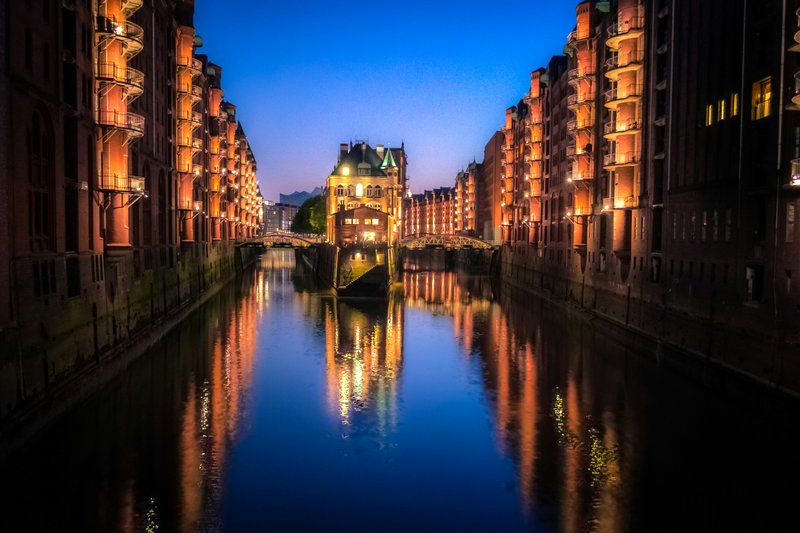
The sole hotel within Hamburg's UNESCO-listed Speicherstadt occupies a landmark warehouse where Art Deco flourishes meet mid-century modernism—think burnished hardwoods, leather seating, and saturated Sixties hues. Upper floors survey the canal network and city skyline, while a wellness center offers sauna and sanarium retreats. An elevated walkway leads across the water to the Italian restaurant, adding theatrical flair to evening dining.
Where to Eat
Overlooking the Inner Alster Lake from the storied Hotel Vier Jahreszeiten, Restaurant Haerlin showcases Chef Christoph Rüffer's two-decade mastery of classic French technique. His three-Michelin-star kitchen delivers precisely composed courses where langoustine and saddle of venison shine alongside exceptional sauces. An outstanding wine program offers prestigious bottles by the glass, while polished brigade service completes this refined Hamburg landmark.
Kevin Fehling's three-Michelin-star table delivers a tasting menu titled 'Das Tor zur Welt'—Gateway to the World—where French technique anchors crossover flights through Asia, the Middle East, and South America. Diners gather along one sinuous communal table, watching a brigade move with orchestral precision as dishes like poached oyster with hamachi, sea urchin, and horseradish arrive in measured succession. Precision, depth, spectacle.
A freight elevator climbs to the third floor of a Hamburg factory building, where chef Thomas Imbusch orchestrates a two-Michelin-starred experience around a Molteni stove calibrated to just two temperatures—100°C and 200°C. The surprise menu channels fermentation and smoking techniques to coax depth from produce sourced through personal relationships with small-scale farmers, earning a Green Star for mindful gastronomy. Industrial chic meets uncompromising craft.
Perched on the seventh floor of The Fontenay, Lakeside commands sweeping views across the Outer Alster through floor-to-ceiling windows. Chef Julian Stowasser holds two Michelin stars for his restrained, modern seven-course menus—think Faroe Islands langoustine paired with silky sour cream and piel de sapo melon. The bold white interiors feel luxurious yet relaxed, with aperitifs served one floor below before dinner.
Currently temporarily closed, Bianc showcases the Mediterranean mastery of chef Matteo Ferrantino, who previously helmed the kitchen at two-Michelin-starred Vila Joya in Portugal. His tasting menus—'Emotion' and the vegetarian 'Garden'—deliver dishes like red prawn with cantaloupe and pata negra, or Azores squid with guanciale and Pecorino. Architect Julia Erdmann's interior evokes an Italian piazza, with views into the open kitchen adding theatrical flair.
Chef Fokke Mick earned a Michelin star at this elegant dining room within the Hotel Atlantic, overlooking the River Alster. The 'Identité' tasting menu spans four to seven courses of refined international cuisine, with 'Flora' offering an equally ambitious vegetarian counterpart. Classic preparations—lobster bisque, whole sole—anchor a separate menu, while polished service maintains the Hanseatic grandeur throughout.
Perched on a mezzanine above the open kitchen of 100/200 Kitchen, Glorie offers an intimate theater of gastronomy under chef-owner Thomas Alfons Imbusch. The one-starred concept reimagines regional classics—beef pâté en croûte with sauce gribiche, lobster Thermidor—through a sustainability lens that earned its Green Star. A striking steel-girder-divided table, artwork, and grand piano create an atmosphere where old-school technique meets contemporary conscience.
Jellyfish brings a Michelin-starred focus on fish and seafood to Hamburg's Schanzenviertel, delivering five to seven courses of modern, inventive cooking. The kitchen's charcoal-grilled Spessart trout—glazed with BBQ sauce, paired with marinated red cabbage and citrus marigold gel—exemplifies its creative precision. A minimalist dining room, expert sommelier guidance through German Rieslings and Champagnes, and weekend bistro lunches complete a refined yet relaxed experience.
Named for the Low German phrase meaning "to make a choice," Koer operates as both refined restaurant and cocktail bar. The Michelin-starred kitchen delivers farm-to-table dishes with creative precision—think smoked sardine alongside Dutch razor clams with grilled peppers and pickled coriander seeds. A surprise tasting menu with alcohol-free pairing options rewards the adventurous, while the lively atmosphere keeps the evening relaxed.
Chef Heinz O. Wehmann has commanded this Michelin-starred dining room since 1980, building a reputation for modern French cuisine rooted in regional, often organic ingredients. His Holstein venison with rosemary sauce exemplifies the kitchen's precision, while a 10,000-bottle cellar rewards serious wine enthusiasts. The classic interior—anchored by a provocative large-format painting—sets an appropriately bold tone for the cooking.
Frequently Asked Questions
Which Hamburg neighborhoods offer the best hotel locations?
+
The Neustadt and areas around the Binnenalster provide central positioning with lake views and proximity to shopping along Jungfernstieg. HafenCity appeals to those wanting contemporary architecture and Elbphilharmonie access. For residential calm with Elbe views, Blankenese and Ottensen in the Altona district offer smaller properties away from the city center, though with longer commutes to main attractions.
What makes Hamburg's dining scene distinctive?
+
The city's maritime heritage shapes its kitchens. The Sunday Fischmarkt in St. Pauli has operated since 1703, and this connection to North Sea and Baltic produce influences menus citywide. Hamburg also served as Germany's entry point for global ingredients — coffee, spices, tea — creating a cosmopolitan food culture. The Portuguese quarter near the Landungsbrücken reflects generations of dockworker migration, while the Schanzenviertel hosts some of Germany's most inventive contemporary cooking.
When is the best time to visit Hamburg?
+
Late spring through early autumn brings the most reliable weather for exploring on foot and enjoying the city's waterfront terraces. The Hamburg Cruise Days in September animate the harbor with tall ships and liner arrivals. December transforms the city with Christmas markets, including the historic version at Rathausmarkt and the more atmospheric Santa Pauli market. Summers can be warm enough for beach bars along the Elbe at Övelgönne, though rain remains possible year-round.
Germany's second city sprawls across the Elbe estuary with a confidence born of centuries as the Hanseatic League's great northern port. The Speicherstadt warehouse district — now UNESCO-listed — has evolved from coffee and carpet storage into a dramatic backdrop of neo-Gothic brick canyons. In the adjacent HafenCity, Europe's largest urban redevelopment project continues to reshape former docklands into waterfront neighborhoods. The older quarters tell different stories: St. Pauli maintains its rough-edged vitality around the Reeperbahn, while the merchant villas of Blankenese tumble down hillsides to the river like a German Positano.
The hotel landscape follows the city's distinct geography. Properties around the Binnenalster and Jungfernstieg occupy the traditional heart of Hamburg's commerce, their rooms overlooking the inner lake that freezes in hard winters. Westward toward the Elbphilharmonie, newer establishments have colonized renovated warehouses and purpose-built towers with floor-to-ceiling harbor views. The dining scene draws on Hamburg's position as Germany's fish market: Finkenwerder Scholle, the local plaice preparation, appears on tables from dockside restaurants to ambitious tasting menus. Coffee culture runs strong in a city that once controlled European caffeine imports — third-wave roasters now operate from the same brick halls where beans were once graded and traded.