Omakase @ Stevens: An Intimate Table Between Japan and French Touches in Singapore


In Singapore, Omakase @ Stevens reveals itself as an intimate address, where just 16 counter seats create a precious sense of closeness facing the open kitchen. Awarded one Michelin star in 2025, Chef Kazuki Arimoto’s restaurant unfolds a contemporary omakase of remarkable refinement, combining impeccable Japanese ingredients, precise technique, and perfectly measured French touches. Here is the story of an eight-course spring menu, conceived as a gastronomic promenade.
An Address That Whispers Japan On Stevens Road
Nestled on Stevens Road, Omakase @ Stevens, opened in 2023, cultivates a refined discretion that perfectly suits the spirit of omakase. In a warm and resolutely contemporary setting, the restaurant favors a rather open space, punctuated by 16 counter seats where guests naturally engage with the chef and his brigade, close to the gestures and rhythm of service. Pale wood finishes — table, chairs, and furnishing details — bring tactile softness and minimalist elegance, while the whole setting creates a zen, serene atmosphere that highlights the purity of the Japanese experience.

The Omakase Sculpted By Kazuki Arimoto
Becoming Executive Chef at Omakase @ Stevens marked a turning point for Kazuki Arimoto, and 2025 confirmed this exceptional trajectory: the restaurant earned its very first Michelin star in the MICHELIN Guide Singapore, while Chef Kazuki received the Young Chef Award. Originally from Osaka and refined in some of Tokyo’s most demanding kitchens, he draws on more than a decade of experience in Michelin-recognized establishments, as well as a certified culinary license in Japan. His signature is expressed through the meticulous art of omakase, where the season sets the rhythm, technique imposes its precision, and aesthetics elevate every plate.

At Omakase @ Stevens, he composes contemporary Japanese cuisine that deliberately frees itself from classical codes: Japanese ingredients of irreproachable quality, worked with French techniques to achieve bold yet perfectly balanced flavors, vibrant colors, and harmony of great finesse. Offered in 6 or 8 courses, his menu revisits his roots with lightness, sophistication, and subtlety, within the rare intimacy of a pinewood counter with only 16 seats. Here, impeccable service completes the experience with natural elegance — and booking ahead is essential.


Spring In Eight Acts, Between Purity And Panache
In spring 2026, the table becomes a showcase and celebrates the season at its most delicate: an eight-course menu, conceived as a gastronomic promenade, where each plate pays tribute to ingredients at the height of their expression. The flavors, precise and luminous, weave a harmonious narrative of freshness and elegance. And, from dish to dish, the whole experience invites guests to discover the richness and sophistication of a spring embrace, like a crescendo of nuances that never gives in to excess.
To open the performance, the amuse-bouches named Hassun arrive like a casket of delicacy: a trilogy of bites sculpted to awaken the appetite with panache. First, Tuna I Caviar I Wasabi, in the spirit of sushi without rice, served as a fine tartlet where tuna meets the crunch of radish, crowned with a dome of caviar that bursts with briny notes. Then Foie Gras I Rhubarb I Myoga, an airy monaka filled with foie gras marinated with caviar, lifted by the acidity of rhubarb; the small shape placed on top evokes the duck itself, like an indulgent trompe-l’œil. Finally Wagyu I Shintamanegi I Nire Cheese, more earthy and lactic, where the melting richness of wagyu is balanced by the sweetness of spring onion and a touch of cheese; all presented as precious miniatures, like a jewel-like mise en scène.

Continuing this opening movement, the Kuruma Ebi reveals itself as a composition of minimalist elegance, nestled in a small immaculate bowl. At the center, the Japanese tiger prawn, delicately pearlescent, rests beneath a silky, luminous jade-green pea velouté. Coconut oil brings subtle roundness, while cucumber and lemon awaken the whole with crystalline freshness, punctuated by the briny sparkle of caviar and the tangy crunch of finger lime, in tiny pearls that burst in the mouth.


After this finely carved freshness, Sakura Masu appears as an ode to Japanese spring, all delicacy and precision. A slowly cooked trout, with pearly flesh, sits at the heart of the plate, surrounded by a circle of finely smoothed radish purée, while a silky, fragrant sauce nestles at the center. A few Japanese asparagus spears bring crunch, ikura bursts in salmon-hued pearls with briny notes, and tiny flowers punctuate the whole with a poetic touch. In echo, the dish is paired with a sake made with sakura, served well chilled: its floral sweetness and transparency underline the freshness of the fish and the vegetal purity of the composition.


Then, like a step further toward a more marine expression, the Amadai makes its mark with precious sobriety. A piece of tilefish with pearly flesh rests in a deep plate, on a clear dashi broth, dotted with green-reflecting pearls of olive oil. The skin, prepared using the Japanese technique of pouring hot oil over it to make the scales bloom, becomes crisp, golden lace, contrasting with the softness of the fish. Around it, the marine spirit is amplified by the delicate brininess of hamaguri, while nagaimo adds a subtly silky, almost airy touch; a fresh herb and a tiny flower complete the whole, like a delicate signature on a dish that is both minimalist and intensely flavorful.

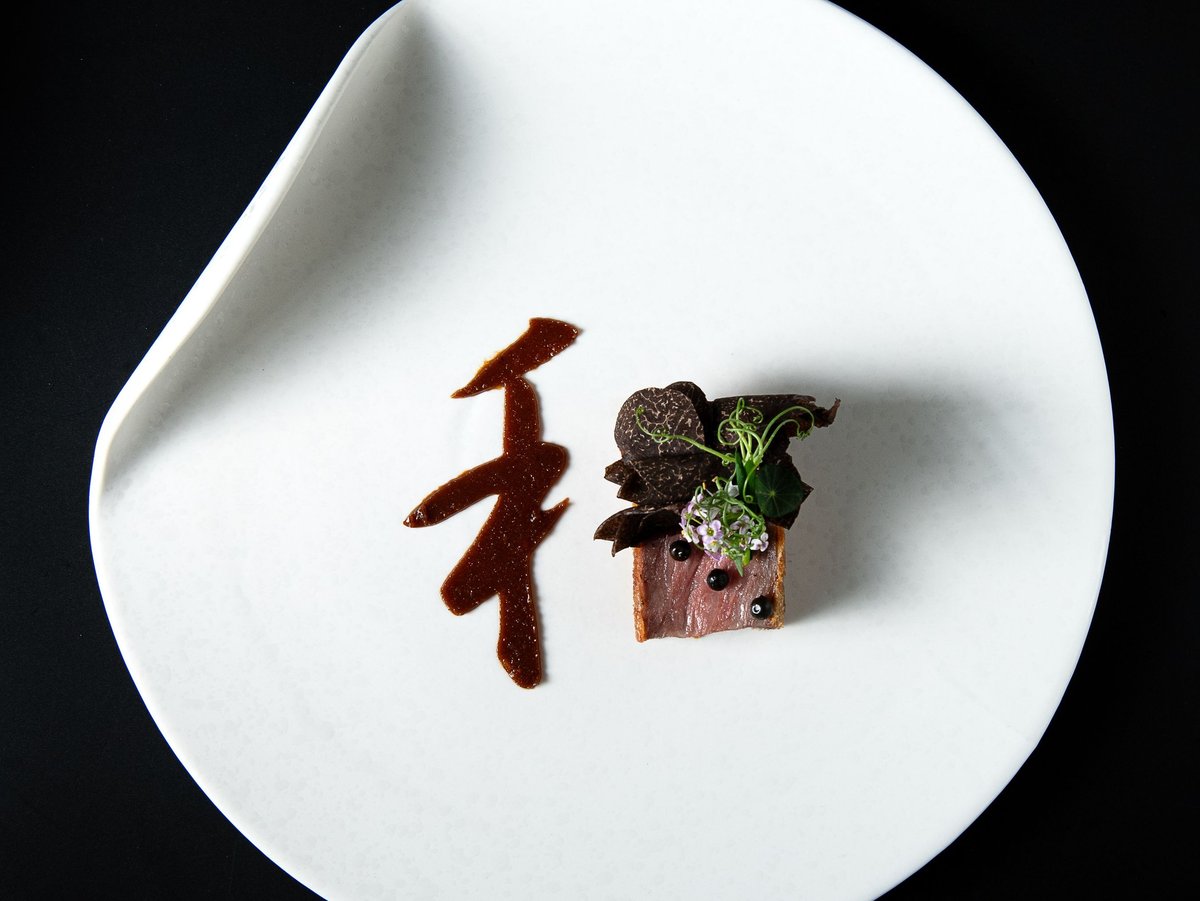
At this stage of the menu, the composition gains in depth with a sophisticated nod to Osaka katsusando, reimagined by the chef, who hails from the city. Beneath a fine, golden crumb, the wagyu reveals its melting texture and delicate fat, lifted by the fermented depth of Hatcho miso, sculpted in kanji to evoke the “wa” of wagyu, like a signature. Truffle adds an earthy, luxurious breath, while a wasabi leaf brings green freshness and a hint of electricity, balanced by the clarity of mustard. Finally, Madeira sauce wraps the whole in a suave roundness that links Japan and European classicism in a dish both comforting and precious. The pairing with the sake 南 純米大吟醸, enjoyed well chilled, emphasizes the purity of the fat and cleanses the palate with crystalline elegance.


Immediately after, the Seasonal Donabe arrives at the table like a small ritual: the chef lifts the heavy lid of the dark donabe, releasing a fragrant wave of warmth. At the bottom, Koshihikari rice, cooked to perfection in earthenware, shows the pearly, tender grain that marks Japan’s great houses, while kinoko bring forest accents and very elegant umami depth. A shower of kuro-shichimi awakens the whole with a toasted, spicy shiver, and a few fresh herbs placed on top add a green, almost airy touch to this composition, as restrained as it is luxurious.


Now for dessert, with Akaniku Melon I Muskmelon I Okinawa Tea opening a sophisticated interlude of freshness. A pale, velvety Okinawa tea cream unfolds toasted, almost vanilla-like nuances. Precisely placed pearls of orange-fleshed Akaniku melon and tender green muskmelon play on pure fruit, sweet and floral, lifted by a small central crisp that adds delicate chew. The pairing with Morishima sake (森嶋) extends this impression of clarity and balance, highlighting the ripeness of the fruit and the infused sweetness of the cream, without ever weighing the dish down.

In the same luminous register, Dekopon appears as a solar mise en scène around the Sumo citrus, inspired by Kumamoto, the pastry chef’s birthplace. On the plate, a glossy sphere evokes the fruit itself, set down like a jewel, accompanied by a play of textures echoing its fragrance: tangy sorbet, delicate champagne jelly, and translucent segments, all coated in a golden-hued Pommery champagne sauce that stretches in a silky flow. The whole, “soufflé candy-style,” favors freshness and elegance, between citrus vivacity and fine sparkling notes.


Finally, to close this promenade on a light note, the mignardises arrive like a small jeweler’s box, blending Japanese precision and French pastry elegance: on the plate, a strawberry from Tochigi Prefecture, simply sliced, rests on a bed of crushed ice that heightens its freshness and fragrance, accented by a delicate sprig of flowers, like a springtime wink. Beside it, in a wooden box, bite-sized sweets are revealed: a translucent, gently tangy plum pâte de fruit, and a smooth, deep chocolate whose refined bitterness balances the sweetness of the fruit. Together, they form a clean, delicate, and terribly chic conclusion, to be savored with the fingertips, like one final promenade.


My Opinion
Omakase @ Stevens unfolds a Japanese interlude of rare precision, where the intimacy of the counter, the exactness of gesture, and the elegance of the sake pairings compose a perfectly mastered narrative, from Hassun to mignardises. Crowned with one Michelin star, the restaurant confirms, course after course, Kazuki Arimoto’s vision — between Japanese rigor and French touches — with impeccable balance, an evident sense of rhythm, and a hushed serenity; an intimate address, already highly coveted, to reserve with care in order to appreciate its full finesse.