Sharp contemporary lines and Swiss timber interiors frame direct views of the Eiger's north face from the Luxury Rooms at this design-forward alpine resort. The Fire & Ice spa complex spans indoor and outdoor pools, sauna, and jacuzzi, while The Other Club cigar lounge—stocked with over 500 varieties—channels old-school mountaineering glamour. Three restaurants include BG's Grill and a terrace facing the Jungfrau massif.
Where to Stay
Facing the sheer drama of Eiger North Face, this 28-room chalet traces its origins to 1864 but now channels contemporary mountain style—think parquet floors, charcoal accent walls, and eclectic Alpine motifs from lobby mosaics to headboard patterns. COCO-MAT beds and Marshall speakers outfit each room; top-tier suites add private wooden decks with outdoor hot tubs. A compact spa with sauna rounds out the offering for design-conscious travelers seeking Alpine immersion.
A late 19th-century wooden chalet in car-free Wengen, this 80-room property pairs retro Scandinavian interiors—vintage travel posters, pale wood built-ins—with a spa conceived as a glass cocoon facing the Jungfrau. The fully glazed indoor pool delivers unobstructed Alpine panoramas, while an outdoor sauna mimics a miniature chalet. Dining splits between Goldlöckchen's mountain-modern cuisine, the fireside Grillkota, and a restored cable car serving fondue for two.
Reaching this century-old grand hotel requires a scenic cog railway climb to car-free Wengen, where the Beaumier group has stripped the Belvedere back to minimalist warmth: spruce parquet, lime-washed walls, and 180-degree Jungfrau panoramas from every vantage. The Japanese onsen-inspired spa opens onto the valley with heated indoor-outdoor pools and Susanne Kaufmann treatments, while Brasserie Belvedere and alpine-focused Waldrand anchor the dining.
Perched on Mürren's high-altitude plateau, this nearly 150-year-old landmark once earned the title of Switzerland's first palace among European skiers. The restoration preserves crackling fireplaces that anchor a convivial après-ski scene, while 49 rooms showcase midcentury modern furnishings, parquet floors, and private balconies overlooking the Lauterbrunnen Valley. A spa complex with indoor and outdoor pools, Turkish bath, and Jacuzzi rewards snow-weary guests.
Contemporary architecture defines this 56-room property near Grindelwald's center, where an exclusive executive floor crowns the building with premium accommodations. The spa complex anchors the wellness offering—indoor pool, jacuzzi, Turkish bath, and sauna available to guests seeking alpine restoration. A private tennis court and nearby golf courses appeal to active travelers, while the garden setting welcomes those arriving with pets.
With just twenty rooms dressed in warm Alpine wood and textiles, Schönegg delivers an intimate village-center stay where mountain panoramas dominate every angle. Restaurant 1903 pairs seasonal cooking with those sweeping views, while the rustic Stübli bar draws guests for unhurried evenings. A compact sauna and garden offer post-hike recovery; bicycles and a tennis court suit those seeking more active pursuits.
Where to Eat
During winter season, the Carlton Hotel hosts this two-Michelin-starred outpost of the legendary Da Vittorio in Brusaporto. Chef Paolo Rota and his team deliver refined Italian cuisine with characteristic precision, from the iconic paccheri alla Vittorio to Carte Blanche tasting menus spanning five to ten courses. Lake views through elegant windows and house-made panettone among the petits fours complete a memorable Alpine dining occasion.
Hungarian chef Dávid Imre Rózsa commands an intimate six-table dining room at Hotel Belvedere, earning a Michelin star for his technically precise, emotionally resonant cooking. The hyper-local approach—ingredients foraged and cultivated by the kitchen team—culminates in signatures like dry-aged pike perch paired with Frutigen Oscietra caviar. Vegetarian dishes anchor the menu, with Swiss organic wines completing each course.
Chef Aurélien Mettler's four-to-six-course tasting menu earned this intimate dining room a Michelin star, with regional ingredients driving a contemporary approach that changes with the seasons. The meal begins unconventionally—hors d'œuvres served on the terrace or directly in the kitchen—before guests settle into a Nordic-Alpine space of light wood and clean lines. Summer tables face the Eiger's north face.
A private lift ascends from Zermatt's pedestrian streets to this contemporary dining room perched dramatically above the village, where floor-to-ceiling windows frame the Matterhorn. Chef Hauke Pohl's vegetarian-forward menu features dishes like baked cauliflower with wild mushrooms, cedar nuts, and mountain thyme, complemented by an exceptional Swiss and Burgundy wine selection. The intimate sixty-seat space invites lingering over the five-course tasting menu beside a crackling fireplace.
An open kitchen anchored by an impressive charcoal grill defines BG's Grill, where Chef Urs Gschwend crafts seasonal plates rooted in Alpine terroir—think regional cheeses and beef aged to exacting standards. The signature Wiener schnitzel arrives golden and fragrant, while prime cuts from the flames draw carnivores seeking substance. Warm hardwood floors and sculptural lighting lend modern polish to the mountain setting; a Swiss-French wine list completes the scene.
Floor-to-ceiling windows frame the Eiger's north face at this contemporary restaurant, where regional ingredients take center stage in both set menus and à la carte options designed for sharing. The 320-year-old wine cellar houses some 500 labels, with over 200 available by the glass—each pairing guided by an enthusiastic sommelier whose recommendations prove as memorable as the alpine panorama from the terrace.
Inside the Hotel Schweizerhof, Schmitte occupies an intimate dining room where elegant Alpine warmth meets refined gastronomy. The kitchen delivers a six-course menu built around regional Swiss ingredients, interpreting classic techniques through a contemporary lens that shifts with the seasons. Service remains attentive without intrusion. When weather permits, the hotel garden opens its sun terrace and bar—a civilized conclusion to an evening in Grindelwald.
A tavern since 1542, this historic Bernese house wraps diners in warm wood panelling and the glow of an antique turquoise tiled stove decorated with Langenthal porcelain. The kitchen works with local produce to craft traditional dishes, offered à la carte or through three to five-course set menus. Chateaubriand for two remains a signature indulgence worth the detour.
What to Do
Beneath Les Airelles in Courchevel, this La Mer sanctuary addresses the specific demands of Alpine skiing with bespoke treatments targeting cold-stressed skin and fatigued muscles. A cryotherapy chamber and snow cave complement indoor and outdoor hot tubs, while certified physiotherapists deliver lymphatic drainage and orthopraxy sessions. Pre- and post-ski coaching, aqua-gym, and Pilates round out a comprehensive recovery program.
Vaulted ceilings and warm lantern light frame the heated pool, sauna, hammam, and whirlpool at this Alpine sanctuary within Airelles Val d'Isère. Before each treatment, guests choose from Guerlain's L'Art & La Matière collection to scent their private room—a ritual preceding facials and massages calibrated for high-altitude recovery. Osteopath Tom Pichaud draws skiers seeking post-slope realignment, while the monastery-inspired interiors wrapped in natural wood offer contemplative stillness.
Frequently Asked Questions
What is the best way to travel between villages in the Jungfrau Region?
+
The Jungfrau railway network connects all major villages efficiently. The Berner Oberland Regional Pass covers unlimited travel on trains, cable cars, and the PostBus system. Interlaken serves as the main transport hub, with connections to Grindelwald via the BOB railway and to Wengen and Mürren via the Lauterbrunnen funicular and cable car routes.
Which village offers the most scenic hotel views in the Jungfrau Region?
+
Mürren provides arguably the most dramatic vantage point, with hotels positioned directly opposite the Eiger, Mönch, and Jungfrau triumvirate across the valley. Wengen offers similar sightlines from a slightly lower elevation. Grindelwald hotels look up at the imposing Eiger north face, particularly striking when alpenglow illuminates the rock at sunset.
When do restaurants in the Jungfrau Region serve traditional Swiss cuisine?
+
Traditional dishes like fondue and raclette appear on menus year-round, though they're most prevalent from October through April. Many mountain restaurants maintain seasonal schedules aligned with ski and hiking operations. Village restaurants in Grindelwald, Wengen, and Mürren generally serve lunch from 11:30 to 14:00 and dinner from 18:30 to 21:00, with some closing one day per week during shoulder seasons.
Nearby Destinations
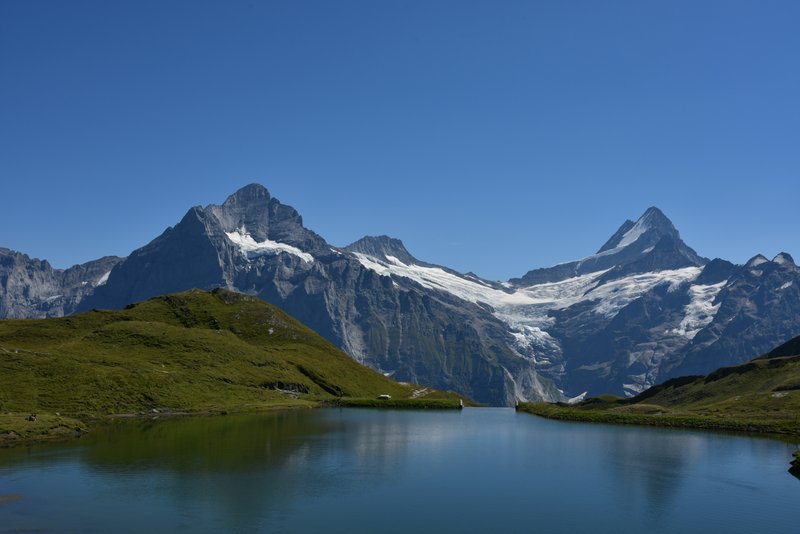
Explore SwitzerlandThe Jungfrau Region rises dramatically from the Bernese Oberland, a concentrated stretch of Alpine terrain where three peaks — Eiger, Mönch, and Jungfrau — form one of Europe's most recognizable skylines. The resort villages here developed along the cog railways built in the late 19th century, and that heritage still shapes the experience. Grindelwald sits at the foot of the Eiger's north face, its main street lined with wooden chalets and shops selling locally made Alphorn memorabilia. Wengen, accessible only by train, maintains a car-free tranquility that feels increasingly rare. Mürren, perched on a shelf above the Lauterbrunnen Valley, offers unobstructed views of 72 waterfalls cascading down sheer limestone cliffs.
The dining scene reflects both Swiss mountain tradition and contemporary European influences. Restaurants in converted farmhouses serve raclette and fondue alongside more inventive preparations of local game and freshwater fish. The café culture revolves around afternoon Kaffee und Kuchen — strong coffee paired with fruit tarts or Engadiner Nusstorte. Hotels range from grand Belle Époque establishments built for Victorian-era mountaineers to family-run pensions where the same families have welcomed guests for generations. The region's spas draw on Alpine wellness traditions, incorporating hay baths, whey treatments, and mineral-rich thermal waters sourced from deep below the mountains.