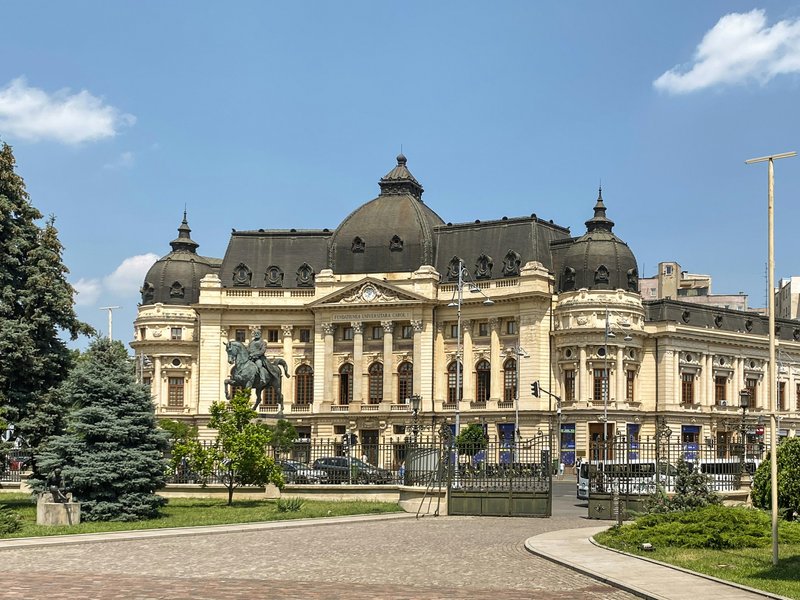
Bucharest's first hotel to receive electric lights and an elevator has been restored to its original grandeur under Corinthia's stewardship. The 1873 landmark houses just 30 suites behind its historic façade, where marble staircases and carved columns recall an era of royal receptions. Boulevard 73 occupies the former ballroom, while a spa provides contemporary retreat within these storied walls.
Where to Stay
A French neo-classical facade conceals 43 suites with garden-facing balconies, each designed around neo-Romanian architectural principles and contemporary restraint. The spa complex—indoor heated pool, hammam, sauna, jacuzzi—operates as a genuine urban retreat steps from Cișmigiu Park and the Romanian Athenaeum. L'Atelier restaurant applies creative technique to seasonal Romanian ingredients. Suited to culture-focused travelers seeking central quietude.
Dual marble staircases rise beneath an immense glass cupola in this 402-room landmark facing the Palace of Parliament—the first JW Marriott to open in Europe. Rooms dressed in Danube-inspired blues showcase locally crafted ceramics and traditional Romanian patterns. Six restaurants draw herbs from the on-site JW Garden, while the World Class Health Academy spa, one of Bucharest's largest, anchors a full wellness program with heated indoor pool.
This Art Nouveau landmark has witnessed over a century of Bucharest's political intrigue, its walls still resonant with wartime and communist-era history. Generously proportioned rooms overlook the Romanian Athenaeum, while the restored Le Diplomate ballroom—with its stained-glass ceiling and mirrored Belle Époque detailing—remains among the city's most striking interiors. An indoor pool, spa with jacuzzi, and old-school formal service suit travelers seeking historic grandeur on Calea Victoriei.
A former 19th-century bank building now housing 217 rooms where Art Deco flourishes alongside Art Nouveau details, the Marmorosch anchors its grandeur in original architecture—most dramatically in the wood-paneled Palace Suite. Below ground, a subterranean spa carved from dark stone offers atmospheric refuge, while the ornate Blank Bar & Lounge buzzes as Bucharest's de facto social salon. The intimate Vault bar rewards those seeking discretion.
An hour from Bucharest, this former hunting lodge sprawls across 1,500 acres where deer roam freely and Arabian horses stable beside guest rooms at Paul's Horses inn. The equestrian program ranges from leisurely rides to dressage instruction and Saturday afternoon horse shows. Chef Alexandru Dumitru's La Hambar restaurant showcases modern Romanian cooking with estate-grown produce, while weekend evenings conclude around the campfire.
Romania's largest five-star property occupies the former site of the legendary Nestor pastry shop on Calea Victoriei, its ice-blue atrium and angular contemporary architecture commanding attention along Bucharest's grandest boulevard. The 462-room hotel delivers serious leisure infrastructure: THAIco Spa with Turkish bath, a large indoor pool, and the seasonal NAMI Beach Club featuring the city's biggest outdoor pool. Family-friendly with interconnecting rooms and playground facilities.
Bucharest's tallest hotel dominates the skyline from Bulevardul Nicolae Balcescu, its panoramic views stretching across the Romanian capital from every upper floor. The InterContinental carries its heritage as the city's original luxury address with quiet confidence, offering interconnecting rooms and suites with separate living areas that accommodate families with ease. A practical base for exploring Bucharest, wrapped in landmark architecture.
What to Do
Romanesque columns and classical statuary frame the indoor pool at this central Bucharest retreat, lending an unexpected grandeur to the wellness experience. Private treatment rooms offer stone therapy and sensory showers, while a Turkish steam bath and Finnish sauna complete the thermal circuit. The neo-classical setting—all ornate details and hushed corridors—provides a cultivated escape from the capital's energetic streets.
Frequently Asked Questions
Which neighborhoods are best for exploring Bucharest on foot?
+
Lipscani and the surrounding old town offer the densest concentration of historic architecture, restaurants, and bars within walking distance. The area around Piața Romană and Calea Victoriei provides an elegant corridor of museums, boutiques, and interwar buildings. For green space and waterside strolls, Herăstrău Park in the north remains the city's most popular retreat.
What is the best time of year to visit Bucharest?
+
Late spring (May to early June) and early autumn (September to October) offer the most pleasant conditions — warm days, fewer crowds, and outdoor terraces in full swing. Summers can be hot and humid, with temperatures regularly exceeding 35°C, while winters bring cold snaps and occasional snow. The George Enescu Festival in September draws classical music enthusiasts from across Europe.
How easy is it to get around Bucharest without a car?
+
The metro system connects major points efficiently, with four lines covering the center and extending to the airport via the M6 line completed in recent years. Ride-hailing apps operate widely and remain affordable by Western European standards. Within the old town and central districts, walking is often the fastest option, though pavements can be uneven and traffic aggressive at crossings.
The Romanian capital reveals itself through contrasts: Belle Époque mansions along Calea Victoriei stand shoulder to shoulder with brutalist apartment blocks, while the sprawling Palatul Parlamentului looms over the southern skyline. The historic Lipscani district, once the commercial heart of medieval Wallachia, now draws evening crowds to its cobblestone streets. North of the center, leafy Primăverii and Herăstrău offer a slower pace, with villas hidden behind high walls and the city's largest park stretching along an artificial lake.
Dining here has evolved rapidly since the 2010s. Young Romanian chefs are reinterpreting traditional dishes — sarmale, mici, zacuscă — with contemporary techniques, while international kitchens have gained a serious foothold. The coffee culture runs deep, with third-wave roasters now competing alongside the classic cafenele. For evening drinks, rooftop bars overlooking the old town have become a local institution, particularly during the long summer nights when the city stays awake well past midnight.