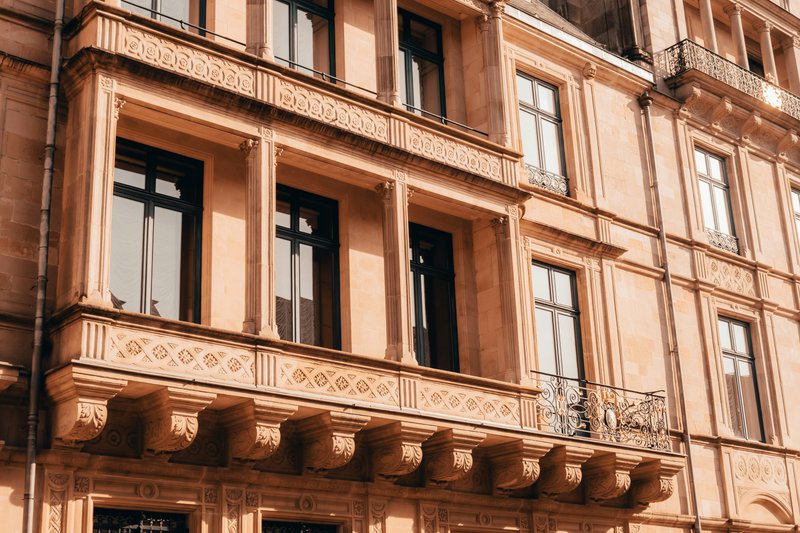
Seven 18th-century townhouses fused into one labyrinthine Relais & Châteaux address on the Place d'Armes, their exposed stone walls and coffered ceilings now backdrop to 30 individually styled rooms mixing Art Nouveau flourishes with contemporary design. Chef Millan Brée's La Cristallerie delivers precise, theatrical gastronomy, while Le Plëss and Café de Paris offer chic brasserie and bistro alternatives. A destination for architecture devotees and serious gastronomes alike.
Where to Stay
Built in 1880 as a textile merchant's private château, Villa Pétrusse sat empty for three decades before its careful restoration revealed worn stone staircases and hidden passages. The century-old gardens, designed by Édouard André, slope toward the Pétrusse River and Adolphe Bridge. Each of the 22 rooms displays watercolors by Luxembourgish painter Sosthène Weis, while restaurant Le Lys presents traditional cuisine with Asian inflections.
Boulevard Royal's grande dame delivers traditional luxury without pretense: 210 rooms split between park and street views, with sixth-floor Privilege suites offering private terraces and dressing rooms. Club Santé provides the wellness trifecta—pool, hammam, sauna—while Brasserie Amélys handles French classics on a seasonal terrace. The Royal Lounge maintains a proper cigar room. Dogs welcome throughout.
A converted bourgeois mansion in Clausen's historic quarter, Les Jardins d'Anaïs houses just seven rooms dressed in Louis XV furniture, custom draperies, and freestanding bathtubs. The lush garden—threaded with vines and a water feature extending toward Robert Schuman's former residence—sets the stage for terrace dining. Chef Fabrice Salvador's Michelin-recommended kitchen honors Luxembourgish terroir: pike-perch from Haute-Sûre, foie gras with mirabelles, elderflower in quiet variations.
Léon Bouvart's 1930s Art Deco landmark opposite the central station once housed Allied generals during the war—a history now layered beneath geometric motifs, rich wood paneling, and powdery pink accents in the renovated lobby. The 153 rooms range from compact to suite-sized, while Brasserie Alfa serves updated bourgeois classics like truffle poultry and reimagined millefeuille. Pet-friendly, with round-the-clock service.
The oldest building in Luxembourg City—a 1510 timber-framed structure once home to a salt merchant—now houses eleven suites where original stone walls and wooden panels meet Murano glass lighting. Architectural layers accumulate visibly: baroque windows from 1736, a Victorian bay window, Italian furnishings. Each suite includes a separate living room; several add fireplaces or mezzanines. Le Friquet's brasserie completes the residence with local and European dishes.
Directly facing the European Court of Justice on Kirchberg plateau, this 109-room property delivers interiors that dodge the beige anonymity typical of business hotels in institutional districts. Two restaurants anchor the dining program: Radici for Italian, De Feierwon for Luxembourgish specialties. Pet-friendly policies accommodate traveling companions, though the absence of spa or pool confirms its orientation toward deal-makers rather than leisure seekers.
Perched above the Pétrusse valley, this Green Key-certified five-star hotel commands sweeping views of Luxembourg's UNESCO-listed fortifications through floor-to-ceiling windows. The interiors break with local convention—vivid colors and boldly contemporary furniture define 128 rooms. Upstairs, rooftop restaurant Mu delivers modern French cuisine, while L'Observatoire draws locals for sunset cocktails against a striking graphic backdrop. A discreet spa and pet-friendly policy complete the offer.
Where to Eat
Louis Linster has shaped his own identity at this two-starred family table, honoring classical foundations while threading in exotic inflections. His sauces achieve remarkable depth—witness the dashi-enriched beurre blanc accompanying trout salmon cooked precisely at 40°C. The dining room balances casual luxury with contemporary art, though the terrace stealing views across Luxembourg's rolling hills proves the prime seat. Partner Njomza orchestrates service with polished grace.
Chef Cyril Molard's two-Michelin-starred table in Oetrange approaches seasonal cuisine with childlike joy and exacting technique. His signature pithiviers—puff pastry cradling ultra-fresh scallops and aromatic truffles, sauced with a red wine fish stock—exemplifies the kitchen's philosophy: classical foundations amplifying pristine ingredients. Creative side dishes punctuated by subtle acidity showcase produce at its peak, while the chef's tableside visits foster a warm, playful atmosphere.
Behind an unassuming façade in Roeser, Michelin-starred chef Roberti Fani runs a refined Italian table where technique speaks louder than décor. His signature risotto—fragrant herbs, fried capers, bright citrus—reveals years of classical training, while a young brigade adds contemporary verve. Fani himself circulates tableside, grating truffles with theatrical precision. A first-rate sommelier completes the experience for serious gastronomes.
At the Airfield Hotel, René Mathieu pursues his singular obsession with Luxembourg's plant kingdom. The one-starred chef grills leek hearts over open flame until smoky and succulent, pairs green leek cream with fermented lemon and truffle, and personally presents each raw ingredient tableside. His Green Star-awarded kitchen turns seasonal vegetables into intensely flavored, sauce-driven compositions that surprise even seasoned gastronomes.
A striking green marble counter frames the open kitchen where Chef Clovis Degrave orchestrates his several-course tasting menu, a precise dialogue between French technique and Japanese restraint. Balfegó tuna belly kissed by binchotan charcoal, egg yolk ravioli under white truffle shavings—each plate arrives with gutsy sauces and fermented accents that reward close attention. Counter seats offer the fullest immersion.
A single Michelin star shines over this old stone farmhouse in Schouweiler, where the legacy of founder Pierrick Guillou lives on through the chefs he trained and the watchful hospitality of his widow and daughter. The kitchen deals in unapologetic French classicism—foie gras, butter, cream—culminating in a legendary meat pie laden with périgourdine sauce. The garden terrace and encyclopedic menu reward those seeking tradition without compromise.
Chef Ryôdô Kajiwara's Michelin-starred table pairs Japanese precision with French generosity—A5 wagyu tucked into cabbage leaves with truffle, langoustine tempura finished tableside with cucumber dashi. The minimalist dining room, attended by kimono-clad staff, offers evening menus spanning omakase sushi to fully vegan kaiseki. Sake pairings, selected with scholarly care, complete an experience rooted in dual culinary traditions.
A glassed conservatory frames views of verdant gardens at this Italian table, where the chef pivots freely between classical technique and playful invention. The signature smoked sturgeon arrives with gin and caviar sorbet, offset by asparagus, foie gras, and grapefruit—a dish as precise as it is unexpected. A champagne trolley glides between tables, underscoring the polished, unhurried elegance throughout.
A former apothecary with herringbone parquet and subtle manga references houses Chef Mathieu Van Wetteren's one-starred table in Steinfort. His surprise menu favors purity over complexity—crispy grey shrimp parcels with cod espuma, celeriac millefeuille cooked in hay, salmon trout confit with fermented daikon jus. Bold, forthright flavors delivered with painstaking precision for diners who appreciate culinary mystery.
Frequently Asked Questions
Which neighborhoods in Luxembourg City offer the best hotel locations?
+
The Ville Haute (upper town) places you within walking distance of the Grand Ducal Palace, museums, and historic squares. The Grund, in the valley below, offers a quieter atmosphere with riverside dining. Kirchberg suits those with EU institutional business or interest in contemporary architecture, while the Gare district provides direct rail connections to Paris, Brussels, and Frankfurt.
What traditional dishes should visitors try in Luxembourg City?
+
Look for Judd mat Gaardebounen (smoked pork collar with broad beans), Bouneschlupp (green bean soup with potatoes and bacon), and Gromperekichelcher (fried potato fritters). Many restaurants also reflect the French and German culinary traditions that shape local cooking, with charcuterie, game dishes, and Moselle wines featuring prominently on menus.
How does Luxembourg City's compact size affect getting around?
+
The entire city center can be crossed on foot in under thirty minutes, though the dramatic elevation changes between the upper town and valleys require navigating steep paths or the Pfaffenthal lift. Public transport is free throughout the country, including buses and the tramway connecting Kirchberg to the center. Most hotels arrange airport transfers for the fifteen-minute journey from Findel.
Built atop dramatic sandstone cliffs that plunge into the Alzette and Pétrusse valleys, Luxembourg City rewards visitors with a peculiar sense of scale — intimate enough to walk end to end in an afternoon, yet layered with the complexity of a former fortress that once rivaled any in Europe. The Ville Haute preserves its UNESCO-listed old quarter around Place Guillaume II and the Grand Ducal Palace, while the Grund neighborhood sits in the valley below, its winding streets lined with restaurants occupying converted medieval houses. Kirchberg, the modern plateau to the northeast, hosts EU institutions and contemporary architecture including the Philharmonie and Mudam museum.
The dining scene reflects the Grand Duchy's position at the crossroads of French, German, and Belgian influences. Traditional brasseries serve Judd mat Gaardebounen (smoked pork collar with broad beans) alongside French-accented tasting menus, while a newer wave of chefs draws on global techniques. Hotels cluster in three distinct zones: the old town for atmosphere, Kirchberg for business travelers, and the station district for practical access. The Clausen quarter, once home to the city's breweries, now offers a converted industrial aesthetic for evening drinks along the riverside.