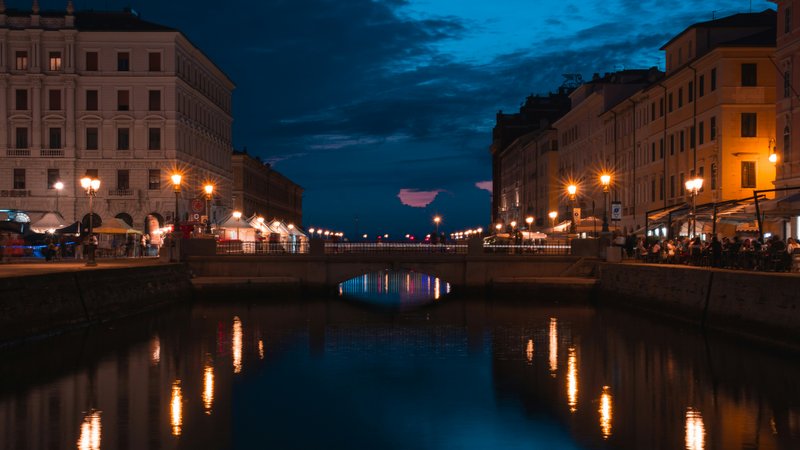
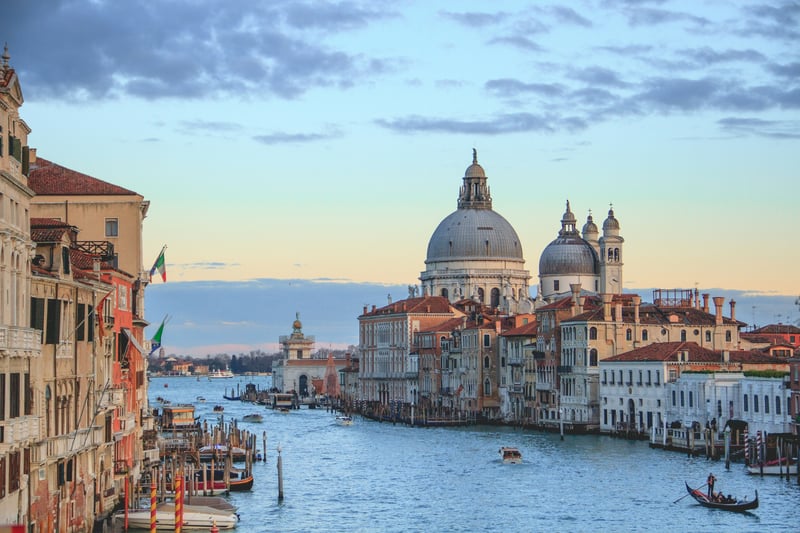
Occupying a 19th-century palazzo directly on Piazza Unità d'Italia, this 37-room property commands sweeping views across the Gulf of Trieste to the Adriatic. Period architecture meets contemporary refinement throughout, while the Duchi Damare Spa offers sauna and hammam for afternoon unwinding. Harry's Bistrò serves creative cuisine with terrace seating. Interconnecting rooms and children's menus make it equally suited to traveling families.
Where to Stay
A former limestone quarry on the Gulf of Trieste now rises as a car-free waterfront amphitheater, home to this 58-room resort channeling Gio Ponti's Modernist vision. Interiors evoke elegant ocean liners—nautical palettes, polished wood, curving lines—while suites offer garden terraces with outdoor Jacuzzis overlooking the marina. Six pools, a private beach club, and the all-white Maxi's restaurant complete this Adriatic retreat.
Where to Eat
Trieste's former stock exchange now houses one of northeastern Italy's most compelling tables. Chefs Matteo Metullio and Davide De Pra orchestrate their two-Michelin-star kitchen as theater, with a handful of seats arranged before an open pass. Three tasting menus—meat, fish, or signatures featuring the celebrated Harrysotto—showcase seafood-driven cooking of remarkable precision and regional conviction.
Tucked into the narrow lanes of Trieste's historic quarter, Al Petes brings a contemporary sensibility to Adriatic seafood under chef Marko's direction. The kitchen draws primarily from local waters, layering Mediterranean foundations with occasional Asian accents that add unexpected depth. The surprise tasting menu offers the fullest expression of this approach. Guests extending their stay find convenient lodging at the affiliated James Joyce hotel nearby.
Since 1903, Menarosti has occupied a quietly confident place on Via del Toro, its warm dining room a gathering point for those who appreciate seafood served without pretense. The kitchen sources pristine fish and lets quality speak through restrained preparation—grilled, simply dressed, allowing briny sweetness to emerge unadorned. A Michelin Plate holder, this is Italian contemporary dining rooted in over a century of Triestine hospitality.
What to Do
Drawing on Adriatic waters and Central European geothermal traditions, this spa within the Grand Hotel Duchi d'Aosta channels the region's thermal heritage through treatments that layer hydrotherapy, skilled manual techniques, and botanical preparations. A sauna and hammam anchor the facility, while unhurried relaxation areas allow guests to decompress before or after massages calibrated to individual tension patterns and physical needs.
Frequently Asked Questions
Which neighborhoods in Trieste are best for exploring on foot?
+
The Borgo Teresiano, built under Maria Theresa in the 18th century, offers flat walking along canals and through Piazza Unità d'Italia — one of Europe's largest seafront squares. For something more atmospheric, climb the winding lanes of Città Vecchia toward the Roman ruins and cathedral on San Giusto hill. The seaside promenade from Barcola beach to the Castello di Miramare makes for a scenic three-kilometer walk.
What is the best time of year to visit Trieste?
+
Late spring and early autumn deliver the most pleasant conditions, with warm temperatures and fewer crowds than the summer months. The Bora wind can make winter visits bracing but atmospheric — locals consider it part of the city's character. June through September brings beach season to Barcola, while October's grape harvest opens the osmize in full force across the Karst.
How does Trieste's café culture differ from other Italian cities?
+
Trieste's coffeehouses owe more to Vienna than to Rome or Milan. The city served as the Habsburg Empire's primary port, and its cafés became gathering places for writers, intellectuals, and merchants from across Central Europe. Today, ordering coffee here requires learning local terminology — a 'nero' is an espresso, a 'capo' comes with a drop of milk. Several historic establishments have operated continuously since the 19th century, maintaining reading rooms stocked with newspapers and the unhurried atmosphere of another era.
Nearby Destinations
Explore ItalyTrieste occupies a peculiar position on the map — wedged between the Karst plateau and the Adriatic, closer to Ljubljana than Venice, shaped by centuries of Habsburg rule that left their mark on every piazza and coffeehouse. The city's grande dame hotels still line the waterfront along Rive, their Viennese facades facing the Molo Audace where locals gather at sunset. Behind them, the Borgo Teresiano district unfolds in a grid of canals and neoclassical buildings, while the steep streets climbing toward the Castello di San Giusto hide smaller, more intimate properties.
The dining scene here draws from three culinary traditions: Italian, Slavic, and Mitteleuropean. You'll find osmize — seasonal farmhouse taverns in the Karst villages above the city — alongside refined restaurants serving seafood pulled from the gulf that morning. The historic caffè culture remains remarkably intact: Caffè San Marco, Caffè Tommaseo, and others preserve the literary atmosphere that once drew James Joyce during his decade-long residence. Evening aperitivo unfolds along the Canal Grande or in the narrow streets of Città Vecchia, where wine bars pour local Vitovska and Terrano from producers just minutes away in the surrounding hills.