A 15th-century monastery converted into 118 rooms and suites, this Golden Quadrilateral address preserves Renaissance frescoes, ogival vaults, and ancient fireplaces within interiors refreshed by Patricia Urquiola and Pierre-Yves Rochon. The tree-lined cloister hosts Zelo restaurant and Stilla Bar, where DJ sets accompany evening cocktails. Below, vaulted cellars contain an 800-square-meter spa with hammam, sauna, and indoor pool—a quiet counterpoint to the Versace and Prada flagships steps away.
Explore Milan
Where to Stay
Four 18th-century palazzos near La Scala house 104 rooms and suites designed by Antonio Citterio, blending Milanese heritage with contemporary luxury. Seta, the two-Michelin-starred restaurant, commands attention with over 1,300 wine labels and refined Italian cuisine. Below ground, a spa rooted in feng shui philosophy anchors holistic treatments around an indoor pool tiled in retro turquoise. Families benefit from dedicated swim times, panda welcome gifts, and child-sized amenities throughout.
Portrait Milano transforms a 16th-century seminary founded by St. Charles Borromeo into a Ferragamo-owned retreat where Michele Bönan's design weaves Baroque architecture, mid-century modernism, and Japanese kansō. The 7,500-square-foot Longevity Spa occupies vaulted warehouse cellars with cryotherapy and biohacking treatments, while the colonnaded courtyard houses Antonia boutique, So-Le leather atelier, Beefbar, and Rumore speakeasy. Seventy-three rooms feature rattan headboards and leather details inspired by vintage Ferragamo trunks.
Giuseppe Verdi spent his final 27 years in this family-run palazzo steps from La Scala, dying in Suite 105—preserved exactly as he left it. Public rooms retain their marble floors, Oriental rugs, and antique furnishings from the maestro's era, while 95 guest rooms dressed in rich fabrics span nineteenth-century, art deco, and art nouveau styles. Nureyev, Callas, and Caruso all frequented the address, drawn by its proximity to the opera house and refined, classically styled interiors.
Nearly a century of history permeates the neoclassical Principe di Savoia, where fin de siècle furnishings, ceiling frescoes and antique carved woodwork create an atmosphere favored by fashion royalty. The rooftop Club 10 spa delivers heated pool laps, saunas and panoramic city views, while the Principe Bar draws Fashion Week's inner circle and local weekenders. Sunday brunch includes a dedicated children's entertainer organizing games for families.
The Martone family's former perfume factory in the Tortona design district now houses sixty all-suite rooms named after fragrant botanicals—jasmine, magnolia, sandalwood—each featuring Brera Academy artworks and private libraries. Architects Colombo, Benelli and Murgia wrapped original industrial walls in steel, aluminium and glass, creating light-flooded spaces overlooking a courtyard garden dense with liquidambar trees and roses. Guests craft bespoke fragrances at LabSolue, dine on Piemonte cuisine, and discover a secret bar behind a copper door forged by art students.
Bvlgari's first hotel occupies a private cul-de-sac between the Quadrilatero della Moda and Brera, crowned by a rare 43,000-square-foot terraced garden. Antonio Citterio's interiors marry teak, oak, Zimbabwe granite and Navona travertine with a jeweler's precision, from 35-square-meter entry rooms to the 2,400-square-foot penthouse with its Murano glass chandelier and wraparound terrace. Below, a subterranean spa centers on a pool tiled in gold and emerald Vicenza mosaics, while Il Ristorante-Niko Romito reimagines Italian classics.
Giorgio Armani's meticulous vision shapes every corner of this minimalist retreat, from custom bathrobes to the sandy hues and greige palette defining its 95 rooms. The A-shaped 1930s façade conceals glossy interiors that function as a living gallery for the Armani Casa aesthetic. Upper-floor dining and cocktails deliver sweeping Duomo views, while a rooftop relaxation pool and comprehensive spa — including four-hand jet-lag massages — serve business travelers and style-conscious guests exploring Montenapoleone's fashion district.
Edward Tuttle transformed an 1870 Baroque palazzo—once a bank—into a study of restrained modernism, where travertine, alabaster, and hand-blown Murano fixtures replace ornament. Bathrooms rival bedrooms in scale, with mirrored walls and octagonal stone-and-glass showers. Below street level, a spa offers Turkish baths and 111Skin treatments; upstairs, La Cupola Lounge glows beneath a glass dome echoing the adjacent Galleria. Pellico 3 delivers seasonal Mediterranean cooking, while Mio Lab's terrace hosts aperitivo hour.
This exclusive members' club occupies a stone palazzo near the Giardini Indro Montanelli, offering just fifteen rooms and suites with butler service and interiors by Florentine designer Michele Bönan. Lacquered woods and jewel-toned fabrics define intimate spaces where bellinis flow late into the evening, while the spa features a Turkish bath, sauna, and steam rooms. Children under eighteen stay free, though dining rooms close to them after 6pm.
Where to Eat
Enrico Bartolini commands his flagship Milan address from Mudec's third floor, where Japanese influences merge with Italian technique under the chef's exacting hand and resident chef Davide Boglioli. The three-Michelin-star menu emphasizes flavor intensity: beetroot risotto enriched with 'Evoluzione' gorgonzola demonstrates signature creaminess, while an off-menu tasting of five creative cheeses presents rare pairings. Two tasting formats—'Best Of' and 'Mudec Experience'—anchor the contemporary dining room overlooking the Museum of Cultures.
Andrea Aprea's two-Michelin-starred seafood restaurant occupies the top floor of the Luigi Rovati Foundation, a historic palazzo housing an Etruscan art collection. The dining room's bucchero-clad walls frame an open kitchen where the chef prepares three tasting menus: a four-course creative exploration, a six-course Campanian itinerary featuring tortello alla genovese, and an eight-course signature menu tracing his culinary philosophy by vintage year. A ground-floor bistrot serves classic Italian dishes in the courtyard.
Antonio Guida's Mandarin Oriental dining room holds two Michelin stars for modern cuisine that mirrors Milan's cosmopolitan character. Choose from three tasting menus—signature classics, seasonal compositions, or single-ingredient explorations—complemented by an extensive wine list featuring exceptional by-the-glass pours and magnums. Winter brings game-focused dishes like cinnamon-spiced veal sweetbreads with passion fruit, risotto laced with raspberries, and contemporary desserts such as pumpkin millefeuille.
The Capitaneo brothers bring Puglian flair to Milan's fine-dining scene at this two-Michelin-starred address above Piazza del Duomo. Three communal counters face the open kitchen, offering front-row views of the brigade at work, while quieter tables sit beyond. The cooking draws on both their southern roots and Milanese tradition, rendered through a contemporary lens that favors precision and invention over theatrics.
Chef Enrico Bartolini's Milano Verticale venture earns its Michelin star through resident chef Michele Cobuzzi's modern Asian cuisine, rooted in Puglia's finest produce. The minimalist dining room channels Gio Ponti's mid-century aesthetic, while Cobuzzi's Apulian origins inform exceptional vegetable work and house-baked breads. An adventurous cocktail programme spans global traditions, complementing the nuanced wine cellar for a polished gastronomic encounter.
Andrea Berton's Michelin-starred restaurant occupies a contemporary space in Porta Nuova, recently expanded with a glass veranda that opens onto Milan's futuristic skyline. The signature 'Non Solo Brodo' menu centres on fragrant broths poured tableside—squid enhanced by its own intensely flavoured stock, lamb accompanied by cardamom-scented consommé served separately. Berton's approach favours precision over complexity: few ingredients, transformed into refined compositions that avoid minimalism while maintaining clarity.
Matias Perdomo's one-starred Italian contemporary kitchen occupies a colorfully refurbished period building where two menus frame the approach: Riflesso revisits tradition through modern technique, while Riflessioni ventures into bolder terrain with unexpected ingredient marriages. An intimate courtyard offers pre- or post-dinner refuge beneath city greenery, and the professional team navigates an internationally focused wine list—French labels especially—alongside thoughtful non-alcoholic pairings for a complete gastronomic evening.
Chef Luca Sacchi, whose training under Alain Ducasse and Giorgio Pinchiorri shaped his approach, delivers contemporary Italian technique in the Galleria Vittorio Emanuele II. Open ravioli and a modern vitello alla Milanese exemplify his reinterpretation of tradition, while the wine list—among Italy's finest French selections—includes bottles from Sacchi's organic Vistamare estate in Romagna. Window tables offer views of the Octagonal building; book well ahead.
Norbert Niederkofler's Milan outpost champions radical localism, sourcing every ingredient from within an hour's radius of the city. Three tasting menus—L'Ora Etica, Il Lago, Vegetali Mon Amour—showcase modern Alpine-Italian cuisine recognized with a Michelin star and Green Star. The natural-wood interior adapts from fine dining to casual lunch, while summer terraces frame Duomo spires and Castello Sforzesco, making the extensive cocktail list a compelling aperitif draw.
This Michelin-starred address marries Japanese tradition with creative fusion, its long open kitchen lined with sushi chefs preparing classics—sashimi, tempura, intricate nigiri—alongside more adventurous plates blending European and Asian techniques. The dining room favors soft tones and striking round Patagonian marble tables, a contemporary pivot from its former black-marble aesthetic. An extensive wine program offers some 500 labels, many poured by the glass.
Frequently Asked Questions
Which neighborhoods in Milan offer the best hotel locations?
+
The Quadrilatero della Moda provides immediate access to high fashion and central attractions, with grand historic properties along via Montenapoleone. Brera suits those seeking gallery-lined streets and independent boutiques in a quieter residential setting. Porta Nuova appeals to design enthusiasts with its contemporary architecture, while Navigli offers canal-side atmosphere and evening dining options.
What is the traditional Milanese aperitivo, and where does it take place?
+
Aperitivo is an early evening ritual, typically between 7pm and 9pm, where the price of a drink includes access to extensive buffets of stuzzichini — small bites ranging from olives and cured meats to pasta salads and bruschetta. The Navigli district and Brera are traditional epicenters, though hotel bars throughout the city maintain their own interpretations of this daily custom.
When is the best time to visit Milan for fewer crowds?
+
January and February see thinner tourist numbers, with the bonus of winter sales across the fashion district. Late September through early November offers mild weather after summer crowds depart and before the Christmas shopping season begins. August brings a quieter city as many Milanese head to the lakes or coast, though some restaurants and smaller shops close for annual holidays.
Nearby Destinations
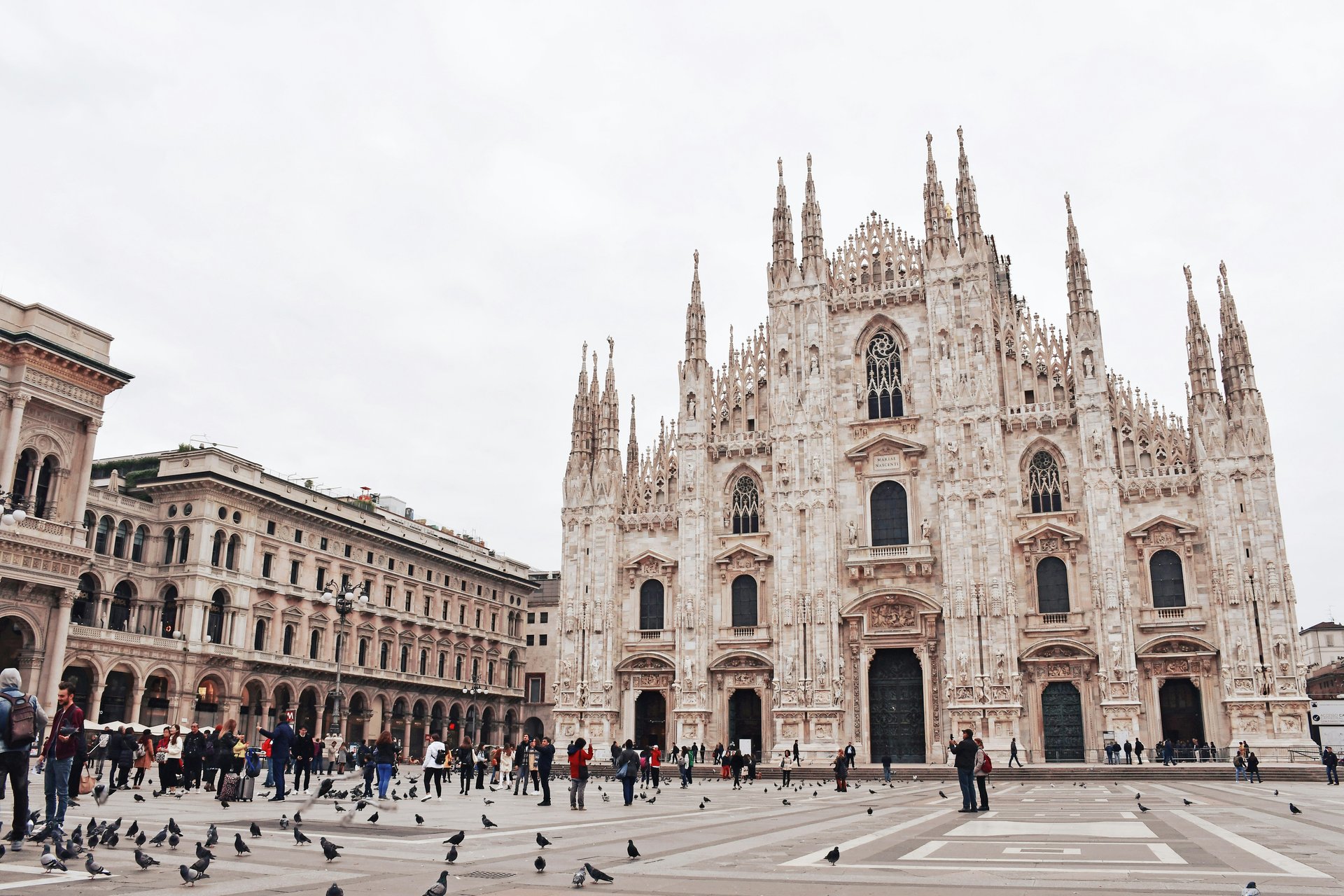
Explore ItalyThe Quadrilatero della Moda sets the tone: via Montenapoleone and via della Spiga draw fashion pilgrims to palazzo-turned-hotels where marble staircases meet contemporary art. Beyond the boutiques, Brera's cobbled streets harbor converted convents and design-forward properties, while Porta Nuova's glass towers host some of the city's newest accommodation. The Navigli canals, once working waterways, now anchor a neighborhood where industrial spaces have been reimagined as loft-style stays.
Milan's dining culture rivals its fashion credentials. Risotto alla milanese and cotoletta remain canonical, but the city's gastronomic restaurants push further — multi-course tasting menus in converted palazzi, omakase counters bringing Tokyo precision to Lombard ingredients at the best Japanese restaurants. For accommodation, the best hotels cluster around the Duomo and stretch toward Porta Venezia, ranging from historic grande dame properties to minimalist design statements. Aperitivo culture peaks between seven and nine, when bar counters overflow with complimentary stuzzichini and the Milanese ritual of the evening drink becomes dinner itself.