This Art Deco landmark between the Maison Carrée and Jardin de la Fontaine once drew Hemingway, Picasso, and Ava Gardner through its doors. Architect Marcelo Joulia's renovation preserves that golden-age glamour across 60 rooms and eight private houses. Pierre Gagnaire's two-Michelin-star Duende anchors the culinary program, while the 350-square-metre Codage spa—with twin pools, hammam, and jacuzzi—rewards those seeking refined indulgence.
Where to Stay
Three eco-lodges dissolve into the Provençal garrigue, each built from local sustainable materials and powered by solar panels and heat pumps. Private hot tubs, saunas, and rain showers accompany Sofitel-standard beds, while acoustic guitars await idle afternoons. The adults-only retreat sits ten minutes from Nîmes station yet feels immersed in wilderness—ideal for couples seeking design-forward seclusion with genuine environmental credentials.
An 18th-century coach-house with just 14 rooms, Jardins Secrets channels the cerebral mystique of Roman Nîmes through the exacting eye of its proprietors—a stylist and photographer. Boudoir chambers wrapped around an Italian cloister feature brocade canopies and vintage standalone tubs, while outside, a cloistered garden with cascading bougainvillea surrounds a jade-colored pool. The candle-lit spa, complete with Roman bath and hammam, suits couples seeking theatrical romance over family practicality.
A grand spiral staircase winds through this opulent mansion just blocks from the Roman amphitheater, connecting ten sophisticated rooms dressed in hardwood floors and leather furnishings. The Rouge restaurant commands attention with its soaring scarlet walls and dramatic bar, while outside, a courtyard strung with twinkling lights frames a plunge pool—arguably the city's most romantic setting for a sunset apéritif.
Where to Eat
Pierre Gagnaire channels the passion of bullfighting and flamenco into his two-Michelin-starred kitchen at Hotel Imperator, where a separate entrance signals the chef's autonomous vision. The tasting menu draws from Gard's terroir—Baron des Cévennes pork, Mediterranean fish, vegetables from local market gardeners—executed with technical precision and spontaneous flair. A wine list exceeding 1,000 labels favors regional bottles, served with polished elegance.
Beneath century-old cedars between Nîmes and Arles, chef Michel Kayser holds two Michelin stars for his intensely personal Mediterranean cooking. His signature red mullet arrives grilled under the salamander alongside ravioles of picholine olives, while a nose-to-tail philosophy ensures nothing is wasted—even the fish scales are baked into bread designed for mopping robust, bouillabaisse-style jus.
A converted farmhouse on the outskirts of Nîmes provides the setting for Jérôme Nutile's one-starred kitchen, where this Meilleur Ouvrier de France 2011 channels classical technique through a seasonal lens. The legendary hare à la royale arrives in two preparations—Carême and Couteaux styles—while humbler ingredients like leeks gain new dimension over Camargue fleur de sel. A thoughtful regional wine list completes the experience.
Chef Julien Caligo returned to his native Vaunage plain to honor his grandmother's culinary teachings in this converted farm building of white walls and exposed stone. His carte blanche menu reveals bold technical ambition—calf intestine paired with red mullet, Baron des Cévennes pork finished with spicy black pudding sauce. Local ingredients from the surrounding hills between Nîmes and Montpellier anchor every course.
Inside a magnificent 15th-century town house, Rouge holds one Michelin star under chef Luka Tao-Debenath, whose résumé spans Plaza Athénée and Guy Savoy. His Mediterranean cooking foregrounds vegetables and seafood through inventive preparations—grey mullet breaded in fig leaf, served cool with tarragon béarnaise and tomato water. Sauces remain his calling card, each one meticulously built. A generous courtyard welcomes fine-weather dining.
Behind the Arènes and facing the Musée de la Romanité, Skab showcases chef Damien Sanchez's vegetable-forward cooking, honed through stages at La Réserve de Beaulieu and Christopher Coutanceau. His one-starred cuisine delivers bright, precise regional flavours—Grau-du-Roi shrimps, lightly seared John Dory with honey-glazed squash. When weather permits, the maple-shaded patio becomes the preferred setting for this refined Nîmois table.
Steps from the Roman amphitheatre, this family-run bistro channels the Mediterranean through rigorously local ingredients—Camargue rice, pigeon, olive oil, and meat from the covered market's own butcher-breeder. Father commands the stove while his daughter shapes bread and desserts; her partner and mother-in-law orchestrate the dining room. Grilled Mas Soula oysters, roast sweetbreads with wild mushrooms, and warm chestnut-quince tart reward those who secure a terrace table overlooking the quiet square.
Ring the bell at this unmarked townhouse near the Carré d'Art to discover Vincent Croizard's inventive table. The self-taught chef builds seasonal menus around vegetables and ultra-local ingredients—hay-smoked camembert with Chipotle, roast lamb perfumed with garrigue herbs and Phu Quoc pepper—while his wife pours thoughtfully chosen Languedoc-Roussillon wines. The intimate rooms feel like dining at a friend's home, if that friend happened to bake exceptional organic bread.
Jérôme Nutile's Bib Gourmand bistro operates as the spirited annex to his starred establishment, offering a daily slate menu rooted in market finds. French classics receive inventive treatment here—artichoke soup enriched with truffle oil and foie gras, ember-cooked duckling glazed with honey and thyme. Fish arrives each morning from the Grau-du-Roi auction, ensuring coastal freshness shapes every plate.
A former wine storehouse in Sommières now hosts chef Guillaume Dercourt and pastry chef Amandine Sabot, whose Bib Gourmand kitchen reinterprets French classics with playful precision. Chicken liver royale glazed with port, slow-cooked pork filet mignon, and a black sesame tartlet with yuzu demonstrate their confident range. The stone-cobbled patio, shaded by an olive tree, makes an ideal setting for unhurried bistronomic dining.
Frequently Asked Questions
What is the best area to stay in Nîmes for visiting Roman monuments?
+
The Écusson, the historic oval centre, places you within walking distance of the Arena, Maison Carrée, and Jardins de la Fontaine. Most characterful hotels occupy converted townhouses along its narrow streets.
When does the Féria de Nîmes take place and how does it affect the city?
+
The Féria de Pentecôte occurs in late May or early June, transforming the city for five days with bullfights, street bodegas, and flamenco. Hotels book months in advance; restaurants extend their hours but expect crowds throughout the Écusson.
What local dishes should visitors try in Nîmes?
+
Brandade de morue—salt cod whipped with olive oil—is the city's emblematic dish. Petits pâtés nîmois, individual meat pies, appear on many bistro menus, alongside Camargue rice, taureau de Camargue beef, and pélardon goat cheese from the Cévennes.
Nearby Destinations
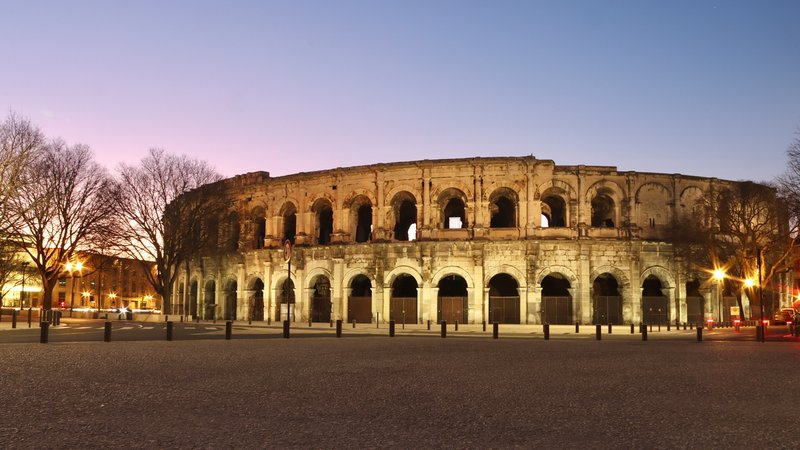
Explore FranceThe Roman amphitheatre still hosts concerts and bullfights, while the Maison Carrée stands as one of the best-preserved temples outside Italy. Hotels cluster around the Écusson, the oval historic centre bounded by tree-lined boulevards that trace the old ramparts. Here, seventeenth-century hôtels particuliers have been converted into intimate properties with interior courtyards and stone staircases. The Jardins de la Fontaine, France's first public garden, anchors the northwest corner—its terraces rising toward the Tour Magne offer a quiet counterpoint to the city's café-lined squares.
Dining runs from market-driven bistros along Rue de l'Aspic to more formal restaurants near Place aux Herbes, where chefs work with Camargue beef, Cévennes chestnuts, and local olive oils. The covered market, Les Halles de Nîmes, opens every morning and supplies much of the city's restaurant trade. Brandade de morue remains the local signature, appearing in everything from traditional gratins to contemporary small plates. Wine lists lean heavily on nearby appellations—Costières de Nîmes, Pic Saint-Loup, Duché d'Uzès—and natural wine bars have multiplied in the streets behind the arena.