Perched on a quiet hill in central Steyr, this intimate one-Michelin-starred dining room seats guests before an open kitchen where owners Lukas Kapeller and Michael Schlöglhofer execute a seven-course menu rooted in regional produce. King oyster mushrooms arrive with celery and nut butter; pikeperch comes grilled alongside peas and horseradish. The smart modern interior and surrounding greenery create an unexpectedly pastoral atmosphere just minutes from town.
Beneath the barrel-vaulted ceiling of a listed Linz townhouse, chef-patrons Marco Barth and Sebastian Rossbach pursue a rigorously regional vision that has earned one Michelin star. Their concise set menus showcase organic produce and wild-caught saltwater fish, yielding dishes like maple syrup-glazed shiitake on braised leeks brightened by apple brunoise. The chefs themselves circulate through the minimalist dining room, detailing each ingredient's provenance.
Behind an unassuming entrance in the historic Salzamt, a luminous vaulted ceiling sets the stage for chef Andreas Zika's creative cuisine. Three surprise menus—Theater, Bistro, and Gourmet—deliver dishes of exceptional nuance, from yellowfin tuna sashimi with shiso and ginger-kefir broth to venison with gremolata crumbs. The wine cellar holds over 1,200 labels and 50,000 bottles, with monthly tastings drawing oenophiles citywide.
Perched on a forested hillside above Linz, Verdi brings one-star precision to Austria's culinary map under the father-son partnership of Erich and Philipp Lukas. Their cooking grounds modern technique in classical foundations while drawing on Asian accents—crispy piglet belly with Calamansi gel and a Karashi-lemongrass broth exemplifies the approach. A terrace with city views and polished service complete the picture.
Seasonal Italian cooking takes a refined turn at this modern dining room near Linz's Landestheater, where fish and seafood anchor a menu rooted in cucina casalinga traditions. The ikejime dry-aged sea bass, matured in-house, exemplifies the kitchen's exacting approach to sourcing. Patron Ingmar Goetzloff guides diners through daily creations tableside, drawing from a cellar of some 400 wines to match each course.
Perched on a forested estate above Linz, Verdi-Einkehr rewards the drive with sweeping valley views best savored from its summer terrace. Father-and-son team Erich and Philipp Lukas craft a modern, seasonally driven menu that pivots between Austrian tradition and global accents—think miso-dressed tuna with mango alongside braised veal cheeks glazed in Barolo. Cordial, family-run service completes the unhurried escape.
Christian Göttfried commands the kitchen while his wife Simone orchestrates the dining room in this vaulted old-town space steps from the Danube. The cooking draws on regional Austrian produce with Mediterranean inflections—organic veal schnitzel and branzino with parsley vinaigrette among the signatures. A 350-label wine list, mostly Austrian, complements the Bib Gourmand-recognized cuisine; summer diners retreat to the tranquil courtyard.
Down a few steps from Linz's old town pedestrian quarter, a bright vaulted dining room stripped to modern minimalism sets the stage for Muto's playful regional cooking. The name—from Latin 'mutare,' to change—signals a kitchen that experiments freely with textures and flavours, earning Michelin recognition. Service stays refreshingly casual, matching the creative spirit without a trace of formality.
Frequently Asked Questions
Which neighborhoods in Linz are best for walking and dining?
+
The Altstadt around Hauptplatz concentrates historic architecture, traditional restaurants, and coffeehouses within a few blocks. The Kulturmeile along the Danube connects major museums and contemporary dining spots, while the Tabakfabrik — a converted tobacco factory — hosts creative studios, cafés, and weekend markets.
What is the Linzer Torte and where did it originate?
+
The Linzer Torte is a lattice-topped almond pastry with redcurrant jam, considered one of the oldest recorded cake recipes in the world. First documented in 1653, it remains a specialty of the city's traditional bakeries and coffeehouses, often served with whipped cream.
How does Linz compare to Vienna and Salzburg for a shorter Austrian stay?
+
Linz offers a more concentrated experience focused on contemporary art and Danube river culture, without the crowds of Vienna or Salzburg. The compact center covers easily on foot, and the Pöstlingberg hill provides quick access to views and nature trails just minutes from the main square.
Nearby Destinations
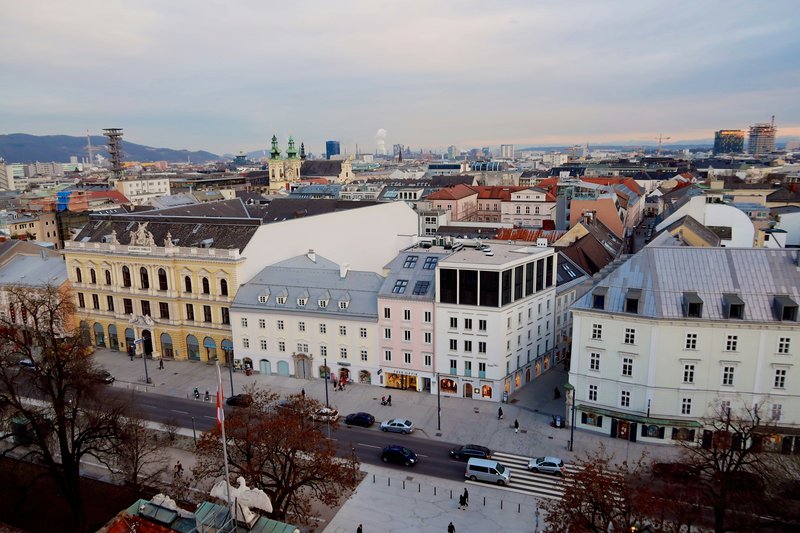
Explore AustriaAustria's third-largest city stretches along the Danube with an industrial heritage that has pivoted sharply toward contemporary culture. The Ars Electronica Center and Lentos Kunstmuseum anchor the northern riverbank, their illuminated facades reflecting off the water after dark. South of the river, the compact Altstadt preserves Baroque architecture along Landstraße and the sloping lanes leading to Pöstlingberg, where a pilgrimage church offers views across the city and into the Alpine foothills.
The dining scene reflects Linz's dual identity. Traditional Gasthäuser around Hauptplatz serve Knödel and Linzer Torte — the city's namesake pastry documented since 1653. Newer establishments along the Kulturmeile and in the regenerated Tabakfabrik district draw on Austria's farm-to-table movement, with menus built around Mühlviertel beef, Eferdinger Landl vegetables, and Trappist cheese from nearby Schlierbach. Coffeehouses remain central to daily life, their marble tables and newspaper racks unchanged for generations.