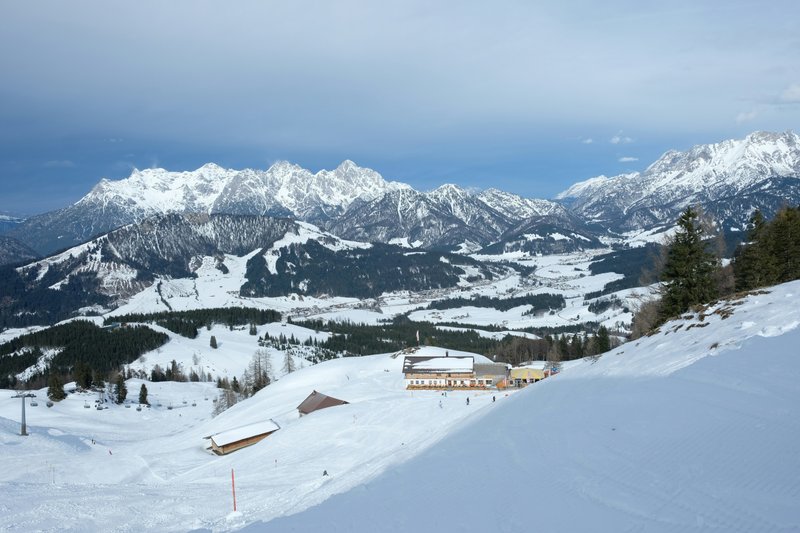
The Schmuck family has tended this 17th-century forest farmstead for over four centuries, planting the surrounding woodland themselves. Their waldSPA—Europe's first forest-inspired wellness concept—features outdoor saunas opening onto pine clearings and treatments steeped in alpine botanicals. A heated outdoor pool faces the Leogang peaks, with ski-in/ski-out access in winter. Families find purpose-built facilities including a 70-metre flume and forest kindergarten, while three restaurants champion seasonal, regionally sourced cooking.
Where to Stay
Fourth-generation hoteliers run this 124-room mountain retreat minutes from Leogang's cable car, where mid-century architecture doubles as a gallery for international contemporary art. The spa complex—a futuristic pavilion overlooking a natural bathing lake—houses an Olympic-length infinity pool, ice grotto, and zen garden. Pet-friendly and resolutely cosmopolitan, Krallerhof suits art collectors and spa devotees seeking Alpine depth.
The Hörl family's alpine retreat in Maria Alm channels generations of mountain hospitality into 76 rooms dressed in blonde wood and earth tones, punctuated by whimsical lighting fixtures. An extensive spa complex features Turkish hammam, jacuzzi, and sauna, while both indoor and outdoor pools offer year-round swimming. After the slopes, the High Queen Bar draws skiers for unhurried après-ski rituals.
With a mountain gondola station at its doorstep and a ski-slope snack shack serving spit-roasted chicken, mama thresl channels urban energy into Alpine terrain. Maximalist knotted pine interiors include an "empty room" with a suspended vintage stove for panoramic meditation. The Finnish sauna ranks among Leogang's finest; upgraded suites add private hot tubs and rooftop terraces facing the Pinzgauer peaks. One private dining table requires indoor rock climbing to reach.
The Madreiter family's alpine retreat spreads across Leogang's mountainscape, its freestanding chalets bathed in natural light through blond wood interiors. An on-site organic farm feeds the kitchens and stocks shelves with house-made goods, while an indoor-outdoor infinity pool frames the peaks beyond. The full-service spa and sauna facilities complete a property built for families and nature-seekers drawn to authentic mountain hospitality.
Built entirely from wood, this family-run eco-hotel occupies a dramatic Alpine perch above Leogang, with direct access to both winter slopes and summer hiking trails. The on-site spa offers recovery after days on the mountain, while the sustainable ethos runs through every detail. Best suited to active couples seeking Austrian mountain culture without the polish of larger resorts.
Perched at Wagrain's edge, this 23-suite property resolves the Alpine design dilemma—neither rustic chalet nor sterile minimalism. Burnished-gold accents and forward-thinking furniture fill the public spaces, while suites balance natural wood with plush textiles against mountain panoramas. The heated rooftop infinity pool delivers those views from above; a spa with sauna completes the wellness offering. Pet-friendly, with golf nearby.
Lake Rizensee's crystalline alpine waters lap at the edge of this 69-room retreat, where guests swim directly from the property in warmer months or retreat to the indoor pool year-round. The spa delivers Turkish bath and sauna rituals, while interiors wrap visitors in lilac hues, plush carpeting, and warm oak. Pet-friendly policies and nearby golf courses extend the appeal to active travelers and their companions.
A ski slope descends directly to the door of this 24-suite retreat near the Zwölferkogel Cable Car, where floor-to-ceiling windows and warm timber interiors frame unobstructed alpine panoramas. The bathhouse spa offers sauna and Turkish bath rituals, while twin pools—one an outdoor infinity edge overlooking the peaks—provide year-round immersion. The restaurant draws from the property's own farm for Austrian dishes rooted in hyperlocal produce.
Where to Eat
A Michelin-starred table within a 1326 inn, Kirchenwirt remains in the hands of its sixth-generation family stewards. Chef Stefan Birnbacher anchors his seasonal cuisine in Alpine provenance—his signature brook trout arrives with gossamer lardo, kohlrabi two ways, and a Leogang saffron broth. Six-course tasting menus share billing with impeccable Wiener schnitzel, while summer terrace service frames the parish church.
Chef Andreas Herbst honed his craft under Austrian culinary luminaries Johanna Maier, Andreas Döllerer, and Mario Lohninger before returning to his native Leogang. His tasting menu—available in three formats—showcases intensely local ingredients through fermentation, pickling, and foraged elements, including white chocolate crafted from regional grains. A white bull leather map traces each producer. One Michelin star; Green Star for sustainability.
Inside die HOCHKÖNIGIN hotel, chef Maximilian Reuter crafts two distinctive tasting menus—'Asian Alpin' and the vegan 'Asian Green'—that marry Austrian terroir with Asian technique. Herbs from the kitchen garden and beef from the property's organic farm anchor dishes presented tableside by the kitchen team. The vaulted dining room seats only a handful of guests, while the bartender's inventive alcohol-free pairings deserve particular attention.
Ten seats, no more—Silva at Naturhotel Forsthofgut operates as one of Austria's most intimate fine dining rooms. Chef Michael Helfrich channels the surrounding forest through fermentation and smoking techniques, offering two seasonal tasting menus: the omnivore 'Wald' and vegetarian 'Wiese,' both available à la carte. Tableside beverage pairings, alcoholic or not, complete an experience designed for unhurried, focused gastronomy.
Inside the Forsthofgut spa hotel, Mizūmi delivers precise Japanese cooking in a space of dark timber and clean minimalism. The open kitchen reveals chefs assembling sushi and sashimi, ladling house-made ramen, and tending to barbecued plates. Floor-to-ceiling windows frame views of a natural pond and the hotel's outdoor pool—an Alpine setting for an authentically Nippon dining experience.
Five rustic wooden tables fill this intimate Alpine dining room at Naturhotel Forsthofgut, where warm wood panelling and live zither music set a distinctly regional tone. The kitchen champions local ingredients, with Pinzgauer beef Tafelspitz as the signature dish, preceded by a memorable bacon amuse-bouche. Staff in traditional dress navigate an impressive wine list spanning Austria, Germany, France, and Italy.
Frequently Asked Questions
What is the difference between Saalbach, Hinterglemm, and Leogang?
+
Saalbach is the most developed village with concentrated nightlife and shopping along its main street. Hinterglemm lies further up the Glemmtal valley with a more residential feel and direct access to family-friendly slopes. Leogang sits in a separate valley to the south, sunnier and quieter, popular with mountain bikers in summer thanks to its bike park and trail network.
When is the best time to visit for skiing versus summer activities?
+
The ski season typically runs from early December through mid-April, with the most reliable snow conditions between January and March. Summer activities peak from late June through September, when all hiking trails and mountain bike routes are fully accessible and the cable cars operate for uplift.
How accessible is the Skicircus from each village?
+
All three villages offer direct gondola access to the shared ski area. Saalbach's Schattberg X-Press and Kohlmais lifts sit steps from the village center. Hinterglemm connects via the Zwölferkogel and Reiterkogel gondolas, while Leogang's Asitzbahn provides the main southern entry point to the circuit.
Nearby Destinations
Explore AustriaThree villages share one of the Alps' most extensive lift networks: Saalbach anchors the western end with its pedestrianized center and après-ski terraces along Dorfstraße, Hinterglemm stretches eastward through a narrow valley where family-run guesthouses cluster near the Reiterkogel gondola, and Leogang occupies a sunnier south-facing position beneath the Steinberge peaks. The ski circus connects 270 kilometers of groomed runs, but summer brings a different crowd—mountain bikers descend from the Spielberghaus trails while hikers tackle the Pinzgauer Spaziergang ridge walk to Zell am See.
Dining here follows the Austrian mountain template: wood-paneled Stuben serving Kasnocken and Kaiserschmarrn, hotel restaurants pushing toward contemporary alpine cuisine with local Pinzgau beef and Salzburg trout. The après-ski scene drives much of the village energy, particularly around Saalbach's Bauer's Schi-Alm and the Goaßstall umbrella bar. Summer evenings are quieter, with hotel terraces and valley-floor beer gardens replacing the slope-side crowds.