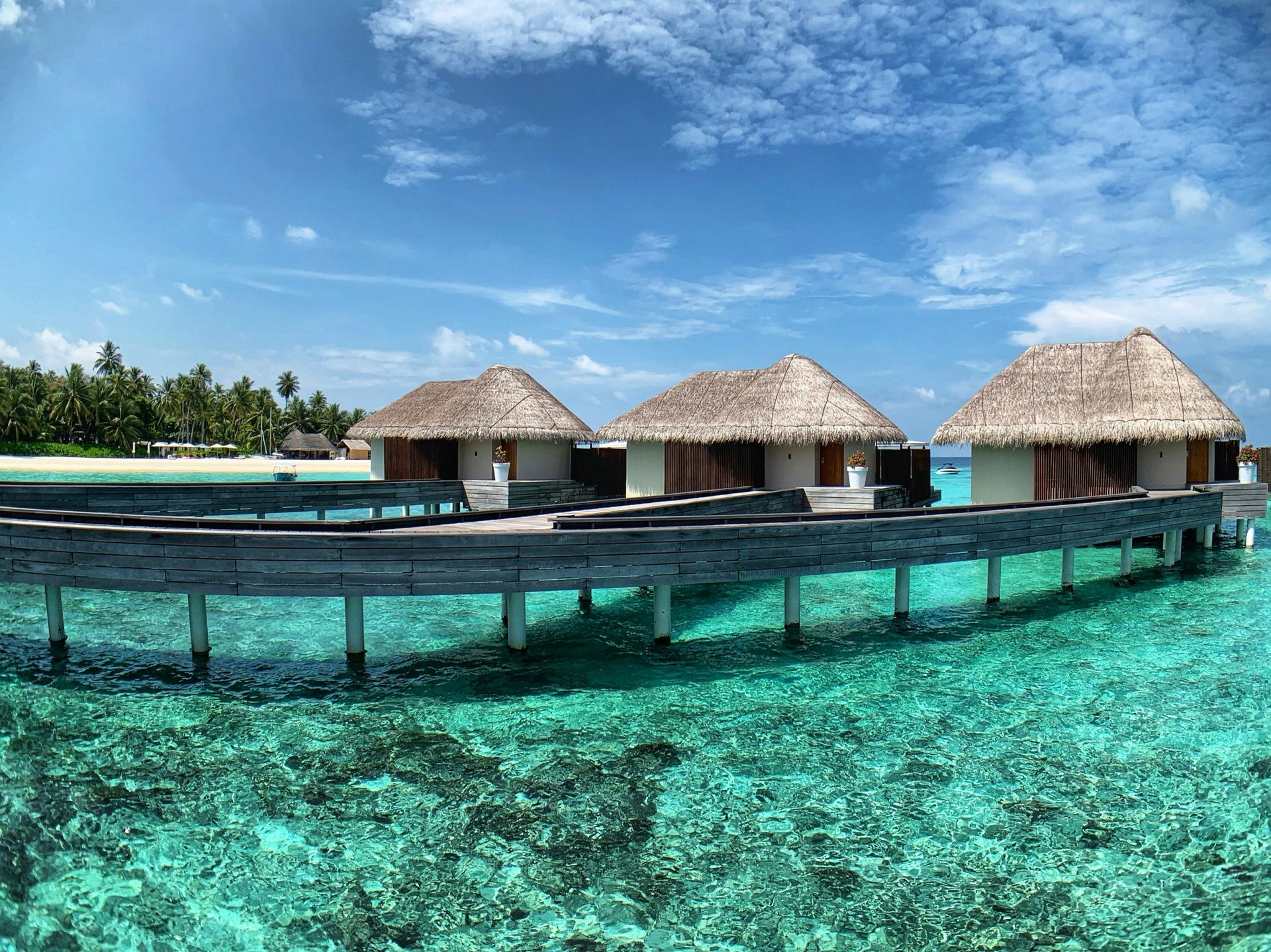
Huvadhoo Atoll's exceptional depth—279 feet—draws gray reef sharks and whale sharks through its channels, and Park Hyatt Hadahaa positions guests at the edge of this marine theatre. The house reef drops off mere feet from overwater villas whose stilts were hand-placed by divers to protect coral. Ashore, a reception hall crowned by an upturned dhoni roof crafted from salvaged tsunami wood anchors the minimalist architecture, while a 144-foot pool and garden spa suit couples seeking quietude over animation.
A dual-identity retreat in remote Gaafu Alifu, Raffles Meradhoo splits its 37 spacious villas between a tree-lined beachfront and overwater bungalows reached by boat across the lagoon—each with terraces descending into the Indian Ocean. The house reef, explored on complimentary marine biologist-led tours, rivals the elaborate spa for attention. Families find a compact but well-programmed kids' club; couples gravitate toward sunset-facing suites.
Some 250 miles south of Malé, this remote island retreat rewards the journey with one of the Maldives' most vibrant house reefs—sea turtles, reef sharks, and pristine coral mere strokes from shore. Families find particular appeal in the Reef Ranger programme, where resident marine biologists immerse young guests in hands-on conservation. Seclusion here feels earned, surrounded by nothing but clear blue ocean and untouched sand.
Italy's first luxury hotel brand to establish itself in the Maldives, Baglioni Resort occupies the remote island of Maagau in Dhaalu Atoll. Ninety-six private villas marry classic Italian refinement with tropical ease, while three restaurants showcase the group's culinary heritage. A dedicated kids' club and genuinely warm service make this an appealing choice for families seeking understated elegance over flashy spectacle.
A ring of white sand encircles this remote Gaafu Alifu retreat, where gin-clear waters rank among the Maldives' purest. Eagle rays and reef sharks glide past underwater villas fitted with floor-to-ceiling glass walls—marine theater without leaving the room. Families find genuine range here: a dedicated Skillz zone keeps teenagers occupied with karaoke and gaming consoles, while younger children join nature walks and treasure hunts through the kids' club.
Deep in the southern Maldives, where Huvadhoo's waters plunge into one of the world's largest atolls, The Residence Dhigurah spreads across its island with rambling private pool villas. A majestic house reef draws snorkelers directly from shore, while the generous all-inclusive programme delivers strong value. Families find genuine welcome here, with children's menus across all restaurants and a dedicated kids' club.
Frequently Asked Questions
How do you reach Huvadhoo Atoll from Malé?
+
The journey involves either a 75-minute seaplane flight directly to your resort's lagoon, or a domestic flight to Kaadedhdhoo Airport followed by a speedboat transfer. Seaplane services operate only during daylight hours, so late arrivals to Malé typically require an overnight stay before continuing south.
What makes Huvadhoo's diving conditions different from northern atolls?
+
The Huvadhoo Channel reaches depths exceeding 80 meters, creating strong nutrient currents that attract oceanic species rarely seen further north. Hammerhead sharks, manta rays, and whale sharks pass through predictable cleaning stations, while the atoll's relative isolation means reef systems show less coral stress than heavily dived sites near Malé.
When is the best season to visit Huvadhoo Atoll?
+
January through April offers the calmest seas and clearest visibility for snorkeling and diving. Surfers prefer June through September when the southwest monsoon generates consistent breaks on exposed reef passages. The shoulder months of May and November provide lower rates and fewer guests, though brief afternoon rain showers become more frequent.
Nearby Destinations
Explore MaldivesHuvadhoo Atoll sits nearly 500 kilometers south of Malé, separated from the main tourist atolls by the deep Huvadhoo Kandu channel. This remoteness is the point. The atoll's 240 islands — most uninhabited — form one of the world's largest natural lagoons, where reef systems remain pristine and marine biodiversity thrives largely undisturbed by mass tourism. Properties here operate at genuine remove, accessible only by lengthy seaplane transfers or domestic flights followed by speedboat crossings.
The atoll's geography shapes its hospitality character. Resorts occupy individual islands, typically no more than a few hundred meters across, where the boundary between accommodation and reef is measured in steps rather than distances. The Gaafu Dhaalu administrative division includes traditional fishing communities on islands like Thinadhoo and Gaddhoo, where local boat-building traditions persist and Friday mosque gatherings follow customs unchanged for generations. Seasonality matters: the southwest monsoon from May to November brings larger swells favored by surfers, while the northeast monsoon delivers the flat-calm conditions photographers seek.