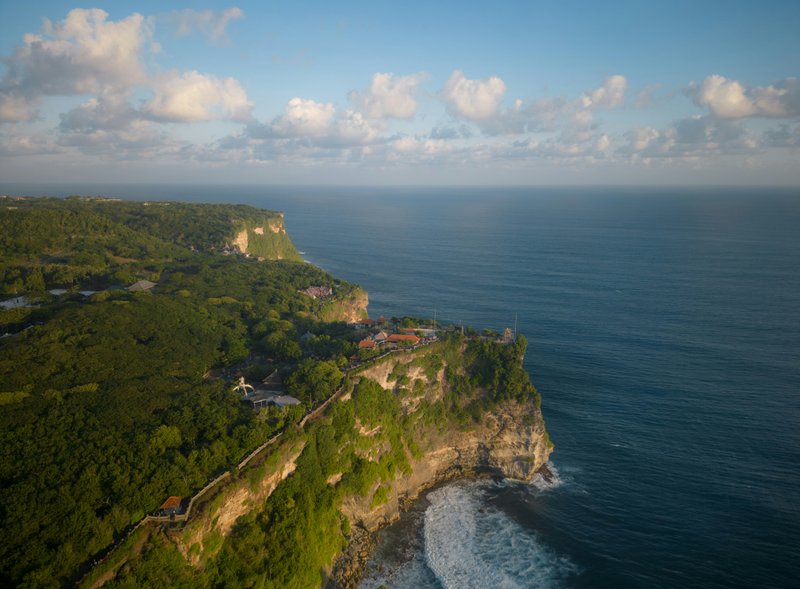
Perched on the Bukit Peninsula with unobstructed views across Jimbaran Bay, Raffles Bali comprises 32 villas dressed in modern Balinese style—high vaulted ceilings, dark teak, batik textiles—each with a private pool and garden. Personal butlers double as buggy drivers navigating the terraced grounds, while the hilltop Writers Bar serves the arak-laced Bali Sling. The energy-healing spa and family-friendly programming suit couples and multigenerational groups alike.
Where to Stay
Perched on Uluwatu's clifftops 500 feet above the Indian Ocean, this resort scatters 59 thatched-roof villas—each 300 to 500 square metres with private pool—down terraced slopes where volcanic stone meets Antonio Citterio's Milanese refinement. An inclinator descends through jungle to a private beach, while Niko Romito's Italian restaurant delivers bold culinary reinvention. The oceanfront spa, housed in a relocated antique Javanese Joglo, specializes in Balinese Ayurvedic rituals.
Traditional bale-style villas descend through tropical foliage toward a rocky peninsula, each with private plunge pool, courtyard garden, and deep soaking tub. The two-mile Coconut Grove beach offers complimentary kayaking, windsurfing, and catamaran sailing, while Sundara draws sunset crowds for cocktails and live music. A dedicated cooking school teaches Indonesian techniques; Jimba Club keeps children occupied with treasure hunts and pastry classes.
WOHA's striking architecture sprawls across 35 clifftop acres above Uluwatu, where 65 contemporary villas—each with private pool and dedicated butler—frame the Indian Ocean through floor-to-ceiling glass. The sunset cabana, cantilevered dramatically over the cliff's edge, ranks among Bali's most photographed spots, while Batique Bar's collection of over 100 rare whiskies draws connoisseurs after dark. Spa Alila's couples treatments and eco-conscious design appeal to romantic travelers seeking sophistication without tropical cliché.
Javanese shadow puppets and intricate woodcarvings adorned with geometric canang motifs set the tone at this Nusa Dua landmark, where every accommodation is a full suite — among Bali's largest — attended by round-the-clock butler service. The butterfly-themed Iridium Spa surrounds its treatment rooms with koi ponds, while the saltwater lagoon connects select villas directly to the beach. Kayuputi delivers pan-Asian plates against ocean views; evening jazz drifts from the bar.
Jaya Ibrahim's refined interiors—parquet floors, dark wood, billowing voile—set a sophisticated urban tone rare among Balinese resorts. The three-tiered infinity pool commands sunset views over the Indian Ocean, while an ocean-facing garden spa delivers Tibetan and Balinese treatments including an exceptional four-hand massage. For deeper seclusion, The Club offers fifteen private-pool villas with butler service, yet the design emphasizes social spaces over isolation.
Perched 230 feet above Melasti Beach, Umana Bali scatters 72 private villas across dramatic clifftop terrain, each equipped with its own infinity pool and jetted tub. The architecture channels Tri Hita Karana philosophy through lobby elements inspired by legong dancers and sacred banyan trees. Lohma Spa's four-hour signature treatment delivers deep restoration, while a Kids Club featuring a hot air balloon slide into a ball pit makes this an inspired choice for families seeking polish without pretense.
From its clifftop perch above Nusa Dua, this 81-room retreat commands sweeping Indian Ocean panoramas through floor-to-ceiling windows and private terraces equipped with telescopes for stargazing. Round-the-clock butlers orchestrate everything from floating pool breakfasts to candlelit dinners in a seaside cave. The all-inclusive formula covers watersports, cooking classes, and spa treatments, while a rarely crowded private beach suits families seeking attentive yet unhurried service.
Traditional Javanese joglo architecture defines this Umalas retreat, where interconnecting teak pavilions house three private villas ranging from three to five bedrooms. Each residence claims its own swimming pool—the Kalua's clover-shaped, the Kayu's framed by feng shui gardens and natural stone—plus lotus ponds, outdoor showers, and fully equipped kitchens. Minutes from Seminyak yet resolutely serene, the property suits families and groups seeking authentic Balinese indoor-outdoor living.
Sixty-four cottages and villas crafted from bamboo, teak, and alang-alang thatch spread across flowering frangipani gardens along Jimbaran Bay's crescent shoreline. The emerald-cut infinity pool, tiled in Javanese stone, anchors the resort, while Nelayan Restaurant stages candlelit degustation dinners directly on the sand—lobster and yellowfin tuna pulled fresh from local waters. A pop-up spa delivers treatments beachside or beneath the palms, completing this Belmond retreat for families and couples seeking traditional Balinese seclusion.
What to Do
Koi ponds line the wooden walkways connecting eight private treatment rooms at this butterfly-themed sanctuary within the St. Regis Bali. Two couples suites feature private back gardens with canopied marble bathtubs and outdoor showers, ideal for the indulgent 150-minute Luxury Champagne Treatment. The aromatherapy steam room rotates scents daily—lemongrass one morning, cooling tea tree the next—while a semi-alfresco lounge displays an ornamental butterfly wall.
Eight riverside treatment rooms with private balconies overlook the Ayung River, where therapies begin with flower-infused foot rituals before progressing to ancient Javanese practices. The Royal Spice Ceremony — a 150-minute couples treatment rooted in 17th-century Indonesian royal wedding traditions — combines seven-flower cleansing with synchronized four-hand massage. Local healers offer pranic acupuncture and pancakosha, while a gifted blind masseuse practices extraordinary reflexology amid tiered rice paddies.
Marble corridors open onto twenty treatment rooms where Ayurvedic consultations determine bespoke protocols, from aromatherapy oils matched to individual temperament to detoxifying thermal circuits. The facility houses the Asia-Pacific's sole sub-zero ice room—Italian-engineered crystals cascading from above for circulation therapy—alongside Cleopatra-style hydrotonic pools with pressurized underwater loungers. Frangipani-framed hot and cold plunge pools address jetlag recovery, while chromotherapy saunas shift between forest greens and oceanic blues.
Perched above Uluwatu's cliffs, this spa draws from ancient healing arts—the Shirodhara ritual begins with a four-hand massage before warm medicated oils flow onto the third eye, following a 5,000-year-old Indian tradition. The signature sayang sayang strokes infuse every treatment. For the adventurous, aerial yoga unfolds in a cabana suspended over the Indian Ocean at sunset, while paddleboard yoga challenges balance on the infinity pool's surface.
Perched nearly 500 feet above the Indian Ocean, this clifftop sanctuary greets visitors through an antique joglo house transported from Java. Treatments open with a ceremonial footbath of fresh flowers and essential oils pressed into reflex points, setting the tone for therapies ranging from Balinese massage to ayurvedic rituals. The signature bath infuses palmarosa, myrrh, and orange oil into mineral-rich waters.
This Nusa Dua sanctuary draws on ancient Indonesian bathing traditions, with a free-form pool framed by waterfalls and tropical gardens for post-treatment immersion. The Hydro-Vital Pool delivers targeted aquatic therapy through five distinct zones—vertical jets, swan-neck showers, air bubble benches—while the Wet Lounge circuits guests through sauna, steam, whirlpool, and cold plunge. Treatments harness coastal ingredients: seaweed, coconut, pearls.
Perched above the Ayung River in dense jungle, this spa draws on Balinese mysticism through treatments that begin with Kriya yoga, meditation, and amethyst crystal rituals before hands ever touch skin. A bamboo pavilion hosts AntiGravity yoga in suspended swings above rice terraces, while Ibu Heny Ferawati, a former Buddhist nun, guides deeper wellness explorations. Signature scrubs—Rice and Spice, Red Ginger—culminate in banana leaf wraps and flower-scented lotions.
Frequently Asked Questions
What are the main differences between Seminyak and Uluwatu for accommodation?
+
Seminyak sits at sea level with direct beach access and a walkable strip of restaurants and boutiques along Jalan Laksmana and Petitenget. Uluwatu properties perch on cliffs up to 70 metres above the ocean, offering dramatic views but requiring transportation for dining and activities. Seminyak suits those wanting nightlife and shopping proximity; Uluwatu appeals to guests prioritising privacy and Indian Ocean panoramas.
When is the best season to visit South Bali?
+
The dry season runs from April through October, with July and August seeing the highest visitor numbers and corresponding rates. April, May, and September offer similar weather with fewer crowds. The wet season from November to March brings afternoon downpours rather than all-day rain, and properties often reduce their rates significantly — though ocean conditions become rougher for swimming.
How far is South Bali from Ngurah Rai International Airport?
+
The airport sits on the isthmus connecting the Bukit Peninsula to mainland Bali. Jimbaran properties are typically 10-15 minutes away; Seminyak requires 30-45 minutes depending on traffic; Uluwatu takes 30-40 minutes via the Mandara Toll Road. Sanur, on the eastern coast, is approximately 25-35 minutes. Traffic congestion, particularly around sunset hours, can double these times.
Nearby Destinations
Explore IndonesiaSouth Bali stretches from the Bukit Peninsula's dramatic limestone cliffs to the grey-sand beaches of Sanur, encompassing wildly different moods within a compact geography. Seminyak draws the design-conscious crowd with its concentration of architect-led hotels and rooftop bars along Jalan Petitenget. Uluwatu, perched above the Indian Ocean, has evolved from a surfers' outpost into a destination for those seeking seclusion — properties here are carved into cliffsides, accessible by private funiculars.
Jimbaran Bay retains its fishing village roots; the morning catch still arrives at the beach market, and the seafood warungs that line the sand have been serving grilled fish at sunset for decades. Nusa Dua, conceived as a master-planned resort enclave in the 1970s, offers a different proposition: manicured grounds, calm lagoons, and the kind of infrastructure that appeals to families and conference groups. Between these poles lies Canggu, where rice paddies increasingly give way to contemporary accommodations and specialty coffee roasters, its Black Sand Beach a gathering point for Bali's international creative community.