Zaha Hadid's final architectural statement rises above Cotai as a sculptural exoskeleton of curved steel and glass, its 770 rooms wrapped in technology and understated luxury. Two Alain Ducasse restaurants anchor the culinary program, while a rooftop pool, spa with sauna and jacuzzi provide respite from the casino floors below. This is adult-oriented glamour within the City of Dreams complex.
Explore Macau
Where to Stay
Reborn from the former Hard Rock Hotel, The Countdown now channels a polished entertainment aesthetic within City of Dreams, the Cotai Strip's flagship complex. Families gravitate here for Kids City, a sprawling play zone featuring video arcades, craft workshops, and adventure structures, while parents explore the surrounding constellation of restaurants and boutiques. A practical base for travelers seeking amusement-driven stays over quiet retreat.
Anchoring the Cotai Strip's glittering casino boulevard, The Venetian Macao delivers spectacle on an almost absurd scale—complete with functioning gondolas drifting beneath painted skies. The mega-resort consolidates hotel, shopping arcades, multiple restaurants, bars, and theatre venues into one overwhelming complex. Families find ample diversions here, though intimate quiet moments prove elusive amid the perpetual buzz of this entertainment colossus.
A Portuguese-Chinese architectural hybrid rising between the colossal Venetian and Parisian resorts, this 360-room property maintains a surprising intimacy on the Cotai Strip. Five swimming pools, a full-service spa, and three restaurants—Cantonese and Portuguese among them—anchor the experience. The golden-toned interiors channel European casino glamour while honoring Macau's colonial heritage, appealing to travelers seeking refinement amid the Strip's sensory overload.
Twin wave-shaped towers rise above City of Dreams, their Lobby Lounge crowned by soaring ceilings and sculptural copper installations. The 791 rooms feature dual his-and-hers bathrooms, while select suites add private saunas and treatment rooms. A 130-foot aqua-tiled pool with submerged loungers and VIP cabanas anchors the outdoor space. Beijing Kitchen delivers Cantonese classics; Pâtisserie draws afternoon crowds for high tea.
Epic Tower delivers a refined counterpoint to Studio City's casino spectacle, its all-suite accommodations overlooking Coloane's greenery and the Golden Reel ferris wheel. The indoor waterpark—featuring Macau's only surfing simulator and an aquatic roller coaster—appeals to families, while the Himalayan salt sauna offers genuine retreat. Afternoon tea brings local flair: black pepper wagyu puffs alongside ruby chocolate cake.
A luminous jellyfish tank greets arrivals beneath a chandelier of over 1,300 rock crystals, setting the theatrical tone for this twin-tower property. The spa suites each feature private steam rooms, saunas, and hydrotherapy baths, while twelve restaurants span every craving. Outside, a performance lake with 300 nozzles delivers nightly spectacle. Shoppers find Chanel, Cartier, and Piaget along the Esplanade.
A $4 billion statement on the Cotai Strip, Wynn Palace wraps guests in flower-inspired opulence — seven elaborate floral installations requiring hundreds of thousands of fresh blooms rotate throughout the property. The 48,403-square-foot spa, Macau's largest, offers four-handed massages and honey-milk baths, while Qing Dynasty Buccleuch vases anchor an impressive art collection. Dining spans 14 venues, from André Chiang's Sichuan Moon to the refined Wing Lei Palace.
Sleek and contemporary, Altira Macau rises above Taipa with floor-to-ceiling windows framing the South China Sea and the glittering peninsula beyond. The 38th-floor lounge draws sunset crowds for live jazz and cocktails, while a two-story spa and infinity pool offer panoramic indulgence. Three destination restaurants—Tenmasa for tempura, Aurora for Italian, Ying for Cantonese—anchor this romantic retreat favored by couples seeking skyline drama.
The largest property in its brand worldwide, this 700-room twin-tower hotel between Old Taipa and Coloane showcases regional art throughout—steel sculptures by Tang Mun Kian, antique vases from the 1840s. Chef André Lai's Andaz Kitchen delivers Portuguese-Macanese plates beneath traditional azulejos tiles, while the moody Andaz Bar pours cocktails inspired by local peanut candy. A 62-foot indoor pool complements access to Galaxy Macau's Grand Resort Deck.
Where to Eat
Three Michelin stars crown this Cantonese temple at City of Dreams, where master chef Kelvin Au Yeung—who once cooked for royalty—crafts dishes rooted in tradition yet sparked by global influences. A traditional Chinese medicine doctor shapes the menu around wellness and longevity, while lychee-wood smoke perfumes the house-roasted meats. Tableside, chef Song Jian Li folds his celebrated hairy crabmeat dumplings to order.
Alain Ducasse brings his two-Michelin-starred vision of contemporary Chinese cuisine to Zaha Hadid's sculptural Morpheus tower, where Jouin Manku's monochrome interiors shimmer beneath pendulum-like crystal fixtures. A secret door behind the wine cellar leads to an exclusive chef's table with one-way glass overlooking the brigade—the first such installation across Ducasse's global empire. The 1,100-bottle cellar emphasizes Champagne, Bourgogne, and the chef's own cuvée.
Master chef Tam Kwok-Fung, who has cooked for royals and world leaders, orchestrates a two-Michelin-starred menu that shifts every two weeks according to the Chinese lunar calendar's 24 solar terms. Beneath a chandelier of 700 Murano glass butterflies, guests encounter seasonal revelations like autumn's ge zha—crispy-crusted egg custard bursting with hairy crab. Nearly fifty rare teas, including 1980 Liubao, accompany each degustation.
A frosted crystal dragon assembled from 90,000 Swarovski pieces presides over this two-Michelin-starred dining room, its glow amplified by walls painted in Van Gogh's Sunflower palette. More than thirty chefs deliver refined Cantonese cooking—dim sum at lunch, seasonal clay pot rice and Dongshan goat in winter—while tables overlook the stillness of Nam Van Lake. The house tea, blending flowers and fruit with select leaves, merits attention.
Chef Umberto Bombana — the acclaimed 'King of White Truffles' — oversees this Michelin-starred dining room within Galaxy Macau, where executive chef Riccardo La Perna crafts Sicilian-focused tasting menus built on hand-rolled pastas and inventive flavour pairings. A gleaming marble bar anchors the elegant space, while the extensive wine list features rare fortified selections. The signature hazelnut soufflé, its centre still molten, provides a memorable finale.
Three distinct kitchens—tempura, teppanyaki, sushi—operate under one Michelin star at Wynn Palace, each helmed by master chefs working with ingredients flown daily from Japan. The main dining room centers on a gilded cherry tree sculpture that shifts through seasons via LED. Kagoshima Wagyu tenderloin arrives from the teppan with wasabi and onion gravy; an exclusive sake collection, guided by an in-house sommelier, completes the kaiseki experience.
Master chef Masaaki Miyakawa brought his celebrated Sapporo technique to Macau with this intimate ten-seat counter carved from 300-year-old Nagano hinoki cypress. The omakase follows 18th-century Edomae tradition: three Hokkaido and Akita rice varieties dressed in triple red vinegar, paired with seasonal fish and signature preparations like Ezo abalone in liver sauce. One Michelin star confirms the precision.
Ten seats encircle a 350-year-old hinoki cypress counter, crafted by artisans who served Japanese royalty, where Osakan chef Yoshinori Kinomoto orchestrates kappo cuisine honed over nearly three decades. His nine- or eleven-course omakase unfolds with ingredients flown daily from Japan—Hokkaido bafun uni, Kagoshima A5 Wagyu—presented on handcrafted ceramics and washi-paper menus that shift with the seasons. One Michelin star.
The Iaccarino family's Southern Italian institution finds a lavish Cotai expression within Palazzo Versace's gilded dining room. Produce arrives directly from the family's organic Amalfi farm—San Marzano tomatoes, Nocellara olives, Namonte lemons—lending vivid authenticity to dishes like handmade tagliolini showered with white truffle and parmigiano. The six-course truffle tasting menu delivers decadence befitting the Versace setting, while 450,000 bottles await in the cellar.
Swathed in gold and crimson, Feng Wei Ju delivers two-Michelin-starred Sichuan and Hunanese cooking with theatrical flair. Chefs work hand-pulled noodles in a display kitchen while the menu moves from classic sautéed chicken with peanuts and chilli to sharing-sized portions of mandarin fish fillets swimming in fragrant chilli oil. Steamed carp fish head with chilli rewards the adventurous palate.
What to Do
Spanning two stories and 6,000 square feet within the Altira Macau tower, this sanctuary fills its spaces with lime, gardenia, and bergamot while floor-to-ceiling windows frame the South China Sea. Vitality pools, ice fountains, and Vichy showers anchor the hydrotherapy circuit. The signature Intuitive Massage adapts entirely to each guest's needs, followed by tea and snacks in private treatment rooms with no pressure to leave.

Across 21 treatment rooms, therapists trained at the Banyan Tree Spa Academy deliver bodywork defined by intuitive touch and meticulous technique. Every session concludes with Calm Time—a thirty-minute ritual of foot baths and herbal infusions designed to extend relaxation. The house product line, Thai Chamanard, draws on an aromatic Thai bloom for its calming properties, while pedicures unfold over ginseng tea and fresh tropical fruit.

Occupying the third floor of the Conrad Macao, Bodhi Spa draws on Ayurvedic, Aboriginal, and Asian healing traditions across ten treatment rooms designed by Aedas. Dark woods and fresh lilac cymbidium orchids establish the mood before consultations tailor each session to individual lifestyle patterns. Couples gravitate toward the Exotic Retreat, a two-and-a-half-hour ritual featuring citrus, fig, ginger, and rose petal body scrubs.
Descending by glass elevator into Zaha Hadid's sculptural Morpheus tower, guests encounter a Scandinavian-inspired snow garden maintained at 41°F with imported birch trees—a theatrical prelude to treatment rooms stocked with Margy's Monte Carlo products favored by Monegasque royalty. A dedicated spa butler orchestrates every detail from welcome tea to the exclusive platinum mask treatment, available nowhere else on earth.
Drawing its philosophy from the Chinese goddess Nüwa and her myth of the five colored stones, this expansive 38,000-square-foot sanctuary channels wood, fire, earth, metal and water into every treatment. The signature Nüwa Elements therapy pairs mineral stones with reiki palm healing techniques following a consultation assessing constitution and chi flow. Vitality pools, a hammam and experience showers complement eight treatment rooms, while a full salon handles grooming essentials.
Behind gold-painted walls and hand-painted imperial murals, this 22-room sanctuary channels the private chambers of Chinese royalty. The signature Emperor treatment deploys two therapists in synchronized four-hand massage, while the Empress ritual layers silk milk baths and herbal body work. Six VIP suites feature handmade silk wall coverings, soaking tubs, and water therapy floors paved with soft stones—a deliberate escape from Cotai's casino floor energy.
Portuguese mosaic details and Chinese wooden accents set the tone in a lobby where marble meets warm neutrals. The women's water zone suspends cocoon-shaped chairs above a shimmering vitality pool, while birdcage-inspired leather loungers fill the relaxation room with tea and quiet. Signature treatments open with a ceremonial foot bath and hot tea, leading into dimly lit rooms wrapped in dark wood and onyx.
Energy-cleansing crystals in the hushed reception set an immediate tone of sanctuary at this intimate eight-suite retreat. Each private treatment room functions as a self-contained spa, equipped with steam room, sauna, and hydrotherapy aroma bath. Therapists draw on both Western anti-aging protocols—the 90-minute DNA facial targets fine lines with specialized creams—and traditional Chinese techniques like ginseng hot stone massage to restore qi. Fresh fruit and juices follow every session.
Superyacht aesthetics define this intimate Cotai retreat, where warm wood paneling and smoky gray marble evoke stateroom elegance across just six treatment rooms. The massage menu is organized by wellness intention—relaxation, detox, recovery, or sleep—while facials draw from Natura Bisse and Margy's Monte Carlo. Post-treatment, an infrared sauna with Himalayan salt wall awaits, followed by the heated pool's submerged loungers overlooking Macau's skyline.
Sprawling across 20,000 square feet on the fourth floor, this serene retreat shields guests from Macau's neon-lit energy below. An ion-balanced vitality pool anchors the pre-treatment ritual, followed by fourteen spacious rooms offering everything from the signature Orange Road—a Natura Bissé sequence of vitamin C scrub, firming mask, and lomi-juma massage—to seasonal therapies that shift with the weather. A dedicated children's menu makes it family-friendly without sacrificing sophistication.
Frequently Asked Questions
What is the difference between staying on Cotai Strip versus the Macau Peninsula?
+
Cotai Strip offers large-scale integrated resorts with extensive gaming, shopping, and entertainment complexes — most properties connect via air-conditioned walkways. The Peninsula provides closer proximity to UNESCO-listed historic sites, local Cantonese and Macanese restaurants, and a more walkable urban environment, though with generally smaller hotel footprints.
When is the best time to visit Macau for fewer crowds?
+
March through April and October through early November offer mild weather and manageable visitor numbers. Avoid Chinese New Year (late January to February), Golden Week (early October), and Grand Prix weekend in November, when hotel availability tightens considerably and prices peak across all categories.
Is Macanese cuisine different from Cantonese food?
+
Macanese cuisine represents a distinct fusion tradition dating to the 16th century, blending Portuguese, Malay, Indian, and Cantonese influences. Signature dishes like minchi (minced meat with fried potatoes), African chicken, and serradura (sawdust pudding) have no equivalent in Cantonese cooking and remain specific to this territory.
Nearby Destinations
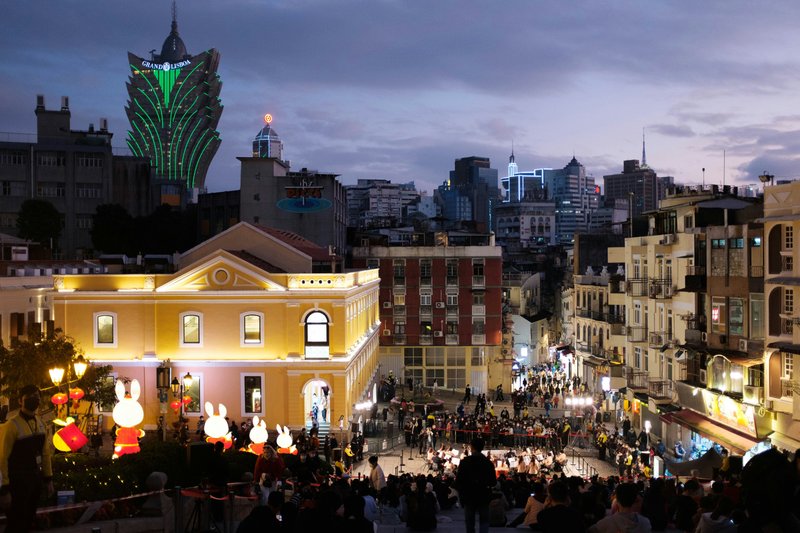
Explore ChinaThe Cotai Strip's integrated resorts rise from reclaimed land between Taipa and Coloane, their towers housing thousands of rooms with views across the Pearl River Delta. The contrast with the Macau Peninsula could not be sharper — here, narrow streets wind past crumbling shophouses in São Lázaro, while colonial-era buildings along Avenida da Praia Grande recall four centuries of Portuguese administration. Properties on the peninsula tend toward heritage conversions and smaller boutique operations, their scale suited to the dense urban fabric.
Taipa Village retains a quieter character, its pastel townhouses now occupied by restaurants and guesthouses that attract travelers seeking distance from the gaming floors. Coloane, the southernmost island, moves slower still — Hác Sá Beach draws weekend crowds, while the village center clusters around the Chapel of St. Francis Xavier. The best tables book weeks ahead during Chinese New Year and the Macau Grand Prix in November, when the city's population effectively doubles and room rates follow suit.