Stéphanie Le Quellec's first solo venture earned two Michelin stars within months, driven by her mission to make haute cuisine generous and story-driven. Each menu unfolds in 'acts' — seven or ten courses showcasing big-boned sauces and a constantly refined signature red mullet. The casual-chic dining room channels a brass-clad cruise liner, while the unorthodox cellar pours Bordeaux grands crus by the glass from magnums and jeroboams.
Explore Paris Gastronomic Restaurant
Grégory Garimbay's vegetable-forward, iodic cuisine earned Bellefeuille both a Michelin star and Green Star within months of his 2024 arrival at this 1892 château. His signature langoustine appears twice—once in hot consommé, once raw in herbaceous oil pressed from the claws—while spring asparagus and ris de veau showcase produce from the estate's 45-hectare Clos de Nonville garden. Laura Gonzalez's 2021 renovation transformed the 30-cover dining room into a contemporary winter garden beneath panoramic botanical wallpaper.
Yannick Alléno commands this three-star institution in the Jardins des Champs-Élysées with a radical mastery of extractions and fermentations, producing sauces of rare intensity—what he calls the verb of French cuisine. La Conciergerie service tailors each visit in advance, while signature preparations like langoustine with shell extraction and caviar enriched by modernized beurre blanc unfold beneath soaring windows overlooking the avenue. A technical tour de force rooted in classical tradition.
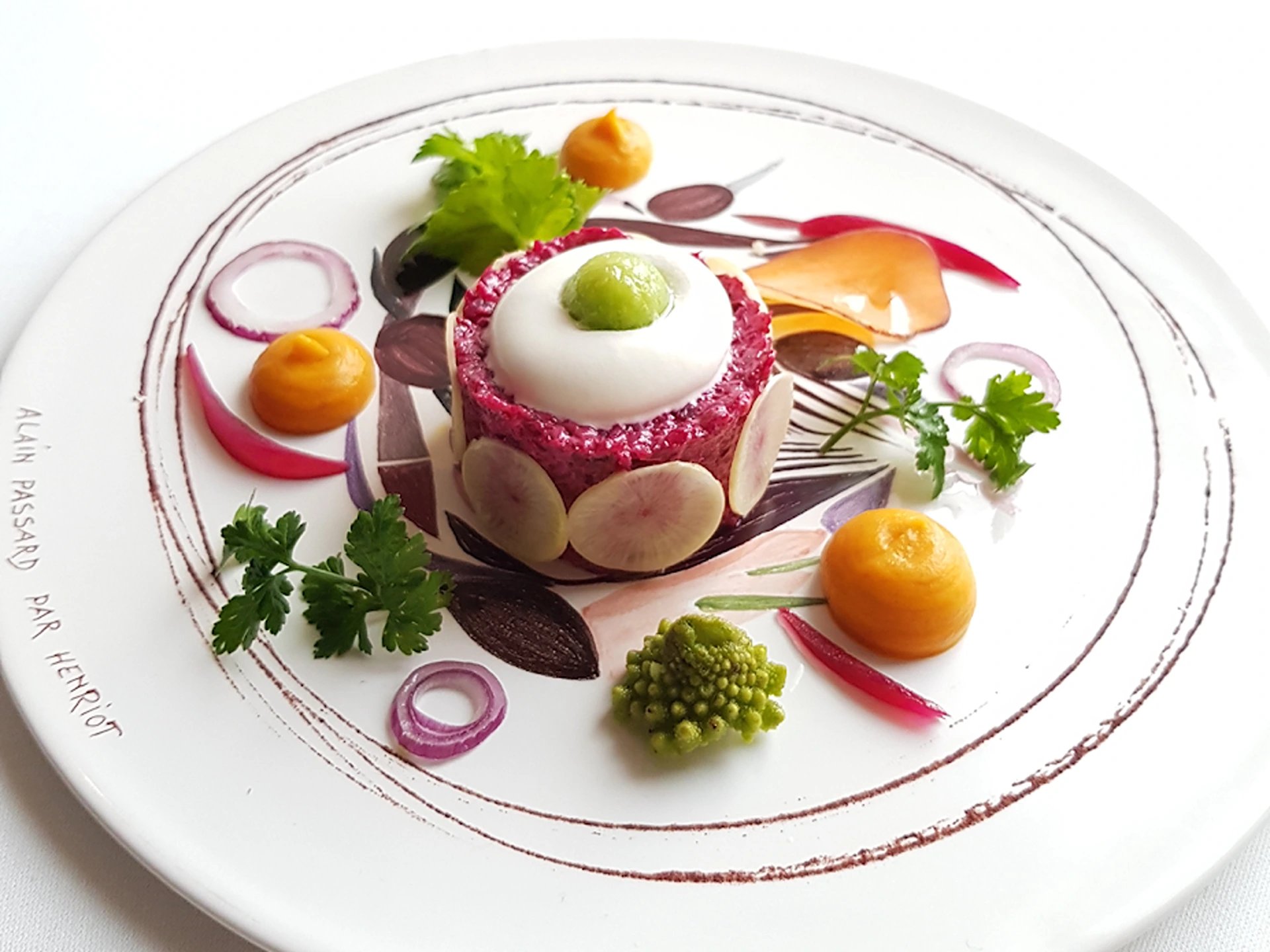
Alain Passard's three-Michelin-starred temple to vegetables near Les Invalides operates entirely without animal protein, sourcing daily from the chef's own kitchen gardens in western France. Signature techniques—beechwood-smoking potatoes, flambéing onions, baking beets in salt crust—apply meat-cooking methods to ultra-fresh produce. The result: ravioli in herb broth, radish sushi, and trompe-l'œil vegetable merguez that convert even dedicated carnivores. Green Star recognition confirms Passard's role as pioneer of the agriculteur-cuisinier movement.
Kei Kobayashi brings kaiseki precision to French haute cuisine in this discreet dining room near Les Halles, earning three Michelin stars for his virtuoso technique. Trained under Gilles Goujon and Alain Ducasse, he crafts flawlessly executed plates—lobster smoked over binchotan with sweet pepper, Vendée pigeon lacquered in red miso, aged Galician beef with sabayon-béarnaise—each dish supremely legible yet complex, marrying Japanese rigour with Parisian sophistication.
Bernard Pacaud's storied triple-Michelin-starred table on Place des Vosges has held its distinction since 1986, now helmed by Shintaro Awa, formerly of Le Bristol. Antique mirrors and tapestries frame a cuisine of unadorned excellence: île flottante with Alba white truffle, lobster fricassée spiked with devil sauce, ris de veau à la grenobloise. The approach is timeless rather than trendy, each plate revealing the essence of impeccable seasonal ingredients within black-and-white marble surroundings.
Christian Le Squer's three-Michelin-starred table at the Four Seasons George V channels the chef's Breton heritage through virtuoso technique: lait ribot with caviar and sea bass, salted butter enriching lobster. His timeless, modern cuisine unfolds beneath gilded mouldings and monumental floral arrangements, while pastry chef Michael Bartocetti closes each meal with nature-inspired desserts that favour fruit and honey over sugar—a meticulous, near-perfect service completing the experience.
Jérôme Banctel's three-starred table inside La Réserve's Napoleon III mansion delivers a culinary manifesto built on contrast: Breton iodine versus earthy depth, tart acidity against bitter undertones. His two tasting menus—'Virée' honoring Brittany with abalone and Kristal caviar, 'Périple' spanning Japanese katsuobushi dashi and Turkish limewater technique—unfold amid Jacques Garcia's Spanish gilt leather and Versailles parquet. Full-bodied sauces of remarkable concentration anchor each dish, justifying the grandest occasions.
Arnaud Donckele's three-Michelin-starred table inside Cheval Blanc earned its constellation in a single season, a rare feat built on his mastery of sauces—complex reductions he calls 'absolus' that blend up to twelve ingredients. The Symphonie menu weaves Norman and Mediterranean influences through dishes like rabbit infused with alexanders and sole napped in savory jus, while Maxime Frédéric's desserts strike a delicate balance between sweetness and restraint in the luminous first-floor dining room.
Arnaud Faye's three-star table at Le Bristol favors minimalist precision over ornamental flourish, delivering light yet intensely concentrated sauces and heirloom-wheat bread baked in-house. Each plate balances refined technique with generous flavor, presented with art-directed elegance in a Louis XVI dining room where mirrors and tall French windows frame the hotel's formal garden. The epitome of modern French gastronomy executed with restraint and purity.
Frequently Asked Questions
Which Paris neighborhoods have the highest concentration of gastronomic restaurants?
+
The 8th arrondissement (around Avenue George V and Place de la Concorde) and the 1st (near the Louvre and Palais Royal) hold many established temples of haute cuisine. However, the 7th near Les Invalides, the 6th in Saint-Germain-des-Prés, and increasingly the 11th around Parmentier have become hotspots for ambitious younger chefs opening more intimate, contemporary gastronomic addresses.
How far in advance should I book a gastronomic restaurant in Paris?
+
For the most celebrated addresses with three Michelin stars, reservations often open two to three months in advance and fill within hours. One- and two-star establishments typically require three to six weeks' notice for dinner, though lunch slots are more accessible. Midweek bookings are easier to secure than Friday or Saturday evenings, and January through March sees less competition for tables.
What is the typical price range for a tasting menu at a top Paris gastronomic restaurant?
+
Tasting menus at one-star establishments generally range from €150 to €250 per person without wine. Two-star addresses typically charge €250 to €400, while three-star restaurants often start at €400 and can exceed €700 for the full experience with pairings. Lunch menus frequently offer exceptional value, sometimes presenting the same kitchen's work at 40-50% lower prices than dinner service.
Nearby Destinations
Explore FranceThe 8th arrondissement around Avenue Montaigne and the Champs-Élysées remains the traditional stronghold of grande cuisine, where historic dining rooms serve as stage sets for elaborate tasting menus. Yet the real energy has shifted eastward — the 11th near Oberkampf, the upper Marais, and pockets of the 10th around Canal Saint-Martin now harbor a generation of chefs who trained in classical brigades but cook with a looser hand. These are smaller rooms, often with open kitchens, where the boundary between service and spectacle dissolves entirely.
Reservations at the most sought-after addresses require planning weeks or months ahead, though cancellations do surface on platforms like TheFork or through concierges at the best hotels. Lunch services frequently offer the same kitchen at gentler prices. Whether you're drawn to the formality of white tablecloths in Saint-Germain or the raw energy of a counter seat watching a chef plate in real time, the depth of talent here rewards those who explore beyond the obvious names. Pair your gastronomic itinerary with our guide to the best restaurants across all styles.