A 19th-century patrician house near Fribourg's centre provides the refined backdrop for Des Trois Tours, where five- to seven-course set menus showcase modern cuisine pared back to its essentials. Each plate arrives with visual precision, the kitchen's restraint allowing ingredients to speak clearly. Service moves with quiet professionalism through the stylish dining room, while the wine list draws thoughtfully from Swiss and French vineyards.
Beneath street level, a futuristic dining room sets the stage for chef Pierrot Ayer's one-Michelin-starred cooking. A local favorite, Ayer brings expressive generosity to French classics—lamb paired with wild thyme, chard, and pimiento reveals his gift for inspired reinvention. The cheese trolley alone merits attention, while evening service offers a dedicated vegetarian tasting menu for those seeking lighter fare.
Perched in the village of Villarepos overlooking Lake Morat, this one-Michelin-star auberge pairs rustic wainscoting and crisp linens with cooking of genuine virtuosity. The kitchen champions regional produce through dishes like Bresse royal pigeon with creamy polenta, and calf sweetbread braised with morels. Desserts—apple financiers crowned with almond nougatine and Tahitian vanilla ice cream—close the meal with quiet precision.
A protected former cheese dairy provides the atmospheric setting for this Murten address, where bare wooden tables and more refined arrangements coexist with equal ease. The kitchen delivers polished international and regional cooking that draws a devoted local following. Midweek lunch offers exceptional value, and the old-town location rewards diners with medieval lanes to explore afterward.
Behind an elegant façade on Rue du Criblet, La Cène presents modern French cuisine through two rotating set menus: the weekly lunchtime 'Inspiration de la Semaine' offering three to five courses, and the monthly evening 'Éclosion des Sens' extending to seven courses. Creative seasonal dishes arrive in a refined dining room, while monthly wine pairing evenings draw collectors and curious palates alike.
A former apartment turned dining room, its walls hung with paintings, photographs, and sculptures, sets the stage for an energetic chef's market-driven cooking. Lunches follow the day's local produce; evenings shift to elaborate tasting menus built on the same regional foundations. The atmosphere runs warm and lively, matching the kitchen's generous, indulgent approach to modern cuisine.
Chef Maxime Arnold's kitchen delivers inventive plates—beef tartare heightened with black garlic, porcini carpaccio paired with preserved lemon focaccia—all built on fresh regional produce. The dining room channels a musical sensibility through its decor, lending warmth to intimate dinners. An exclusively Swiss wine list complements the creative cooking, while a compact summer terrace offers alfresco drinks as the evening unfolds.
Frequently Asked Questions
What is the Röstigraben and how does it affect dining in Fribourg?
+
The Röstigraben is the cultural-linguistic boundary between French and German-speaking Switzerland, and Fribourg sits directly on it. This means menus often feature both traditions: French-style preparations alongside Germanic influences like rösti. Many restaurants offer dishes in both culinary vocabularies, and staff typically switch between languages effortlessly.
Which Fribourg neighbourhoods are best for restaurants?
+
The Bourg quarter around the cathedral offers the highest concentration of established restaurants in historic settings. Basse-Ville along the river has a more bohemian character with converted industrial spaces. The Pérolles district near the university caters to a younger crowd with more casual but often excellent options.
Is Fribourg's fondue different from other Swiss regions?
+
Fribourg fondue traditionally uses a half-and-half blend of local Gruyère and Vacherin Fribourgeois, creating a creamier, more fluid texture than the Gruyère-Emmental combination common elsewhere. The Vacherin adds a distinct earthiness. Many restaurants source their cheese from specific alpine dairies in the nearby Gruyère region.
Nearby Destinations
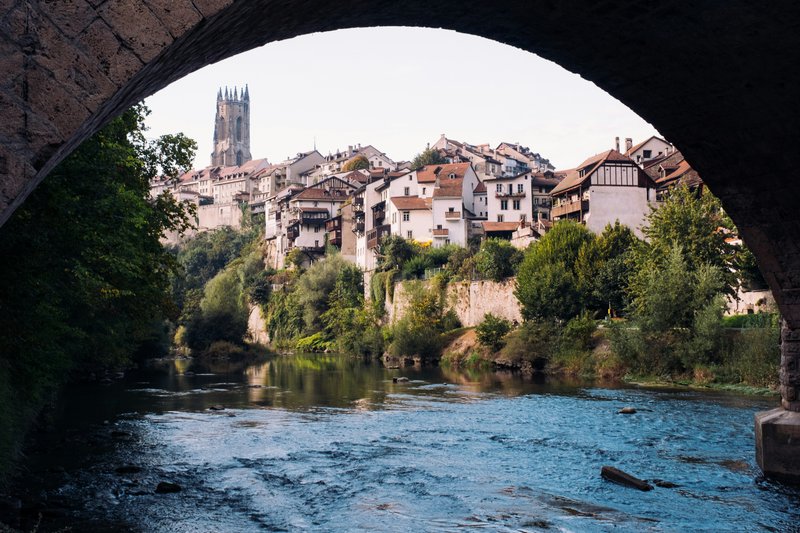
Explore SwitzerlandFribourg straddles a dramatic meander of the Sarine River, its medieval lower town of Basse-Ville connected to the hilltop university quarter by a funicular powered entirely by wastewater. The culinary scene reflects this bilingual city's position on the Röstigraben — the invisible line dividing French and German Switzerland. Fondue here isn't tourist fare but serious business, with local variations using Gruyère and Vacherin from farms less than an hour away.
The Bourg quarter surrounding the 13th-century Cathédrale Saint-Nicolas anchors the dining scene, its cobbled streets lined with vaulted cellars converted into restaurants. Cross the wooden Pont de Berne into Basse-Ville and the atmosphere shifts: former tanneries and mills now house neighbourhood bistros where the clientele switches between French and Swiss German mid-sentence. The city's student population — nearly a quarter of residents attend the university — keeps prices reasonable and quality competitive, an unusual combination for a Swiss cantonal capital.