A vibrant pink Galician villa turned adults-only retreat, Casa Beatnik channels Yves Saint Laurent through interiors mixing French, Italian, and Moroccan influences. Twelve suites and seven luxury yurts surround The Chapel, a signature suite beneath a soaring domed ceiling. Estonian-made Iglusaunas overlook the working vineyard, while chef Marcos Campos runs both the hyper-local Tribu and Silk Road–inflected Bambola restaurants.
Where to Stay
Where to Eat
Perched atop Monte de San Pedro, where historic artillery batteries once guarded the estuary, Árbore da Veira commands sweeping views of both A Coruña's cityscape and the Atlantic expanse. Chef Luis Veira channels his Galician roots into one-starred contemporary cooking that pivots between sea and mountain—think foie gras paired with cherry gelatine and basil. Three tasting menus (Semente, Raíces, Árbore) trace his Atlantic obsession from seedling to full bloom.
Juan Carlos Ochando and Elena Pérez brought their training from Atrio, Casa Marcial, and Bardal back to this unassuming corner of Seville province, earning a Michelin star for their seasonal contemporary cooking. Two tasting menus showcase precise technique—white prawn tartare with cashew ajoblanco, a refined red mullet bouillabaisse, and a playfully deconstructed piña colada that closes meals with textural wit. Half-portions allow flexibility without compromising ambition.
Four generations of the same family have run this seafood institution since 1923, when great-grandmother Jesusa first opened its doors. Chef Miguel Ángel Campos now commands the open-view kitchen, turning out traditional Galician preparations with subtle modern inflections—gratin of turbot with greens, pan-fried sole dusted in cornflour. Two elegant dining rooms and a summer terrace accommodate those seeking impeccable regional fish cookery near A Coruña.
Near A Coruña's fish market, Bido presents contemporary Galician cooking in a sleek designer space that belies its traditional roots. The kitchen earns a Michelin Plate for dishes like grilled lamb loin paired with braised neck, Queso do Cebreiro, and an avocado-pea guacamole—bold combinations executed with precision. Two tasting menus with wine pairings anchor the experience, while half-portion options allow broader exploration of the carte.
A converted railway station in O Burgo now houses this shrine to beef, where two Argentine brothers with Galician heritage showcase their craft. Glass-fronted ageing chambers display prime cuts like gallery pieces—veal, cow, and select beef at various maturations. The kitchen keeps things elemental: charcoal-grilled ribeye, minimal starters featuring steak tartare and cecina croquettes, letting exceptional meat speak for itself.
Chefs Paco Chicón and Sergio Musso reinvent Eclectic annually around a fresh conceptual theme—this year's 'the Collectors' unfolds across four menus exploring marine depths, land-sea crossings, and comprehensive local sourcing. The intimate space, designed to feel like a private residence, features a pass-through kitchen and rotating contemporary art. A carbon-neutral commitment underscores the creative ambition.
Since 1970, this family-run restaurant inside Hotel Ego has built its reputation on Nito himself selecting the day's catch at Celeiro and Burela fish auctions. The kitchen transforms pristine Galician seafood into refined preparations—lobster salpicón, squid braised in its ink, seasonal tuna roll. A modern terrace frames panoramic views across Area beach to distant mountains, matching the coastal simplicity of the cuisine.
Named for owner Daniel López's local nickname, O Camiño do Inglés operates from an open kitchen near Ferrol's port, sending out contemporary plates rooted in Galician tradition yet threaded with Peruvian, Japanese, and Italian accents. Three tasting menus—Magdalena, Medio Camino, Do Patrón—offer structured exploration, while half-portions announced tableside encourage broader sampling across the inventive carte.
Overlooking Plaza de María Pita, this spare dining room holds only a sushi bar and a glass-fronted aging cabinet—nothing else. Vigo-born chef Adrián Figueroa, renowned for his precise knife work and mastery of tuna, serves a single omakase menu shaped by the morning auction. Guests may add eel or crayfish; the rest unfolds at the chef's discretion, one exacting course at a time.
Overlooking A Coruña's waterfront promenade, Salitre delivers an uncompromising celebration of Galician tradition. The kitchen channels regional ingredients into deeply satisfying preparations—rich caldeirada de pescado laden with the day's catch, and savoury rice dishes that have earned loyal followings among locals and visitors alike. A Michelin-recognized address for travellers seeking authentic coastal Galician cooking without pretense.
Frequently Asked Questions
What is the best area to stay in A Coruña?
+
The Ciudad Vieja offers proximity to historic monuments and traditional restaurants, while the Ensanche provides elegant nineteenth-century architecture and easy access to both beaches and the glazed promenade of Avenida de la Marina.
When is the best time to visit A Coruña?
+
Late spring through early autumn brings mild Atlantic weather and outdoor terrace season. August sees the city's Fiestas de María Pita, with concerts and fireworks. Winter remains temperate by northern European standards, though expect frequent rain.
What seafood specialties should I try in A Coruña?
+
Percebes (goose barnacles) harvested from Galicia's Costa da Morte, centollo (spider crab) served cold with its own coral, and navajas (razor clams) grilled a la plancha represent the region's prized shellfish. The Pescadería district specializes in these preparations.
Nearby Destinations
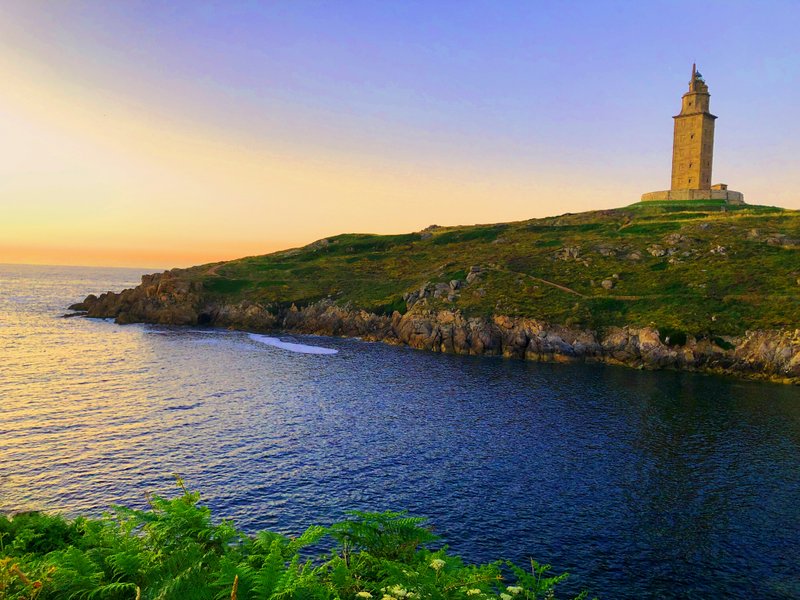
Explore SpainA Coruña wraps around its own peninsula, the Atlantic visible from nearly every quarter. The Ciudad Vieja clusters beneath the Romanesque churches of Santiago and Santa María, its narrow streets opening onto the Plaza de María Pita. Beyond, the Ensanche grid runs with rational nineteenth-century purpose toward the Jardines de Méndez Núñez and the iconic glass-galleried waterfront along Avenida de la Marina—claimed to be Europe's largest concentration of glazed façades. The Orzán and Riazor beaches stretch along the western shore, backed by a promenade that continues north to the Tower of Hercules, the only functioning Roman lighthouse still standing.
The city's dining culture reflects Galicia's fishing heritage. The Pescadería district delivers spider crab, goose barnacles, and razor clams direct from the Lonja fish market to tables within the hour. Along Calle de la Franja and Calle Estrella, pintxos bars operate at a rhythm set by vermouth hours and late suppers. The hotel scene favors converted heritage buildings and contemporary waterfront properties; the café and bar circuit runs from wood-paneled tertulias to design-forward cocktail rooms in the Ensanche.