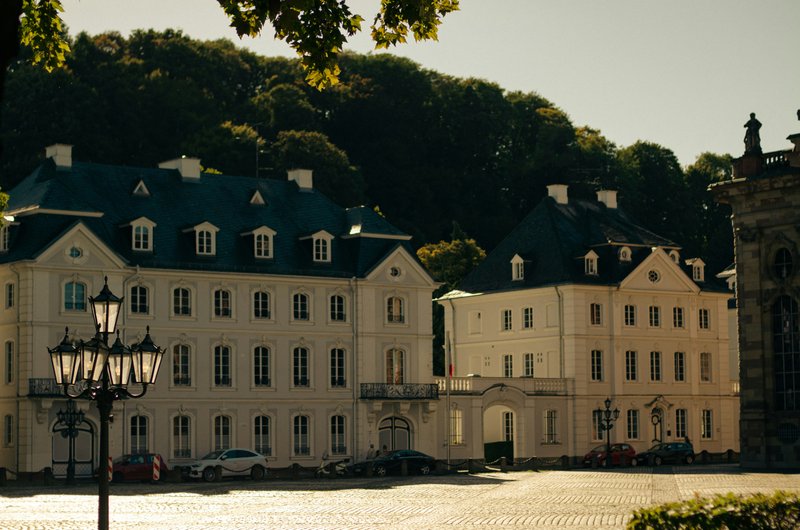
A remodeled villa near the Saar river, La Maison channels the Franco-German heritage of this border region through eclectic artwork and design-forward interiors. The 55 light-filled rooms feature warm wood floors and city views, while a boldly minimalist new annex adds architectural contrast. Manicured gardens and terraces offer grounded retreats, and pet-friendly policies welcome four-legged companions throughout the boutique property.
Explore Saarland
Where to Stay
Sprawling along the shores of Bostalsee lake, this 100-room spa retreat draws wellness devotees to its remarkable 2,700-square-metre facility featuring a Celtic sauna village. Guests drift between indoor and outdoor pools before exploring the adjacent Saar-Hunsrück Nature Park on complimentary bicycles. The all-inclusive approach covers full spa access, making it ideal for those seeking immersive relaxation in a pristine lakeside setting.
At the confluence of Germany, France, and Luxembourg, this riverside property splits across two buildings: a Roman villa with gilded headboards and antiquity-inspired art, and a Renaissance castle where jewel-toned canopies drape the beds. The Roman bath-inspired spa features jacuzzi and sauna, while dining spans Italian, French-Japanese, a beer garden, and a Caesar-themed wine bar amid surrounding vineyards.
Where to Eat
Christian Bau's three-Michelin-starred table in Perl orchestrates a singular dialogue between French technique and Japanese precision. The Paris–Tokyo tasting menu might pair pristine tuna tartare with Imperial caviar, daikon, and a seaweed-ginger vinaigrette, each element placed with surgical intent. His signature bau.stein dessert closes the experience with pandan, exotic fruits, and coconut-yuzu ice cream. Regional Moselle and Saar wines complete the picture; overnight stays at the adjacent Schloss Berg extend the indulgence.
Martin Stopp, formerly of LOUIS in Saarlouis, orchestrates two distinct tasting menus at this two-Michelin-starred table: the ingredient-focused 'Menü für die Seele' and the inventive 'Menü für die Sinne,' where combinations like veal with unagi, pea ash, and myoga showcase his boundary-pushing creativity. The chef and his team deliver courses personally, while formats range from three-course lunch to seven-course evening progressions.
Chef Sebastian Sandor orchestrates a seven-course dialogue between French technique and Japanese precision at this two-Michelin-starred table housed in a former courtroom. Black cod grilled over Binchotan charcoal arrives pearlescent, finished tableside with spices and paired with silken calf's head and lettuce jus. Sommelier Robert Jankowski guides wine selections with scholarly ease beneath the villa's soaring ceilings.
Cliff Hämmerle earned his Michelin star through a philosophy of regional devotion—vegetables and Saarland produce drive a menu that balances classical technique with inventive flourishes. The intimate chef's table seats just twelve, where the kitchen brigade works in full view, narrating each of seven courses. A vegetarian tasting menu and expert wine pairings reward those who linger, while family-run warmth pervades every detail.
Through the glass-fronted conservatory of this one-Michelin-star address in Bliesen, the imposing St Remigius church dominates the view—a dramatic backdrop for chef Patrick Jenal's cooking. The Kunz family offers two set menus alongside à la carte options, moving between classic French preparations like wild-caught red shrimp carpaccio and their celebrated Wiener schnitzel from saddle of suckling veal, executed with outstanding ingredients.
Chef Peter Wirbel has built a devoted following at this Michelin-starred address on Sankt Ingbert's industrial outskirts. His French cooking draws on regional produce, yielding dishes of precise balance and clear flavor. Tuesdays bring an eight-course surprise menu; Wednesday through Saturday, the four-to-seven-course 'midi' format takes center stage. Wirbel himself often visits tables to explain his culinary philosophy—an intimate touch in an otherwise modern, understated setting.
A former 1877 brewery now houses the Dauphin family's creative French table, where chef Florian crafts seasonally driven menus—the four-course Découverte or more expansive six-course Signature—within spaces mixing original industrial character with contemporary refinement. Lorena-Jil orchestrates the dining room with polished warmth. A courtyard entrance leads to a terrace; six artist-designed rooms allow guests to extend the evening into an overnight stay.
The Hämmerle family's Bib Gourmand establishment delivers honest seasonal cooking in a warm country-house setting just outside Blieskastel. Local produce drives a menu that swings from textbook Wiener schnitzel to herb-crusted sea bass with Mediterranean accents. Service is attentive without fuss, and the summer terrace adds pastoral charm. Book ahead—regulars fill tables quickly at this beloved Saarland address.
A 13th-century monastery complex in the remote Bliesgau countryside provides the atmospheric setting for this elegant dining room. The kitchen's signature—a dry-aged pork chop matured twenty-one days on the bone, paired with sage and Serrano ham—exemplifies the ingredient-driven approach. Guests choose between meat-focused or vegetarian set menus, though à la carte remains available. In warmer months, a tree-shaded terrace offers pastoral calm.
Frequently Asked Questions
What makes Saarland's cuisine different from other German regions?
+
Saarland's position on the French border has shaped a distinctive culinary identity. Dishes like Geheirade (a creamy beef stew) and flammkuchen reflect Alsatian influence, while the Schwenkbraten tradition — meat grilled on a swinging grate over open flames — remains uniquely Saarlandish. French wine, cheese, and baking techniques appear naturally in local kitchens.
Which areas should visitors explore beyond Saarbrücken?
+
The Bliesgau region southeast of the capital rewards exploration with its orchid meadows, half-timbered villages like Blieskastel, and farm-to-table restaurants. Mettlach on the Saar Loop offers dramatic river views and the historic Villeroy & Boch ceramics complex. The former mining town of Völklingen provides industrial heritage turned cultural attraction.
When is the best time to visit Saarland?
+
Late spring through early autumn brings the most pleasant conditions for exploring the Saar River valley and biosphere reserves. Summer sees outdoor festivals and Schwenker grilling season at its peak. Autumn delivers wine harvest celebrations and forest hikes through golden beech woods. Winter transforms Christmas markets in Saarbrücken's old town into atmospheric gatherings.
Nearby Destinations
Explore GermanyGermany's smallest federal state packs considerable character into its compact borders. The capital Saarbrücken anchors the region with its Baroque architecture along the Saar River, the St. Johanner Markt square buzzing with café life, and the Deutsch-Französisches Garten reflecting centuries of Franco-German cultural exchange. Beyond the city, the Bliesgau UNESCO Biosphere Reserve offers rolling orchards and traditional villages where time moves at a gentler pace.
The culinary scene draws heavily on French influence — unsurprising given the border sits just minutes away. Local specialties include Dibbelabbes (a hearty potato dish baked in cast iron), Schwenker grilled over beechwood flames, and Lyoner sausage served in countless variations. Wine enthusiasts find unexpected pleasures in the Mosel-adjacent vineyards, while the industrial heritage of former coal and steel towns like Völklingen — its ironworks now a UNESCO World Heritage Site and cultural venue — provides striking backdrops for contemporary dining concepts.