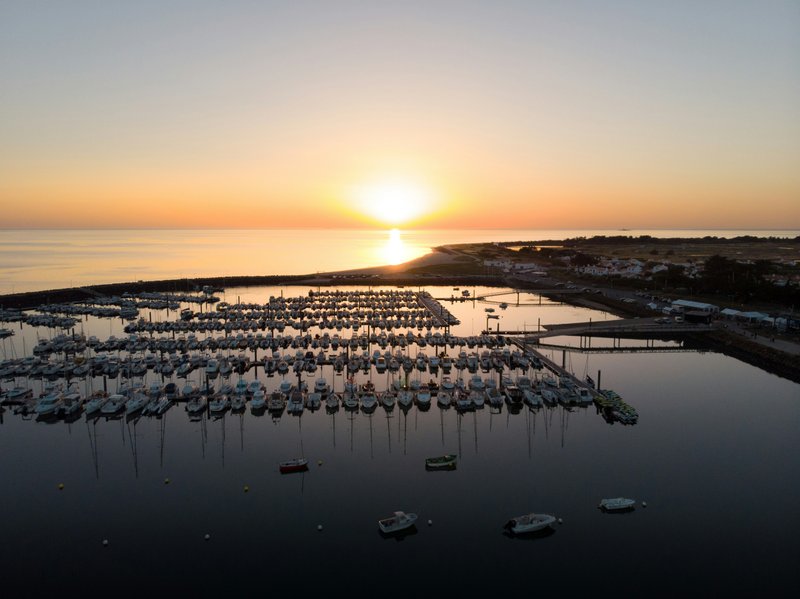
On the working port of Herbaudière, where his father once fished for shrimp, Alexandre Couillon commands three Michelin stars with a cook's intuition for fire and tide. Mackerel arrives charcoal-grilled alongside candied beetroot; lettuces emerge flame-kissed with elderflower vinegar. Vegetables grow steps away in his kitchen garden, seafood comes from sustainable local waters, and the Green Star confirms an operation as rooted as it is refined.
Aurore and Sébastien Duchenne have built their reputation on meticulous sourcing—often organic, always regional—letting market rhythms dictate each day's menu. The kitchen handles local oysters, John Dory, and royal Charmilles pigeon with precision, plating them elegantly against a backdrop of blue-and-white walls hung with contemporary art. A polished address for seafood-focused traditional cooking on the island.
A fishmonger's counter and a dozen seats facing a glass-walled cellar: Élise strips the seaside table down to essentials. The daily haul from L'Herbaudière's market arrives each morning, destined for the charcoal grill that anchors this minimalist space. Céline and Alexandre Couillon keep the menu lean—individual plates, a few sharing dishes—letting smoke and salt speak for the Atlantic.
A cheerful bistro atmosphere greets diners at this Bib Gourmand address, where shelves stocked with fine provisions hint at the kitchen's resourcefulness. The signature Fujiyama oyster anchors a menu that drifts confidently between French tradition and North African-Asian accents—seasonal vegetable tajine, pristine catch of the day. The conservatory and terrace add charm, while 'A Night in Essaouira,' a date-and-honey dessert, delivers a memorable finale.
Surrounded by the serene marshlands near Noirmoutier, this contemporary table showcases a young chef's inventive approach to Vendée's coastal bounty. White mullet appears as ceviche brightened with rhubarb tartness—a preparation as rare as the fish itself—while line-caught pollack arrives alongside crisp French peas and a cherry condiment that bridges savory and sweet. The terrace offers an ideal perch for unhurried summer lunches.
Deep in the Marais Breton marshlands, chef Mathieu Blanchet and partner Pauline Merceron run this minimalist dining room where guests sit at a long pale-wood counter facing the open kitchen. The seasonal menu draws on local produce for inventive compositions—courgette panna cotta with lemon condiment, skate wing terrine paired with leek maki and black sesame. Lunch brings accessible set menus; evenings unfold through a tasting format.
Red Skai banquettes and worn wooden floors set the scene at this spirited bistro beneath the Château de Noirmoutier, where a Lyon-born couple channels the convivial energy of a bouchon lyonnais on island soil. The frequently changing set menu pairs Lyonnaise charcuterie with Vendée specialties, delivering honest regional cooking at accessible prices in a buzzy, mirror-lined room that rewards casual drop-ins.
Frequently Asked Questions
When can you cross the Passage du Gois to Noirmoutier?
+
The Passage du Gois is passable approximately 1.5 to 2 hours on either side of low tide, twice daily. Crossing times shift with the lunar calendar and are posted locally. The bridge offers year-round access regardless of tides.
What is Bonnotte potato and why is it specific to Noirmoutier?
+
Bonnotte is a small, early-harvest potato variety cultivated exclusively on Noirmoutier in sandy soil amended with seaweed. Harvested by hand each spring in limited quantities, it has a delicate, slightly sweet flavour prized by chefs throughout France.
Which areas of Noirmoutier have the best beaches?
+
The Bois de la Chaise on the island's northeastern shore offers sheltered coves and pine-backed beaches with calm, clear water. Plage des Dames remains the most established, while the western Atlantic-facing beaches near L'Épine suit those seeking longer stretches and stronger surf.
Nearby Destinations
Explore FranceConnected to the Vendée mainland by the Passage du Gois — a causeway that disappears twice daily under the tide — Noirmoutier exists at the edge of things. The island stretches twelve kilometres through salt marshes, pine forests, and white-sand beaches, its landscape shaped by Atlantic winds and the patient work of sauniers harvesting fleur de sel. The main town clusters around a 12th-century château and the Quartier Banzeau, where low whitewashed houses with blue shutters line narrow streets.
The island's culinary identity draws from its position between ocean and marshland. Local tables feature Bonnotte potatoes — an early-harvest variety grown only here in seaweed-enriched soil — alongside oysters from the Baie de Bourgneuf and Atlantic sole landed at L'Herbaudière. The dining scene concentrates in Noirmoutier-en-l'Île and the port villages, while accommodations range from converted manor houses to contemporary addresses facing the Bois de la Chaise beaches.



