Built upon the ruins of the ancient Carsac Oppidum, this 19th-century manor sits barely a mile from Carcassonne's medieval walls, its foundations resting on Carolingian abbey cellars. Three generations of the Rigaudis family have cultivated the estate, where a 300-year-old park surrounds an 18-hole golf course. Chef Philippe Deschamps commands the gastronomic restaurant, while the bistrot serves the original local cassoulet recipe.
Where to Stay
Behind Carcassonne's thirteenth-century ramparts, this MGallery property occupies a position of rare privilege—the Romanesque Château Comtal and Gothic Basilica of Saint-Nazaire mere steps away. Rooms dressed in antique furniture and stained glass open onto balconies surveying the fortifications. The Michelin-starred Barbacane delivers cassoulet worth crossing France for, while a seasonal pool and library bar with piano complete the medieval fantasy.
Seventeen rooms occupy this family-run boutique property positioned directly beneath Carcassonne's fortified walls. The sculpture garden showcases local artists, while the castle-facing terrace bar offers aperitifs with medieval ramparts as backdrop. A heated outdoor pool operates alongside an indoor pool and year-round hot tub; the spa's Turkish bath and steam rooms provide genuine restoration. Pet-friendly and suited to couples seeking proximity without crowds.
The Gallinier sisters have carved out something unexpected in Carcassonne's Trivalle district: a starkly modernist bed and breakfast just steps from Pont-Vieux and the medieval ramparts. With only five rooms and one apartment, Bloc G operates in the intimate territory between guest house and boutique hotel. The minimalist interiors serve as a visual reset—a contemporary counterpoint that sharpens appreciation for the fortified city beyond its doors.
Five rooms occupy this medieval village house in the Malepère hills, where traditional stone architecture meets understated contemporary furnishings in muted tones. A garden apartment offers private quarters with kitchenette; the main house draws guests to its conservatory and wood-burning salon. Handmade mattresses, Aesop amenities, and proximity to Carcassonne's citadel and regional wine routes suit travelers seeking rustic refinement without pretense.
Seven rooms and suites occupy this intimate property born from Franck Putelat's celebrated restaurant, where creative tasting menus draw gastronomic pilgrims to medieval Carcassonne. Interiors balance modern sophistication with earthy textures—bearskin rugs, carved wooden furniture, nature-inspired art—while each accommodation opens onto a private terrace overlooking the old ramparts. Several suites include private Jacuzzis, and a wine cellar rewards those inclined to linger.
Where to Eat
At the foot of Carcassonne's medieval ramparts, chef Franck Putelat commands a two-Michelin-starred kitchen where regional traditions meet inventive technique. His signature cassoulet—reimagined with squab supreme and pigeon leg sausage—draws from a prolific on-site vegetable garden that supplies much of the menu. Seven Japanese-inspired rooms with private terraces allow guests to extend the evening beyond the impeccable tasting menus.
Stained-glass windows and heraldic wainscoting set the stage inside this neo-Gothic dining room, part of an early twentieth-century hotel built on the former episcopal palace grounds. The kitchen draws on Languedoc's coastal waters for Mediterranean fish and shellfish, pivoting to wild game and forest mushrooms when autumn arrives. Classical French technique underpins each plate, refreshed with modern inflections that honor regional terroir.
Chef Jean-Marc Boyer forages wild garlic and aromatic herbs from hillside walks near the Montagne Noire, channeling these finds into a single surprise-driven tasting menu. Expect wild asparagus paired with local morels, Banka trout alongside lomo bacon and broad beans. Régis Dho's Japanese-inflected dining room mirrors the kitchen's clarity. One Michelin star. Allow time—this experience unfolds at its own deliberate pace.
Three generations of the Rigaudis family have shaped this nineteenth-century estate, built over the cellars of a Carolingian Abbey on the ancient Carsac oppidum where Carcassonne's story began. The kitchen honors local tradition with the original 'Dieu le Fils' cassoulet recipe while threading modern accents through classical French technique. On warm evenings, the terrace overlooking a three-hundred-year-old park sets a scene of unhurried, deeply rooted elegance.
A former sous-chef from Franck Putelat's acclaimed kitchen now commands this modern brasserie on Boulevard Barbès, bringing rigorous technique to hearty Languedoc classics. The house pâté en croûte arrives with textbook precision, while the cassoulet delivers deep, slow-cooked satisfaction. A shaded terrace offers respite from Carcassonne's summer heat. Reservations prove essential at this Michelin-recognized address.
A modern roadside address on the route to Toulouse, L'Ambrosia delivers precise, thoughtfully composed cooking built around premium ingredients—seabass, sweetbread, langoustine—handled with evident care. The kitchen's approach favors contemporary tastes without sacrificing coherence, each plate reflecting meticulous technique. For travelers exploring the Carcassonne region, this represents genuine value: refined cuisine at accessible prices in an unfussy setting.
A Michelin Plate within the medieval walls, La Table d'Alaïs offers refuge from the tourist-trap dining that plagues the Cité. The kitchen navigates between tradition and modernity with precision: a 64-degree egg arrives with truffle and mushrooms, while the cassoulet stays faithful to Castelnaudary orthodoxy—proper beans, proper confit. The courtyard terrace rewards those who climb the stairs on warm evenings.
Chefs Fabien de Bruyn and Valentin Renaud champion what they call 'avant-garde country fare' at this Bib Gourmand table in medieval Lagrasse, thirty minutes from Carcassonne. The open kitchen frames a communal counter or intimate upstairs room, where Corbières-Minervois terroir takes inventive form: œuf parfait with truffle and Cyril Codina's artisan vinegar, dark chocolate entremet laced with juniper and blackcurrant, buffalo milk ice cream. A spacious terrace offers tapas for lighter grazing.
A converted mill on the banks of the Canal du Midi, Le Moulin de Trèbes offers terrace dining with water views just minutes from Carcassonne. The kitchen delivers straightforward modern cooking, with caramelised calf sweetbreads alongside sesame and braised endives earning signature status. Local wines, thoughtfully chosen, complement the relaxed canal-side setting—ideal for unhurried afternoons in the Languedoc sun.
Frequently Asked Questions
What is the difference between staying in the Cité and the Bastide Saint-Louis?
+
The Cité offers atmospheric accommodation within the medieval walls, with cobblestone streets and rampart views, though it empties of day-trippers by evening. The Bastide Saint-Louis, the lower town built in 1260, provides easier access to everyday amenities, the covered market, and a more authentically local atmosphere with its tree-lined squares and café culture.
When is the best time to visit Carcassonne?
+
May and September offer warm weather without the peak summer crowds. July brings the Festival de Carcassonne, with concerts staged against the illuminated ramparts. The Bastille Day fireworks on July 14th transform the entire Cité into a spectacle. Winter reveals the fortress at its most atmospheric, often shrouded in mist rising from the Aude valley.
What local wines should visitors seek out in Carcassonne?
+
The surrounding Languedoc appellations deserve attention: Corbières produces robust reds from Carignan and Syrah, while Minervois offers increasingly refined expressions of Mourvèdre. Limoux, just south, makes Blanquette and Crémant — sparkling wines predating Champagne by a century. Many domaines welcome visitors for tastings, particularly along the Route des Vins.
Nearby Destinations
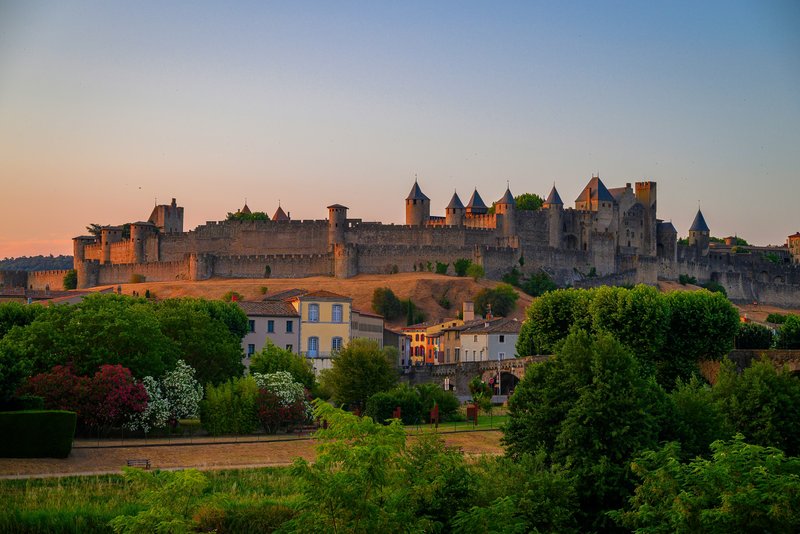
Explore FranceThe Cité, that extraordinary fortress crowning its hilltop above the Aude River, has drawn travelers since the Visigoths fortified it in the fifth century. Today's visitors find accommodation both within the ramparts — where a handful of properties occupy medieval structures with views across fifty-two towers — and in the Bastide Saint-Louis below, the thirteenth-century planned town with its grid of shaded squares and Belle Époque facades. The Canal du Midi traces the city's eastern edge, its towpath lined with plane trees planted under Louis XIV.
Dining here reflects the terroir of the Languedoc: cassoulet remains the essential dish, each restaurant guarding its own proportions of Toulouse sausage, duck confit, and white beans. The wine lists draw heavily from nearby Corbières, Minervois, and Limoux — the last producing sparkling Blanquette centuries before Champagne existed. Summer evenings bring locals and visitors alike to café terraces along Place Carnot, while the medieval city's narrow streets reveal candlelit restaurants set within ancient stone vaults.