Bill Bensley's French-Lao fantasy unfolds along the Nam Dong River, where luxury tents and teak villas sit among Buddhist temples and wandering buffalo. The colonial-style Great House delivers Lao-French fusion with river fish and just-picked herbs, while Sense spa disappears into jungle canopy—tented treatment rooms drawing on northern Lao healing traditions. Couples should book the private waterfall dinner, candlelit above rushing waters.
A former French colonial administration building with distinctive red roofing, Amantaka brings Aman's exacting standards to old-town Luang Prabang. The 24 suites feature outdoor living spaces and private pools set amid mango and palm gardens. A spa draws on traditional Lao therapies, while the restaurant showcases regional cuisine from local ingredients. Temple visits and Mekong cruises extend the immersion for travelers seeking spiritual depth alongside physical comfort.
Luang Prabang's original luxury address pioneered the revivalist Indochinese aesthetic that now defines the city's hospitality scene. Thirty-four rooms wind through lush gardens, each with private terraces and day beds overlooking forested mountains. The intimate scale extends to a spa with sauna and jacuzzi, an outdoor pool, and a restaurant pairing refined Laotian dishes with European preparations—an elegant retreat suited to travelers seeking colonial-era romance with contemporary comfort.
Three UNESCO-listed heritage buildings—once a royal residence, later an ice-cream factory—now form this 15-room boutique hotel at the epicenter of Luang Prabang's Old Quarter. Architect Pascal Trahan's restoration preserved torchis plasterwork and clay-tile roofing, while interiors feature dark exotic woods and king-size four-posters with private terraces. Complimentary bicycles encourage exploration of nearby temples and the dawn tak bat ceremony; evenings wind down at Bar Mango 3 with rice wine moonshine beneath the garden's mango trees.
The childhood residence of Laos's last prince now houses this 31-room boutique retreat, its original structure preserved as a monument to Indochine elegance. Antiques and artworks fill colonial-luxe interiors, while outside, lily-strewn ornamental ponds lead to two swimming pools and a spa complete with sauna, jacuzzi, and steam rooms. The terrace restaurant overlooks these gardens, and the Mekong River and night market wait just beyond.
Architect Duangrit Bunnag transformed a century-old governor's residence into 23 suites where French Colonial bones meet contemporary Lao design. Private gardens frame each room; some include plunge pools. The cherry-tiled main pool sits amid mature palms, while an on-site cooking school and proximity to sister property 3 Nagas expand dining possibilities. A contemplative retreat for architecture-minded travelers seeking seclusion minutes from the old town.
A former organic farm on the Nam Khan River banks, this ecolodge offers accommodations ranging from glamping tents to glass-walled villas with outdoor tubs and full kitchens. Staff gather herbs from the surrounding gardens for the farm-to-table restaurant, while guests drift between the thatched-roof pool bar, open-air spa with steam rooms, and riverfront yoga pavilion. Kayaking, bamboo weaving, and regular shuttles to UNESCO-listed Luang Prabang complete the offering.
Frequently Asked Questions
When is the best time to visit Luang Prabang?
+
November through February offers cooler, dry weather ideal for temple visits and river excursions. The hot season from March to May sees temperatures climb above 35°C. The monsoon months of June through October bring afternoon downpours but fewer visitors and lush green landscapes.
What is the alms-giving ceremony and how should visitors participate?
+
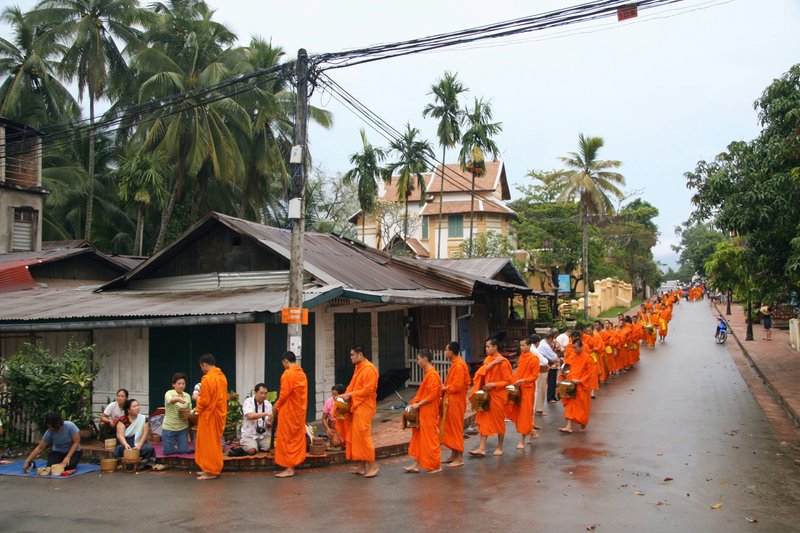
Each morning before dawn, monks from the town's thirty-odd temples walk barefoot collecting sticky rice from kneeling residents. Visitors may participate but should dress modestly, maintain silence, keep a respectful distance, and offer only plain sticky rice — not sweets or packaged goods that disrupt the ritual's meaning.
How do you reach Luang Prabang from other Southeast Asian cities?
+
Luang Prabang International Airport receives direct flights from Bangkok, Hanoi, Siem Reap, and Chiang Mai. The Laos-China Railway, opened in 2021, connects the town to Vientiane in two hours and to Kunming. Slow boats from the Thai border at Huay Xai take two days downstream on the Mekong.
Luang Prabang occupies a narrow peninsula where the Mekong and Nam Khan rivers converge, its gilded temple spires rising above a grid of French colonial shophouses and teak-stilted Lao homes. The old town, a UNESCO World Heritage site since 1995, remains remarkably intact — saffron-robed monks collect alms at dawn along Sakkaline Road, while the night market unfurls each evening on Sisavangvong. The pace here is unhurried, measured by temple bells and the slow drift of longtail boats.
Hotels cluster along the riverbanks and within the peninsula's historic core, many converted from colonial-era buildings or traditional Lao compounds. The dining scene stays modest in scale but draws on exceptional raw materials — Mekong river weed, buffalo skin, herbs from morning markets — prepared in both Lao and French idioms. Coffee culture thrives here, a legacy of the country's arabica plantations in the Bolaven Plateau.



