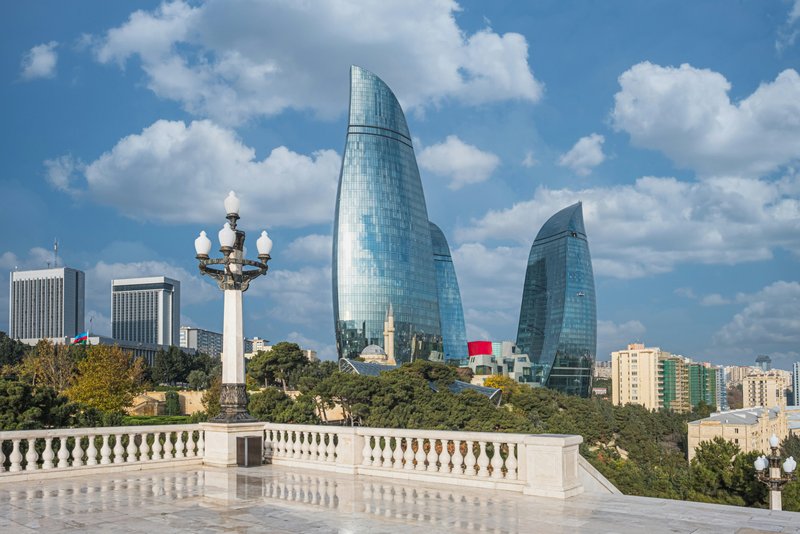
A Beaux-Arts monument flanking the UNESCO-listed Old City walls, this 171-room property commands views across parkland to the Caspian Sea. The Roman bath-inspired indoor pool—mosaic tile, towering columns, glass-roofed double-height ceilings—rivals the Jaleh Spa's 24-karat gold massages for indulgence. Wine tastings unfold in an 18th-century cellar steps away, while promenade-facing rooms deliver front-row seats to the Azerbaijan Grand Prix.
A sail-shaped silhouette rises over Baku's skyline, its marble interiors channeling the city's Silk Road trading past through rich fabrics and contemporary art. The spa offers ESPA treatments, a traditional hammam, and two heated pools—one reserved for adults. Come evening, the Blind Tiger speakeasy pours whiskey-forward cocktails amid Jazz Age leather and crystal, while teatime brings live Azerbaijani music with traditional dance.
The former Caspian Shipping Company headquarters, a handsome 19th-century edifice steps from Baku Boulevard, now houses 63 generously proportioned rooms with soaring ceilings and abundant light. The design reads distinctly Azerbaijani yet resolutely modern. A Silk Road–inspired restaurant bridges Eastern and Western culinary traditions, while the summer bar terrace—staffed by accomplished mixologists—draws locals and travelers seeking the city's most convivial evening perch.
Curved into one of Baku's iconic Flame Towers, this 299-room Fairmont commands sweeping views of the Caspian Sea and the UNESCO-listed Old City through floor-to-ceiling glass. The lobby dazzles with a crystal chandelier and rare Fazioli piano, while two floors of Carol Joy SPA house the region's largest hammam and rooftop pool. Le Bistro delivers East-meets-West cuisine; The Jazz Club draws evening crowds.
A 1930s constructivist landmark once reserved for Azerbaijan's elite athletes now operates as a 28-room boutique hotel dressed in rich Art Deco details. The intimate scale encourages quiet exploration—an indoor pool, sauna, and jacuzzi occupy the spa level, while a terrace surveys Baku's skyline. Proximity to the old city and Caspian waterfront suits travelers seeking atmosphere over anonymity.
Perched above Baku Bay, this 128-room property commands sweeping views of the Caspian Sea and the city's iconic Flame Towers. The interiors reference Azerbaijan's oil-boom grandeur alongside decorative motifs drawn from the poetry of Nizami Ganjavi. A hammam and sauna anchor the spa, while the restaurant pairs Mediterranean cooking with Azerbaijani staples—an intelligent base for exploring the Old City on foot.
Frequently Asked Questions
Which Baku neighborhoods offer the most atmospheric hotel locations?
+
İçəri Şəhər, the walled Old City, places you within walking distance of the Maiden Tower and Palace of the Shirvanshahs. Properties here occupy restored historic buildings with intimate courtyard settings. For seafront access and contemporary architecture, the Bulvar promenade area offers direct views across the Caspian and proximity to the city's cultural institutions.
What is the best time of year to visit Baku?
+
Late spring (April to early June) and early autumn (September to October) bring mild temperatures ideal for exploring on foot. Summers can be hot and humid along the Caspian coast, while winters remain relatively mild compared to the Caucasus highlands. The Novruz spring festival in late March offers exceptional cultural immersion with public celebrations throughout the city.
How does Baku's dining scene reflect its crossroads location?
+
Positioned between Persia, Russia, Turkey, and Georgia, Azerbaijani cuisine layers these influences over a Central Asian foundation. Hotel restaurants often feature refined interpretations of national dishes — slow-cooked lamb with dried fruits, kebabs with sumac and fresh herbs, sturgeon from the Caspian. The dolma tradition here extends beyond grape leaves to include vegetables, quinces, and even fish preparations unique to the region.
The Azerbaijani capital rises dramatically on the western shore of the Caspian, where a twelfth-century walled city meets a skyline of contemporary towers designed by architects including Zaha Hadid. İçəri Şəhər, the UNESCO-listed Old City, remains the historic core — its narrow lanes lined with caravanserais, hammams, and stone merchants' houses that once hosted Silk Road traders. Beyond the medieval walls, the Bulvar promenade stretches for miles along the seafront, connecting the nineteenth-century oil-boom mansions of the city center to the gleaming Flame Towers that have become Baku's defining silhouette.
The hotel scene clusters in three distinct zones: the atmospheric streets within and immediately surrounding the fortress walls, the tree-lined boulevards of the downtown business district, and the waterfront strip near the Heydar Aliyev Center. Restaurants draw on Persian, Turkish, Russian, and Georgian influences — expect saffron-scented plov, herb-stuffed lamb, and pomegranate-laced stews. Tea culture runs deep: the traditional armudu glass appears everywhere from five-star lounges to modest çay evi tucked into Old City alleyways.