On a former cocoa plantation where the Atlantic Forest meets Itacarezinho beach, forty wooden bungalows rise on stilts amid coconut groves—some with private plunge pools and outdoor showers overlooking the surf. The hillside Shamash Spa draws on Bahian botanicals for its treatments, while the kitchen fuses local seafood with European technique. Reforestation programs and sensitive architecture underscore an eco-luxury ethos without compromising comfort.
Where to Stay
A few miles down the coast from Trancoso's bustling Quadrado, Isay Weinfeld's stark white geometric bungalows rise between tropical forest and Itapororoca Beach. The Brazilian architect's minimalist touch yields rooms with wood-paneled ceilings and marble bathrooms that open onto private gardens, while thatched-roof terraces swing with hand-woven hammocks. Below, a casual beachfront bar sets wooden tables on the sand beneath an old almond tree—the property's most memorable spot.
Ten handcrafted villas by Diesel's former creative director line the edge of Trancoso's historic square, their traditional Bahian architecture featuring open-air living spaces and al fresco showers that blur the boundary between indoors and jungle. A mosaic-tiled pool and intimate spa with jacuzzi anchor the eleven-room property, while families find easy rhythms here—capoeira lessons, beach volleyball, and football matches steps from the sand.
Two palm-thatched villas built from raw wood perch at the edge of a remote Bahian fishing village, their doors opening directly onto an expanse of golden sand that stretches toward the horizon. Le Paxa operates on barefoot-chic principles—no shoes required, no children catered to, no distractions from the essential romance of sea, sky, and seclusion. An adults-only retreat for couples seeking genuine escape.
Reaching this eleven-room pousada on the Maraú Peninsula requires determination—a journey by Jeep, boat, and unpaved track—but the reward is an eco-conscious retreat built from salvaged wood and recycled materials. Free-standing bungalows feature Moroccan and French furnishings, some with outdoor showers opening to jungle greenery. A private beach bar serves caipirinhas on empty white sand, while staff arrange trips to Taipú de Fora, consistently ranked among Brazil's finest shores.
Italian expat owners bring easy cosmopolitanism to this eight-room retreat surrounded by tall trees in Bahia's bohemian fishing village. The secluded grounds—beach a ten-minute walk away—center on an outdoor pool where silence reigns. Pet-friendly and equipped with on-request spa treatments, the property earns near-perfect service marks. Trancoso's old town, with its upscale shops and nightspots, sits just beyond the garden gate.
Perched on a Bahian hilltop, this adults-only retreat of just seventeen rooms distills mod-Brazilian minimalism into deep blues, pale sand tones, and polished white cement floors framed by floor-to-ceiling glass. Every balcony gazes over aquamarine waters; every room features a Jacuzzi built for two. Twin infinity pools, terrace lounging with caipirinha service, and proximity to Arraial d'Ajuda's boutique-lined cobblestones suit couples seeking refined coastal seclusion.
Ten independent villas scatter across tropical gardens leading to a private white-sand beach, each featuring two-story layouts with skylights, private Jacuzzis, and four-poster beds draped in mosquito netting. Monkeys swing through treetops above the white marble pool while guests order caipirinhas from lounge chairs on the sand. The open-air restaurant transforms nightly into a fine dining venue beneath thousands of twinkling lights—an intimate Bahian escape for travelers seeking barefoot sophistication.
What to Do
Perched on forested slopes above the Atlantic, Shamash Healing Space commands sweeping ocean views from its treatment rooms. Therapists work with natural Bahia botanicals, offering signature Lomi Lomi massage and heated stone wraps designed for deep tension release. Bespoke protocols accommodate expectant mothers, while sauna, hammam, yoga sessions, and meditation classes extend the restorative program beyond the treatment table.
Frequently Asked Questions
What is the Quadrado and why is it significant?
+
The Quadrado is Trancoso's central square — a long rectangle of grass bordered by colorful 16th-century houses that once sheltered a Jesuit mission. Now protected as a cultural heritage site, it hosts the village's best restaurants, boutiques, and galleries, with the Igreja de São João Batista anchoring its eastern cliff edge.
Which beaches are closest to the village center?
+
Praia dos Nativos lies directly below the Quadrado's cliffs, accessible via a steep path. Praia dos Coqueiros extends northward, while the celebrated Praia do Espelho sits roughly 25 kilometers south — reachable by 4x4 along sand tracks or by boat when tides permit.
When is the best time to visit for fewer crowds?
+
The village fills during Brazilian summer holidays (December–February) and Carnival week. For a quieter experience with warm weather and calm seas, consider April through June or August through November, when hotel rates drop and the Quadrado regains its contemplative atmosphere.
Nearby Destinations
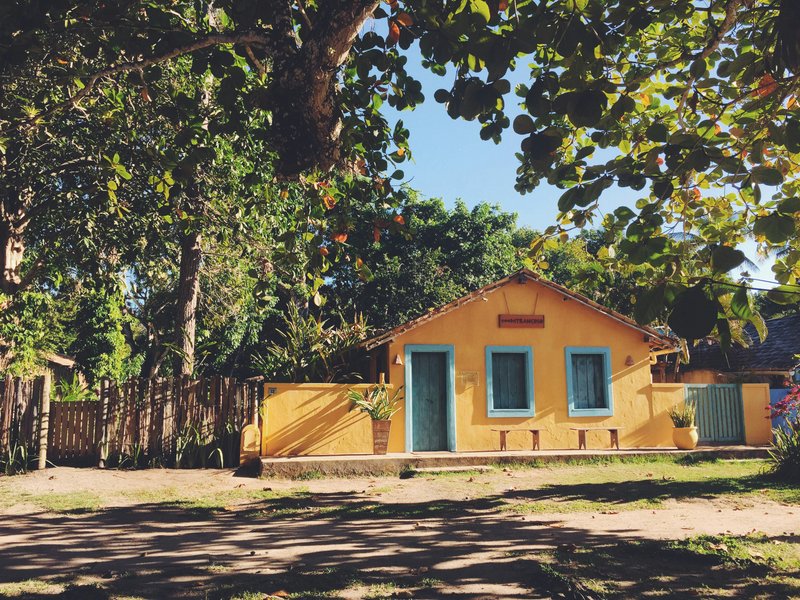
Explore BrazilThis former fishing village on Bahia's southern coast has evolved into one of Brazil's most coveted coastal retreats. The Quadrado, a UNESCO-listed grassy square lined with painted colonial cottages, forms the village center — its whitewashed church of São João Batista marking the edge where red cliffs plunge toward the Atlantic. Accommodations here split between the historic centro and the surrounding Atlantic Forest, where design-forward properties disappear into cashew groves and coconut palms.
The dining scene clusters around the Quadrado's perimeter, where candlelit restaurants serve Bahian seafood and contemporary Brazilian cuisine after dark. Beyond the square, Praia dos Nativos and Praia do Espelho draw daytime crowds to barraca beach clubs. The rhythm follows local tradition: late mornings, long lunches, sunset caipirinha rituals. From December through Carnival, São Paulo and Rio society descends en masse; the quieter months between March and November reveal the village at its most intimate.