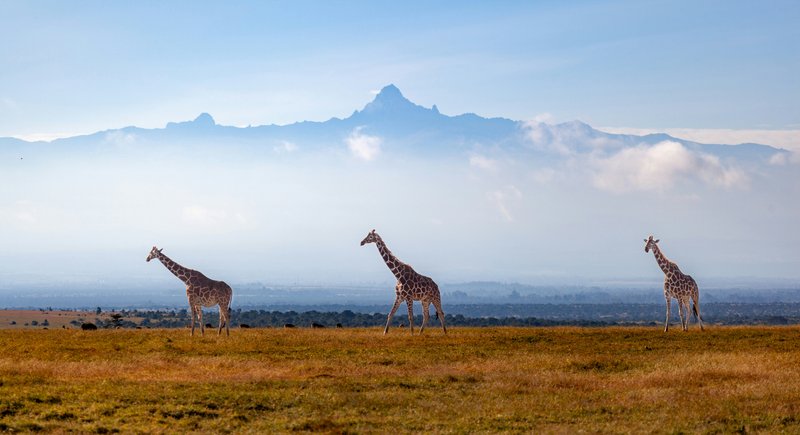
William Holden's former retreat has hosted Churchill, LBJ, and Bing Crosby within its 100 acres of manicured gardens beneath Mount Kenya's peaks. The property's nine-hole golf course — the only one straddling the equator on the continent — draws sporting enthusiasts, while the spa's coffee body scrubs and mountain-view treatment rooms appeal to those seeking restoration. Tusks Restaurant delivers fireside dining framed by panoramic windows.
Forty-four thousand acres of private Kenyan wilderness surround &Beyond's Suyian Lodge, where Grévy's zebra, reticulated giraffe, and the elusive black leopard roam freely. The property channels &Beyond's conservation ethos into an intimate safari experience, with interiors scoring top marks for design. A two-bedroom family suite accommodates multigenerational travelers, with game drives available for children over six.
Perched on Mughwango Hill, this eco-conscious boutique lodge commands sweeping views across Meru National Park's plains. Rustic-elegant cottages frame the landscape, while the restaurant delivers Italian-inflected international cuisine. Families gravitate toward the Private House with its dedicated pool, or the two-bedroom cottage with fishing expeditions and guided walks. Visits to the park's rhino sanctuary round out the safari experience.
From its rocky perch in the Kalama Conservancy, Saruni Samburu commands sweeping views across the plains toward the national reserve. Open-fronted villas with outdoor showers maximize the connection to wilderness, while twin infinity pools and a massage hut provide civilized respite. Families gravitate here for the Warrior for the Week programme, where children learn fire-making and archery in local caves—adventure rooted in Samburu tradition.
Maasai guides who grew up tracking wildlife across Laikipia's plains now lead guests through their ancestral territory at this boutique eco-lodge. Village visits feel genuinely reciprocal—children learn archery and fire-starting from community elders who know every family by name. The "Elephant" and "Lion" rooms, linked by a wooden bridge, suit families seeking immersive rather than observational safari experiences.
Frequently Asked Questions
When is the best time to visit Mount Kenya and Laikipia for wildlife viewing?
+
The dry seasons from June to October and January to March concentrate wildlife around water sources, making sightings more predictable. However, Laikipia's private conservancies offer excellent year-round viewing with far fewer vehicles than the national reserves, and the green season brings dramatic skies and newborn animals.
What makes the conservancy model different from Kenya's national parks?
+
Laikipia's conservancies are privately or community-managed lands where lodges pay fees that fund wildlife protection and benefit local communities. This model allows activities prohibited in national parks — night drives, walking safaris, horseback riding, and off-road tracking — while keeping visitor numbers deliberately low.
How do visitors typically reach lodges in Laikipia?
+
Most guests fly into Nanyuki on scheduled flights from Nairobi's Wilson Airport, then transfer via light aircraft or vehicle to their lodge's private airstrip. The flight takes roughly forty-five minutes and often includes aerial views of Mount Kenya's snowcapped summit and the patchwork of conservancies below.
The Laikipia Plateau sprawls north of Mount Kenya's glaciated peaks, a semi-arid expanse of acacia woodland and open savannah that hosts Kenya's second-largest elephant population. This is conservancy country: private ranches and community lands stitched together into a 9,500-square-kilometre mosaic where cattle coexist with endangered species. Unlike the Mara's theatrical crossings, Laikipia rewards patience — tracking black rhino on foot, observing wild dog packs at dawn, or riding horseback through country the Maasai and Samburu have known for centuries.
Accommodation here favours intimacy over scale. Expect stone-and-thatch lodges perched on escarpment edges, mobile camps that follow seasonal game movements, and historic ranches converted into private retreats where guest numbers rarely exceed twenty. The region's remoteness means most properties operate their own airstrips, and a night might include dinner under a canopy of equatorial stars, far from any electric light. Between game drives, there's fly-fishing for trout in Mount Kenya's highland streams, visits to community cattle markets, and sundowners overlooking valleys where elephants move like grey boulders through the fading light.