GOAT: A Michelin-Starred Table That Elevates Thai Terroir in Bangkok


In an intimate setting blending architectural refinement with cultural roots, GOAT, a one-star Michelin restaurant, invites us to a culinary experience like no other, where every detail—from the decor to the plate—reflects the deep commitment of a visionary chef. Between Sino-Portuguese design, Thai traditions, and sustainable practices, this unique address offers much more than a meal: a sensitive immersion into the flavors, stories, and landscapes of an entire country.
An Architectural Jewel with Sino-Portuguese Heritage
The restaurant stands out for its refined architecture, harmoniously blending the colonial Sino-Portuguese influences of Phuket, Phang Nga, and Penang with traditional elements of Thai Emamai houses. Designed by the Agaligo studio, the space features high ceilings, tones inspired by the Sino-Portuguese style, and meticulous decoration where classical, antique, and modern artworks coexist. The elegantly arranged dining room showcases an open kitchen, inviting guests to admire the chefs at work, while every corner—even the inner courtyard—reveals a unique atmosphere and a meticulously thought-out layout.

Thai Terroir Sublimated by Chef Tan-Parkorn
Founded at the end of 2020 in the heart of Bangkok, GOAT embodies a deep respect for Thai culinary culture and the Thai-Chinese origins of its chef, Tan-Parkorn Kosiyapong. Through a seasonal concept, the restaurant offers refined cuisine that blends Thai, Chinese, and Western influences, while exclusively showcasing 100% local ingredients—an approach rewarded with a Michelin star. Each dish pays homage to its province of origin, offering a true exploration of the country's terroirs, in harmony with homemade drinks, garden infusions, and cocktails inspired by traditional fermentation techniques.

Chef Tan-Parkorn Kosiyapong, who has experience in a three-star Michelin restaurant, presents here a cuisine that is both personal and exacting, where Chinese flavors meet European techniques, grounded in a profoundly Thai identity. His creative approach goes beyond the plate: herbs and edible flowers are grown on-site, waste is turned into biofertilizer, and tableware is crafted from recycled materials like eggshells. Every detail reflects a strong commitment to sustainability and a constant pursuit of excellence.


When Every Dish Tells a Story
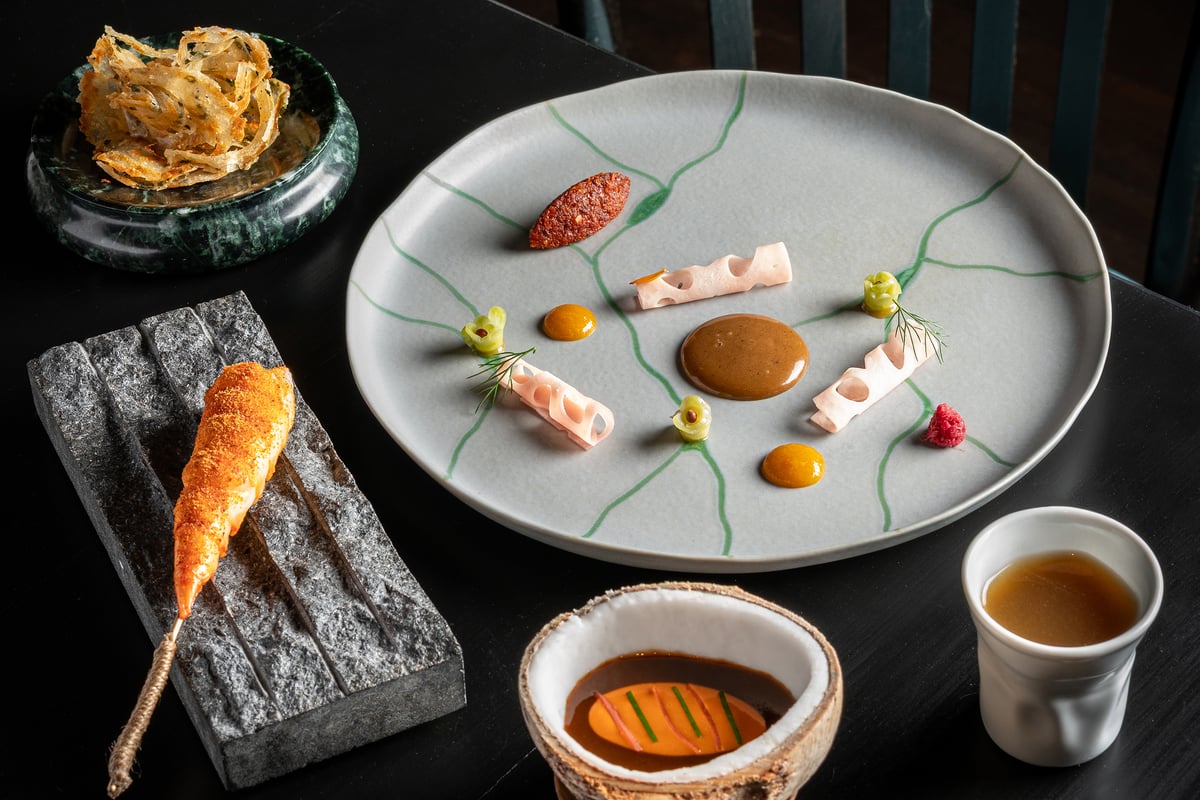
The current menu is a tribute to Thai ingredients and those who grow or catch them. Created exclusively from local ingredients, it reveals a series of original creations where each dish tells the story of its province of origin, its traditional know-how, and preservation methods such as fermentation. Every bite is crafted with precision, combining deep flavors, contrasting textures, and cultural storytelling. More than just a sequence of dishes, this menu offered us a sensory and human immersion through Thailand's terroirs, carried by the chef's demanding and committed vision.
Our dinner began in the intimacy of the chef's house courtyard, where we enjoyed a welcome bite named Home, as poetic as it was symbolic. Set in his own residence, Chef Tan-Parkorn Kosiyapong gives a special meaning to this dish, built around bananas from a tree planted in front of his house on his wedding day. On a banana base lies a soft brioche flavored with dried banana, topped with foie gras from Klong Phai Farm, all glazed with banana *jaew* and sprinkled with crispy chips. This suspended moment, accompanied by a homemade kombucha, offered a first sensitive immersion into a universe where every ingredient tells a story. We were then invited to the dining room to continue this culinary journey, as intimate as it was creative.


The first dish, On Nut, showcases three types of mushrooms cultivated less than fifteen minutes from the restaurant: pink oyster, blue oyster, and golden enoki. Perfectly grilled, they rest on a broth base made from all the menu's ingredients—poultry, squid, fish, vegetables, and mushrooms—creating a deep flavor concentrate. It's topped with goat cheese, crispy shallots, and SCOBY (the kombucha culture) used here as a condiment. This dish is paired with a surprising and delicate juice made from chaba chocolate, watermelon, rose, and lemon, which also accompanies the following courses.


Next is Khao Yai, a nostalgic and intensely creamy dish. An organic egg from the region rests on a velvety corn cream base, sprinkled with grilled Siam Ruby corn kernels, ginger, and chives. A crispy chicken skin adds texture, and an airy mousse of three eggs—fried, in omelet, and soft-boiled—crowns the dish. The journey continues with Surat Thani, where the snakehead fish, aged for eight days, appears in a bold version of its belly. Salted for ten minutes then marinated with fermented ginger, lime, and lemongrass, it's served with a mild fish sauce and a rare Thai herb, bai hu sua, whose aroma evokes oregano. A dish both crispy and intense.


Gulf of Thailand pays tribute to blue crab, served in a crispy tartlet filled with creamy crab curry, a cha-plu leaf, and pickled garlic. It's topped with sour cream and sprinkled with three colorful powders: green from kaffir lime leaf, orange from yellow curry paste, and pink from torch ginger flower. The pairing with a vibrant juice of tomato, rose, ginger, citrus, and mint is perfectly executed.

With 1234 km, the chef creates a link between Chiang Mai and Surat Thani using the back of the aged snakehead fish. The dish is garnished with crunchy lotus stem, chakram dang—a pink salted seaweed—and Chiang Mai strawberries turned into vinegar, all elevated by a green herb oil. Then comes Mae Hong Son, a generous and comforting dish featuring Yunnan ham served as a mousse over a mix of smoked pork jowl, fried Chinese chive, five-spice pork skin, pickled torch ginger, and duck egg yolk from Bang Kachao. The whole is paired with an earthy and enveloping mushroom tea.


With Surin, we enter a playful moment where Thai Wagyu beef is eaten by hand. Three bites follow one another: a tartare larb nuea style with 18 spices, a grilled hanger steak with spices, bitter pak ka-yang and crispy pork rind, then a plant-based bite combining marinated papaya, pak paew from the rooftop, pak kad hin, and Javanese maple leaf, tangy like tamarind, always finished with pork rind for crunch. It's paired with a deep juice blending beetroot, choise date, mushroom, chestnut, and dried fig.


The dish Phang Nga highlights a grouper sous-vide cooked for 30 minutes, served with a Chinese-inspired pesto of shallots, scallion, ginger, garlic fermented for a week, and shrimp paste. It's coated in a demi-glace made from the fish's head and bones, with briny notes from marinated seaweed, sea blite, and Hua Hin caviar.

The South is a true composition of Southern Thai elements: various sauces—black garlic, jackfruit chutney, grilled coconut, torch ginger kosho, chili paste—lotus root flowers and bitter melon, shrimp confit in beef fat, and intense curry served with duck fat roti infused with Sichuan pepper. A Surin biryani rice dish concludes this chapter, garnished with marinated *sataw*, seared radish, grilled okra, kaffir lime leaves, and *cha-muang*, with an oxtail broth poured at the end. This dish is assembled to our taste, freely combining elements. The accompanying juice is just as complex: jasmine, Thai basil, kombu seaweed, coriander, and citrus.

The transition to sweetness comes with a beautiful selection of Thai cheeses—goat and cow—served with well-chosen condiments. The dessert Chanthaburi showcases pineapple carnitas made from three varieties (Phulae, Phuket, and Suan Phueng), a rose apple sorbet lacto-fermented for four days, mint jelly, and a rose petal heart, paired with guava kombucha. The juice offered blends banana, vanilla, and pineapple for perfect harmony.


The final dessert, *Chachoengsao*, revisits the childhood ice cream trucks: a creamy buffalo milk ice cream served in a warm brioche, with five toppings of your choice. Playful, joyful, deeply Thai. The meal ends with four mignardises in little boxes: a palm sugar cake, a crispy rice galette with cashew praline, marinated guava with chili-salt jelly, and a chocolate filled with fermented grapefruit berry, served with an infusion. A sweet, precise, and meaningful conclusion to this exceptional experience.


My Opinion
GOAT embodies a rare form of coherence between intention, execution, and emotion. I found a sincere, intelligent, and above all emotional cuisine, where every dish told me a story with accuracy and delicacy. I was moved by the chef's commitment, his respect for terroir, and his rare ability to create an experience that is both intimate and bold. A memorable experience, both personal and universal.
Contact Details
GOAT